

1. Introduction: Why Need?
The global beauty and personal care market has never been more dynamic—or more demanding. Consumers expect constant novelty, flawless performance, and visible sustainability commitments, while regulators tighten rules on materials, labeling, and environmental impact. At the same time, brands must execute launches across dozens of markets, channels, and formats, often under intense time and cost pressure.
In this environment, packaging has evolved from a “nice finish” to a strategic growth lever. The right pack influences product discovery, trial, loyalty, and even brand trust, particularly in beauty where the pack is often the very first point of contact. For global brands, the challenge is not just designing beautiful packaging once; it is consistently translating brand vision into safe, sustainable, and compliant packs across the entire portfolio and around the world.
This is where a true one-stop packaging solution becomes a competitive advantage. Instead of managing fragmented suppliers, disconnected design agencies, and separate compliance and logistics partners, global brands work with a single expert capable of taking a project from idea to shelf—structural design, materials, decoration, sustainability, regulatory alignment, industrialization, and global delivery. Done well, this approach improves speed, reduces risk, and unlocks a coherent, globally scalable packaging system that supports growth and brand equity, rather than constantly reacting to problems.
2. The New Reality for Global Beauty & Personal Care Brands
Market dynamics and consumer expectations
Beauty is one of the fastest-moving consumer categories, shaped by social media, influencers, and cross-border trends. Within months, concepts from K beauty, C beauty, clean beauty, dermocosmetics, and indie “clinical” brands can jump from niche communities to mainstream retailers. This acceleration compresses development timelines and raises the bar for packaging that looks modern, communicates benefits quickly, and feels intuitive to use.
At the same time, younger consumers are increasingly critical of visual and material choices. They read packaging as a signal of both product efficacy and brand values: too “cheap” and the formula looks untrustworthy, too “wasteful” and the brand feels out of touch with sustainability expectations. As a result, global brands cannot rely solely on formula innovation; their packaging must work hard—on the shelf, on camera, and in the consumer’s hand.
Regulatory and compliance complexity across regions
Global beauty brands face overlapping and evolving regulatory frameworks across regions such as the EU, US, and East Asia. Packaging and labeling rules cover ingredient disclosure, warning statements, durability symbols, recycling information, and language requirements, among other elements. These rules limit what can be printed, where it can appear, and how claims are presented, all of which directly affect pack design and structure.
When brands work with fragmented supplier networks, ensuring that every SKU in every market is fully compliant becomes a major risk. Inconsistent documentation, unverified materials, or incomplete migration testing can result in delays, reformulations, or recalls. A one-stop partner with centralized regulatory awareness and tested material platforms reduces this risk, creating a single source of truth for packaging compliance across global portfolios.
Sustainability and circularity pressures
Beauty packaging is under intense scrutiny for its environmental footprint, from plastic use and recyclability to carbon emissions and waste. Regulators in many regions are advancing stricter rules for recyclability, recycled content, and extended producer responsibility, making packaging choices a strategic sustainability decision rather than a purely marketing one. Brands must prove measurable progress, not only in materials, but in overall system design.
Consumers are also more informed and vocal, questioning excessive secondary packaging, mixed-material components, and non-recyclable decorations. This pushes brands toward solutions such as mono-material packaging, refill systems, lightweighting, and higher recycled content—all while preserving aesthetics, functionality, and brand recognition. One-stop partners equipped with life cycle assessment tools and sustainability frameworks help global brands navigate these trade-offs holistically rather than making isolated, sometimes counterproductive changes.
3. What “One-Stop Packaging Solution” Really Means for Global Brands
From idea to industrialization under one roof
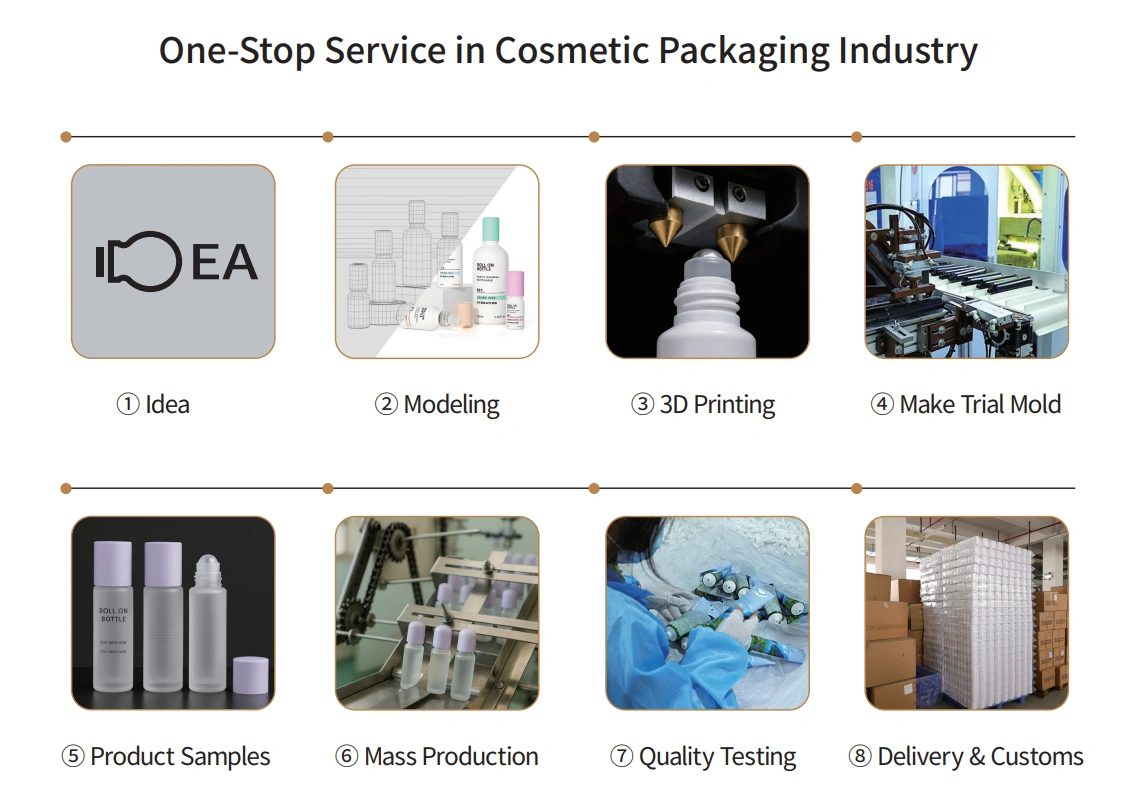
For a global beauty brand, the ideal packaging journey starts with a strategic brief and ends with consistent, on-time delivery to multiple regions. A one-stop solution connects every step in between: insight translation, structural and graphic design, material selection, prototyping, lab testing, production planning, and logistics. Instead of passing projects from agency to engineer to converter, the brand interacts with one integrated team that understands the technical, creative, and business objectives.
This integration yields tangible benefits. Fewer handoffs mean fewer misunderstandings and delays; engineering feasibility is considered from day one; artwork is created with print and regulatory constraints in mind; and packaging is validated before large investments in tooling and inventory. For global launches, this translates into shorter time-to-market and reduced total cost of ownership, not just lower unit prices.
Integrated design, engineering, and branding support
Beauty packaging must be a seamless extension of the brand: texture, sound, weight, and motion are as important as color and typography. An integrated partner brings structural designers, materials engineers, and brand specialists together to design packs that are not only beautiful, but manufacturable, robust, and appropriate for different channels and geographies. This approach prevents late-stage compromises that can dilute brand identity or create quality issues.
Global brands often need families of packs—skincare, haircare, color cosmetics, body care—to look coherent while adapting to different usage contexts and regulatory demands. A one-stop partner can build modular design systems: shared shapes, finishes, and decoration rules that can be flexed by volume, format, and market without losing the core brand handwriting. The result is a recognizable global presence, supported by efficient tooling and supply chain planning.
Centralized quality, testing, and compliance
Packaging quality and safety are non negotiable in cosmetics, because failures can directly impact product integrity and consumer safety. Proper packaging evaluation includes tests for mechanical performance, compatibility with the formula, barrier properties, and potential migration of substances into the product. A one-stop partner can embed these tests into its standard workflows, ensuring that only validated solutions reach scale.
Centralized systems also simplify compliance management. Rather than chasing documents from multiple suppliers, brands access harmonized technical files, declarations, and test reports from a single partner. This is invaluable when regulatory landscapes evolve, because the partner can update documentation and materials across many SKUs in a coordinated way, rather than leaving the brand to manage dozens of separate conversations.
4. End-to-End Packaging Capabilities Global Brands Rely On
Structural design and material selection
Global beauty portfolios span everything from tiny lip balms to large shampoo refill pouches, each with different functional demands. Good structural design starts with how the consumer will use the product—dose, frequency, environment—and works backward to determine volume, closure type, dispensing mechanism, and ergonomics. A one-stop partner can offer a broad library of proven platforms (jars, bottles, tubes, sticks, droppers, airless systems, compacts) that can be customized rather than reinvented from scratch every time.
Material selection is equally critical. Glass communicates luxury and purity but is heavy and fragile; plastics can be lightweight and precise but raise end-of-life concerns; metals provide excellent barriers and premium cues but may complicate recycling; and advanced paper-based structures are emerging for certain applications. One-stop partners help brands navigate these options across categories, integrating performance, recyclability, cost, and brand positioning into a coherent material strategy.
Decoration and finishing at scale
In beauty, decoration and finishing often carry as much weight as structure. Color accuracy, gradients, metallics, soft-touch finishes, embossing, and hot stamping can significantly influence perceived value and recognition. However, every decorative choice interacts with sustainability, cost, and production complexity—some effects may reduce recyclability or require specialized lines, for example.
One-stop partners with in house or tightly integrated decoration capabilities can prototype and industrialize finishes more reliably. They can advise when to use label versus direct print, how to simplify color systems, or how to achieve premium effects with recyclable-friendly inks and lacquers. Crucially, they can coordinate consistent finishes across multiple formats and regions, avoiding the “patchwork” look that sometimes occurs when local suppliers interpret brand guidelines differently.
Sustainability-by-design
Sustainability-by-design means integrating environmental considerations into packaging decisions from the outset, not as an afterthought. A robust one-stop partner uses tools such as life cycle assessment and region-specific recyclability indicators to evaluate different scenarios: lightweighting, switching materials, adding recycled content, or introducing refill systems. This data-driven approach helps global brands set realistic sustainability targets and understand trade-offs before committing to large-scale changes.
Practical design levers include reducing material thickness, eliminating unnecessary components, shifting to mono-material structures where possible, and designing for disassembly of pumps or closures. Brands can also explore refillable solutions, concentrates, or solid formats that reduce packaging per use. A one-stop partner can prototype these concepts, test them for performance and consumer acceptance, and then scale them across markets while tracking progress against sustainability KPIs.
Compliance, safety, and risk management
Packaging safety is formally part of the cosmetic product safety assessment in many regions. That means packaging materials and structures must be evaluated for their interaction with formulas, potential migration, and any contributions to impurities or instability. A one-stop partner can standardize this evaluation process and maintain approved material “platforms,” significantly reducing risk when brands roll out new products at scale.
Risk management also covers labeling space, multilingual requirements, and regional claims. Smart structural and graphic design ensures there is room for mandatory information without compromising brand storytelling. When regulations change or new symbols become mandatory, a central partner can coordinate updates across packaging families, ensuring compliance while minimizing disruption to production and inventory.

5. How One-Stop Solutions Support Different Global Launch Scenarios
New brand or sub-brand creation across multiple markets
Launching a new global brand or sub-brand is one of the most demanding packaging challenges. The pack must express the brand’s positioning, stand out against competition, and remain flexible enough to grow as the portfolio expands. A one-stop partner can participate early, helping translate insights and storytelling into tangible form factors, textures, and visual codes that feel coherent across geographies.
Global rollouts often involve staggered launch waves—pilot markets, followed by regional expansions, then global distribution. An integrated partner can design packaging architectures that support this evolution, pre planning line extensions, sizes, or limited editions so that new SKUs can be added efficiently without breaking the design system. This approach protects brand equity and keeps operational complexity under control as the portfolio grows.
Line extensions and seasonal or limited editions
Beauty thrives on novelty: new shades, seasonal fragrances, collaborations, and gifting programs. For global brands, this means frequent line extensions and limited runs that must feel fresh but be delivered at tight cost and time parameters. A one-stop partner can leverage existing molds and structures, proposing new decoration, sleeves, or secondary packaging to create excitement without large investments in tooling.
Holiday and promotional collections add another layer of complexity, as they need to deliver a cohesive global look while accommodating local regulations, holidays, or retail partners. An integrated partner can orchestrate color harmonies, finishes, and formats across sets, then localize labeling or assortments where required. This results in visually strong campaigns that remain operationally manageable and on time in every region.
Rebranding and sustainability transitions
Rebranding or modernizing a long established line is high stakes work: change too little and nothing happens; change too much and loyal users may feel alienated. A one-stop partner can help global brands map out where and how to evolve shapes, colors, or materials while preserving recognizable elements such as silhouettes, logos, or key color blocks. Using prototypes and consumer testing, they can validate which directions resonate before committing to full-scale change.
Sustainability transitions often run in parallel with rebranding. Brands may seek to reduce plastic, introduce recycled content, or add refills. A one-stop partner can analyze multiple scenarios—for example, switching from multi-layer to mono-material components or introducing refill pods—and estimate impacts on carbon footprint, recyclability, cost, and aesthetics. This allows global brands to phase changes by region or category, achieving visible progress without overwhelming operations or confusing consumers.

6. Regional Nuances: Adapting One System to Many Markets
Cultural and aesthetic differences
What feels “premium,” “natural,” or “clinical” varies widely across cultures. In some markets, ornate patterns and saturated colors signal luxury; in others, minimalism and muted tones do. A one-stop partner with global insight can help brands adapt decoration, typography, and storytelling while keeping core brand assets intact.
Cultural nuances also extend to symbols, motifs, and language. Certain flowers, animals, or colors can carry very different connotations across regions. Packaging that works in one market might inadvertently signal the wrong message in another. Working with a partner who understands these subtleties reduces the risk of missteps and allows for thoughtful localization within a global design framework.
Usage habits and functional expectations
Regional usage habits strongly influence preferred formats. Cushion foundations, ampoules, and sheet masks are more common in some Asian markets, while pump bottles and jars dominate in others; certain regions prefer larger sizes, while others prioritize travel-friendly formats. Climate, humidity, and distribution conditions also affect packaging performance requirements, from closure tightness to breakage resistance.
A one-stop partner can design modular systems that share core components but adapt elements such as dispensing mechanisms, closure types, or wall thicknesses to local needs. This enables global brands to respect local preferences and conditions without fragmenting their supplier base or losing economies of scale.
Regulatory and sustainability landscapes by region
Sustainability rules vary widely by region, with differences in recyclability criteria, labeling obligations, and incentives for refill and reuse. A material that is widely recycled in one country may be problematic in another, and labeling requirements for recyclability or environmental claims can be stricter in some markets than others.
A centralized packaging partner tracks these differences and builds them into design and specification decisions. For example, they may recommend different resin grades, additives, or decoration techniques depending on where the product will be sold, all while aiming to maximize harmonization across the global system. This ensures that sustainability claims are credible and compliant everywhere the brand operates.
7. Partnership Model: How Global Brands Work with a One-Stop Supplier
Early involvement and co-creation
The most successful packaging outcomes occur when the partner is involved early, ideally at the concept or even strategy stage. Early co creation allows technical feasibility, sustainability, and regulatory considerations to shape the concept rather than constrain it at the end. This avoids late rework and helps align cross functional teams—marketing, R&D, operations—around shared goals.
Typical co creation practices include collaborative workshops, design sprints, rapid 3D mock ups, and consumer testing of form factors or opening/closing experiences. With a one-stop partner, insights from these activities flow directly into engineering and production planning, compressing timelines and reducing friction between creative and technical teams.
Project management across portfolios and regions
Managing packaging for a global beauty brand resembles coordinating multiple overlapping programs rather than discrete projects. A strong one-stop partner will assign dedicated key account teams, regional liaisons, and centralized project managers to oversee everything from concept to delivery. They often integrate with the brand’s PLM or data systems so specifications, artworks, and test reports are accessible across functions and geographies.
This structured governance is particularly important for portfolio-wide initiatives, such as sustainability upgrades or global rebrands. The partner can help create implementation roadmaps, prioritize SKUs, and monitor progress, creating a single cockpit view for all stakeholders. In doing so, they reduce duplication of effort and ensure that decisions made in one region are visible and reusable in others.
Supply chain resilience and risk mitigation
Recent years have highlighted the vulnerability of global supply chains to disruptions, from raw material shortages to logistics bottlenecks. For beauty brands, packaging availability can determine whether a launch proceeds or stalls. One-stop partners manage risk by diversifying manufacturing locations, qualifying multiple material sources, and implementing safety stock strategies for critical components.
They also play a key role in crisis response. When regulations change suddenly, transportation routes are disrupted, or demand spikes unexpectedly, an integrated partner can quickly propose alternatives—design adjustments, temporary material substitutions, or production rerouting—while maintaining quality and compliance. This agility is difficult to achieve with fragmented suppliers acting in isolation.

8. Measuring Success: KPIs for One-Stop Packaging Solutions
Commercial and brand metrics
The impact of a one-stop packaging partnership should be visible in commercial outcomes. Time-to-market is a key KPI: integrated workflows should reduce the duration from brief to shelf, particularly for global or multi country launches. Improved launch punctuality and on-shelf availability translate directly into revenue and help brands capture trend windows more effectively.
Packaging also influences brand metrics such as preference, perceived quality, and willingness to pay. Studies consistently show that carefully designed packaging can increase purchase intent and enhance brand equity by communicating benefits and values more clearly. Tracking these indicators before and after packaging upgrades helps quantify the strategic value of the partnership.
Operational and sustainability metrics
Operational KPIs include reduced supplier count, fewer tooling variations, improved forecast accuracy, and lower defect rates. One-stop partners can standardize components and materials, optimizing the SKU architecture and creating economies of scale without compromising variety where it matters to consumers.
On the sustainability side, brands can measure improvements in recyclability, recycled content, material usage per unit, and carbon footprint per product. A good partner will help define and track these indicators across regions and categories, providing transparent data to support corporate sustainability reporting and external communication.
Risk, compliance, and quality outcomes
Risk reduction is another major dimension of success. This includes fewer non compliance incidents, fewer recalls or reformulations due to packaging issues, and lower rates of consumer complaints related to functionality or defects. Standardized testing protocols and documentation systems at the partner level directly contribute to these improvements.
Audit readiness and regulatory responsiveness are also important. With centralized, well-maintained technical files and test reports, global brands can respond quickly to regulatory inquiries or audits in any market. Over time, this builds trust with regulators, retailers, and consumers alike.
9. Future Directions in One-Stop Packaging for Global Beauty
Smart and connected packaging
Beauty packaging is starting to integrate digital features, from simple QR codes for ingredient and recycling information to advanced NFC tags and digital product passports. These elements can provide authenticity verification, personalized content, or traceability data, aligning with regulatory and consumer demands for transparency.
One-stop partners must be prepared to integrate these technologies, coordinating electronics, printing, data management, and user experience design. This requires new competencies and closer collaboration between packaging teams, IT, and marketing, but offers powerful opportunities for deeper engagement and richer storytelling.
New materials and formats
Innovation in materials and formats will continue to reshape beauty packaging. Bio-based and biodegradable materials, as well as experimental concepts like edible packaging, are under active exploration, though not all are ready for mass-market adoption. Refill systems, concentrates, solid formats, and waterless products can dramatically change packaging needs, sometimes reducing primary packaging while increasing the importance of durable, premium refillable containers.
A forward-looking one-stop partner will monitor these developments and pilot new solutions with brands, carefully evaluating performance, regulatory status, environmental impact, and consumer acceptance. In many cases, hybrid approaches—combining improved conventional packaging with selective adoption of new materials—will provide the best balance of risk and reward in the near term.
Deepening collaboration between global brands and packaging partners
As packaging becomes more complex and strategic, relationships between brands and their one-stop partners are shifting from transactional purchasing to long-term strategic alliances. Joint roadmapping of innovation, sustainability, and digital integration allows both sides to invest in capabilities and infrastructures that will pay off over multiple product cycles.
Data sharing and joint R&D will be central to this evolution. Partners will co develop new material platforms, circular solutions, and smart packaging concepts, sharing insights from consumer research, regulatory developments, and technological advances. Over time, the most successful global brands will be those that treat their packaging partners as extensions of their own teams, aligned on objectives and accountable for measurable outcomes.

10. Closing: Why One-Stop Packaging Is a Strategic Lever for Global Brands
For global beauty and personal care brands, packaging now sits at the intersection of consumer desirability, regulatory compliance, sustainability commitments, and operational efficiency. The complexity of delivering consistently high-performing, beautiful, and responsible packaging across dozens of markets makes fragmented supplier models increasingly fragile and costly.
A true one-stop packaging partner offers an alternative: a single, integrated ecosystem that takes projects from idea to shelf, aligning design, engineering, sustainability, compliance, and supply chain under one roof. This model accelerates launches, reduces risk, and improves brand coherence while making it easier to achieve and document sustainability progress at scale.
For global beauty leaders, elevating packaging partnerships from tactical sourcing to strategic collaboration is no longer optional. It is a decisive move that shapes speed to market, brand equity, profitability, and environmental performance for years to come. By choosing the right one-stop partner and engaging them early and deeply, brands can turn packaging from a constraint into a powerful engine of growth and differentiation in an increasingly competitive and conscious world.
FAQs
Can you help with both structural design and visual branding?
Yes. Our team supports structural engineering, ergonomic design, and decoration development. We translate your brand guidelines into manufacturable shapes, colors, finishes, and graphics that stay consistent across formats and regions.
How do you make sure the packaging fits our brand and target consumer?
We start with your brand strategy, moodboards, and target personas, then develop concepts and 3D mockups that reflect your positioning. You review physical samples before we lock specifications, so you can validate the look, feel, and user experience.
How do you ensure your packaging is compatible with our formula?
We evaluate the formula type and key actives, then recommend suitable materials and structures. You perform lab compatibility and stability tests; in parallel, we can run internal tests (e.g., stress, leakage, functionality) to confirm performance before mass production.
Do you offer specific solutions for sensitive or active-rich formulas?
Yes. For formulas with high actives, we can propose airless systems, UV-protective materials, barrier layers, and specific closures to limit oxidation, contamination, and product loss, while still keeping packs on-brand.
How do you balance sustainability with aesthetics and cost?
We work with you on clear priorities (e.g., recyclability vs. PCR content vs. cost) and present options with pros and cons. Our goal is to reach a solution that upgrades sustainability while staying on-brief visually and commercially viable.
What information do you need to prepare a quote?
We typically need: product type, formula characteristics, target markets, preferred materials and finishes, expected annual volume and launch phasing, desired sustainability targets, and target launch dates.