


1. Let’s Talk About What’s Actually Changing
If you work in cosmetic packaging — whether you’re on the brand side, a packaging developer, a supplier, or a sustainability lead — you’ve probably been hearing about the PPWR for a while now. Maybe you’ve sat through a few presentations on it. Maybe it’s sitting in your “must read properly” folder.
This blog is the one to actually read.
The EU’s Packaging and Packaging Waste Regulation, formally known as Regulation (EU) 2025/40, is now law. It’s not a proposal, not a consultation, not a directive that member states might implement differently. It’s a directly applicable regulation that applies uniformly across all 27 EU member states. If you sell cosmetics in Europe — or you supply packaging to brands that do — it applies to you.
And for the cosmetics industry specifically, it asks for some genuinely significant changes. Not because the industry has been singled out, but because cosmetic packaging is complex, often multi-material, frequently decorative in ways that make recycling harder, and sits in a category the regulation calls “contact-sensitive,” which comes with its own set of rules. All of that adds up to a sector that has more to rethink than most.
So let’s walk through what this regulation actually requires, what it means for plastic packaging design in practice, and what a realistic preparation plan looks like. No jargon overload, no vague calls to “embrace circularity.” Just what you need to know.
2. What the PPWR Actually Is
The PPWR replaces the old Packaging and Packaging Waste Directive that’s been in place since 1994. The key difference is that the old directive had to be turned into national law by each member state, which led to inconsistent implementation across Europe. The PPWR bypasses that entirely — it applies directly and uniformly from day one.
Its goals are ambitious but clear. By 2030 and progressively beyond, the regulation wants:
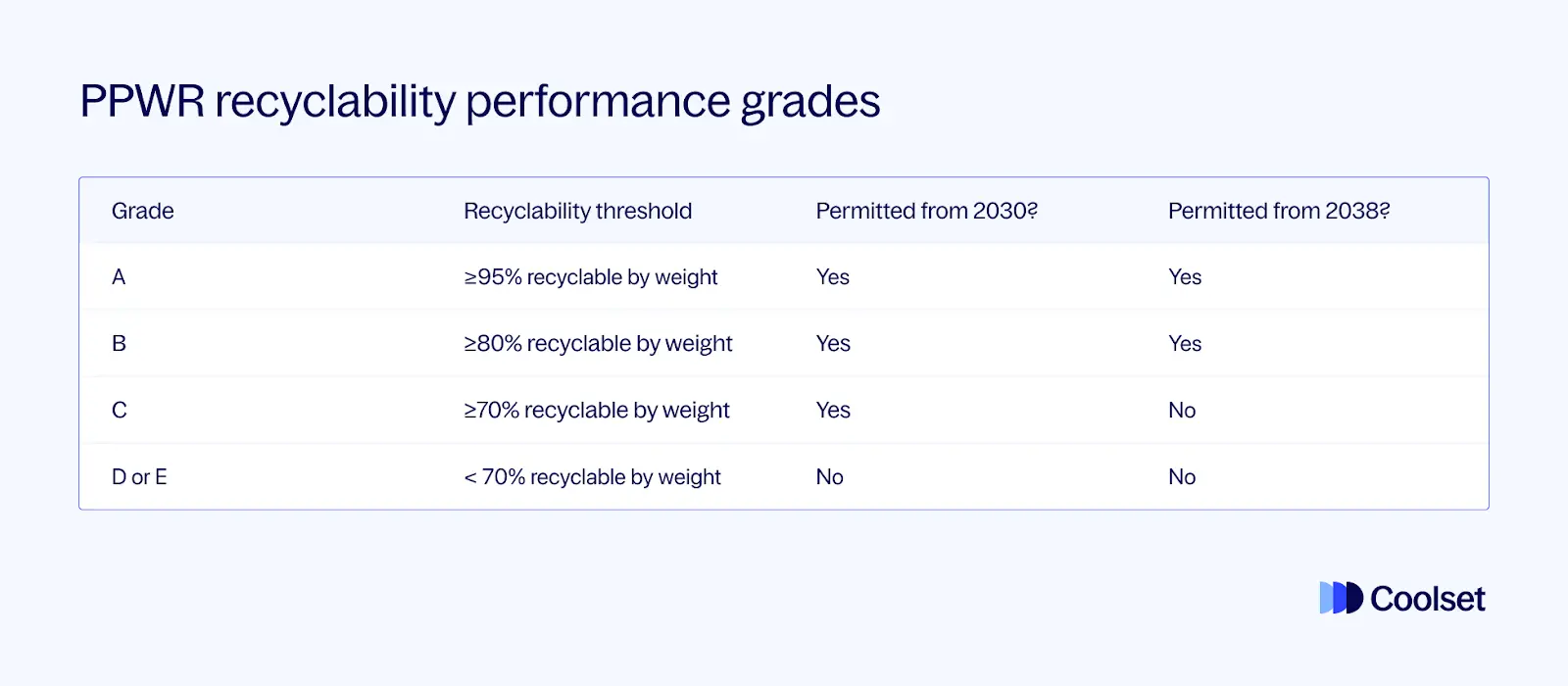
All packaging to be recyclable — with a formal grading system (A through E) that determines whether packaging can legally be sold
Minimum recycled content in plastic packaging, with specific thresholds depending on packaging type and contact sensitivity
Less packaging overall — stricter rules on void space, unnecessary components, and oversized formats
Full Extended Producer Responsibility (EPR) — brands pay into recycling systems based on the weight and recyclability of the packaging they put on the market
Standardized labeling so consumers know how to sort their packaging
The general application date — the point at which the first wave of requirements becomes legally binding — is 12 August 2026. That’s not far away. And several of the most demanding requirements kick in on 1 January 2030, which sounds more comfortable but isn’t, given how long packaging development cycles take.
3. Why Cosmetics Has It Harder Than Most
Let’s be honest about something: cosmetics packaging faces a more complicated path to compliance than, say, a simple food tub or a detergent bottle. There are a few specific reasons for that.
The Contact-Sensitive Category
Cosmetic products touch people’s skin. Because of that, PPWR classifies cosmetic packaging as “contact-sensitive,” and that affects which recycled materials you can use in primary packaging.
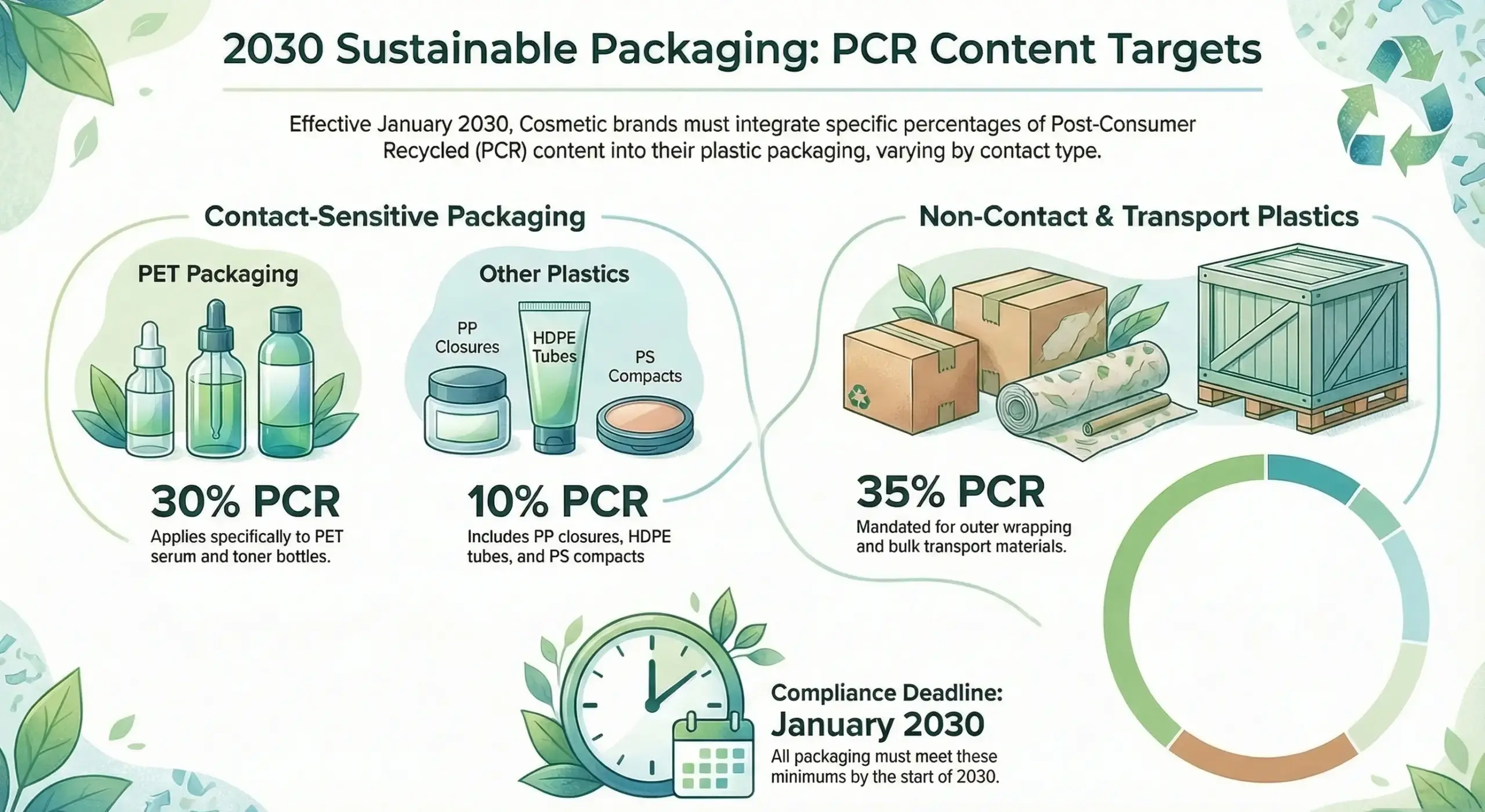
You still have to hit recycled content targets — 30% for PET contact packaging and 10% for other contact-sensitive plastics by 2030 — but that recycled content has to meet higher quality and safety standards to avoid contamination risk. In practice, that usually means sourcing food-grade or cosmetics-grade PCR material, which is more expensive and in shorter supply than standard PCR. That supply crunch is only going to intensify as 2030 gets closer.
The Complexity Problem
Think about a typical luxury foundation bottle: glass body, metal collar, plastic pump with a metal spring, decorative sleeve, printed outer carton. Every one of those materials and every bond between them is a potential problem for the PPWR’s recyclability grading system.
The grading system assesses packaging holistically. If your packaging combines materials that can’t be separated and sorted in real-world recycling facilities, it scores poorly — potentially landing in grade D or E and becoming unsaleable in the EU from 2030. Multi-material formats aren’t automatically banned, but they need to demonstrate genuine recyclability through the recycling chain, and many current cosmetics packaging designs can’t.
The Small Format Trap
A huge proportion of cosmetics packaging is too physically small to be captured by standard recycling sorting machinery. Sachets, sample-size products, miniature hotel amenities — these items literally fall through the screens at sorting facilities, regardless of what they’re made from. PPWR already bans miniature cosmetic products in hotel rooms from 2030. But the small-format challenge runs deeper across sampling, travel retail, and subscription boxes.
The Aesthetics Tension
This one is probably the most familiar to anyone working in beauty. The tools of cosmetics packaging design — metallized finishes, dark or opaque pigmented plastics, multi-layer lacquers, bonded shrink sleeves, hot stamping — are largely incompatible with recyclability. Dark pigments block the NIR sensors that recycling sorting machines use to identify materials. Metallized coatings contaminate recycling streams. Bonded labels prevent clean material separation.
That’s not a small design tweak. For many brands, it’s a fundamental rethinking of what “premium packaging” looks like.
4. The Recyclability Grades: What A Through E Really Means
The grading system is what turns PPWR from an abstract commitment into a hard market-access rule. So it’s worth understanding how grades are actually determined.
Each packaging format is assessed on three things:
Material compatibility — Is it made from materials that existing recycling technologies can process?
Sortability — Can real-world sorting infrastructure correctly identify and separate it?
Actual recycling performance — Is it genuinely recycled at meaningful volumes across the EU?
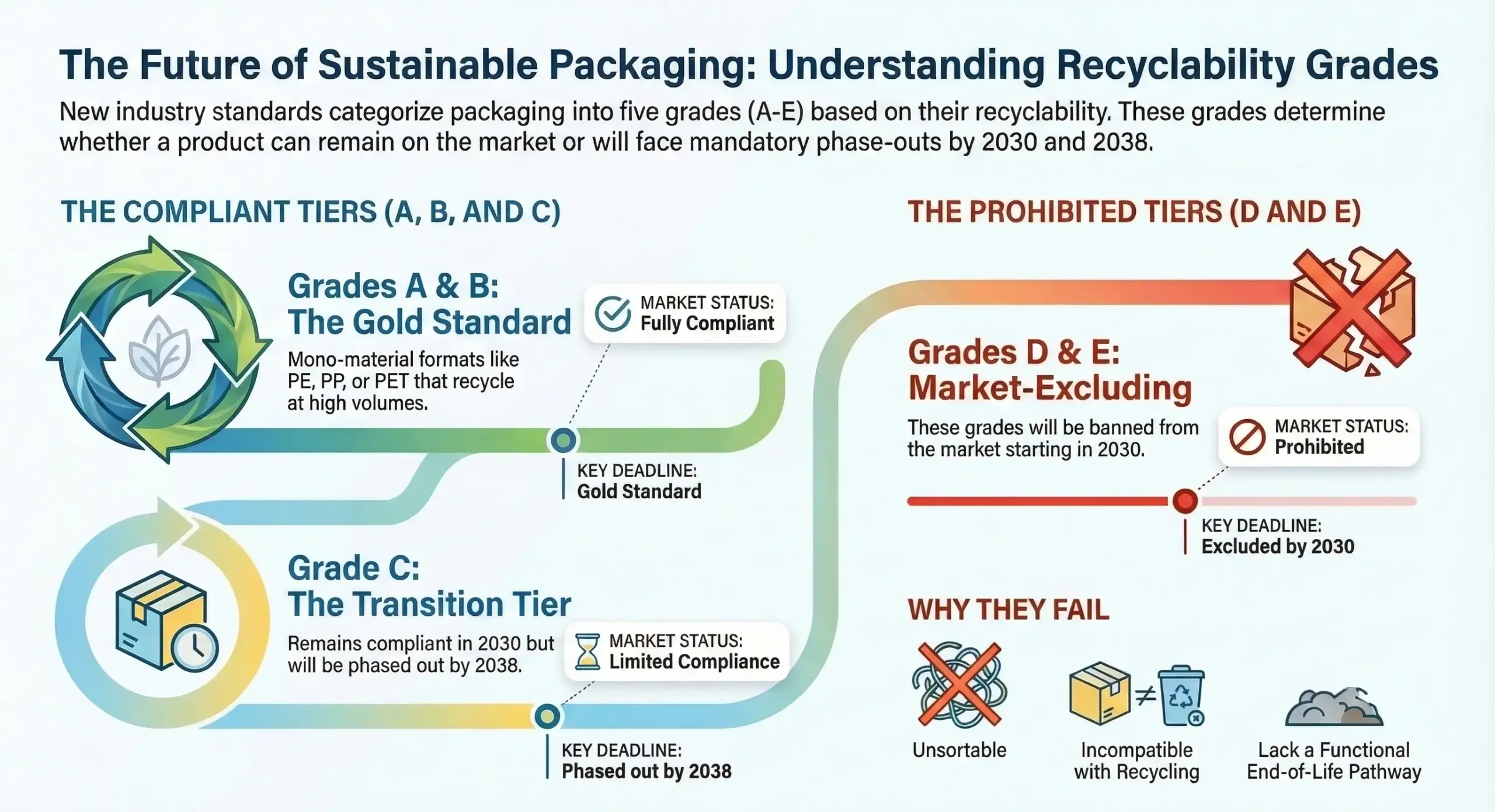
Grades A and B are the gold standard. Think mono-material PE, PP, or PET formats without problematic coatings, correctly sorted and recycled in volume across member states.
Grade C is still compliant from 2030 but gets phased out by 2038. It covers packaging that’s technically recyclable but with some limitations — perhaps only in certain regions or at lower rates.
Grades D and E are market-excluding from 2030. Packaging in these grades either can’t be properly sorted, uses materials incompatible with recycling processes, or has no functioning end-of-life pathway at scale.
The European Commission is still finalizing the detailed Design for Recycling criteria through delegated acts. In the meantime, most compliance experts are using CEFLEX and RecyClass guidelines as planning proxies. These aren’t identical to what PPWR will eventually specify, but they’re the closest thing available and widely accepted as a reasonable basis for design decisions.
5. What Actually Needs to Change in Your Packaging
Here’s where we get practical. These are the specific design changes that cosmetics plastic packaging will need to make — many of them before 2030, some before 2028.
Go Mono-Material Wherever You Can
This is the single biggest shift. Mono-material packaging — where the bottle, closure, pump, and any structural components are all made from the same polymer — is the most reliable route to a high recyclability grade.
In practice, this means:
Replacing metal pump springs with all-plastic alternatives (all-PP and all-PE pumps are commercially available now)
Designing caps, closures, and flip-tops in the same polymer as the bottle body
Eliminating metal collars, decorative rings, and inserts made from different materials
Moving squeeze tubes from multi-layer laminates to all-PE formats
Yes, mono-material design can complicate barrier performance for sensitive formulations. But barrier technology for mono-material formats has improved significantly, and recyclable barrier coatings and mono-material multi-layer films (where all layers share the same polymer family) are increasingly viable solutions.
Rethink Your Decoration Strategy
A straightforward audit question: does your current decorative approach pass the NIR test?
Metallized coatings on plastic, carbon-black pigmented plastics, bonded sleeves in different polymers, and incompatible adhesives on labels are all common in cosmetics and all problematic under PPWR recyclability criteria. The alternatives exist:
Water-based inks rather than UV-cured metallics
In-mold labels using the same polymer as the container
Paper labels with water-soluble adhesives
Transparent UV-stable coatings that don’t interfere with NIR sorting
Avoiding black pigmented plastics in favor of lighter-colored or translucent alternatives
None of these are exotic. They require specification changes and sometimes tooling investment, but they’re not R&D projects. They’re available today.
Reduce Your Secondary Packaging Footprint
From 2030, PPWR bans unnecessary packaging and limits void space in secondary packaging to 50%. For cosmetics brands — especially those selling gift sets, subscription boxes, or luxury presentations — this is a real constraint. Oversized outer boxes, decorative inserts with no protective function, double-walled cartons, and false bottoms are all out.
This doesn’t mean your packaging has to look cheap. It means it has to be functional. The creative challenge is designing secondary packaging that feels premium and intentional while fitting within tighter material and volume parameters. Brands that are already working on this are finding that the constraint can actually produce cleaner, more confident design.
Hit the Recycled Content Numbers
From January 2030, your plastic packaging needs to contain:
30% PCR content for contact-sensitive PET packaging (serum bottles, toner bottles, etc.)
10% PCR content for other contact-sensitive plastic packaging (PP closures, HDPE tubes, PS compacts)
35% PCR content for non-contact plastic packaging (outer wrapping, transport packaging)
These aren’t verified by self-declaration. They require mass balance certifications from your resin suppliers, and compliance is calculated as an annual average per manufacturing plant and per packaging category. That means you need data systems that track PCR content across your supply chain and reporting processes that can demonstrate compliance to national authorities.
Start sourcing conversations now. The PCR supply chain for cosmetics-grade material is already stretched, and every month closer to 2030 that you wait, the more competition there is for the same limited pool of compliant material.
Get Your Labeling House in Order
By August 2028, every component of every packaging format you sell in the EU needs a harmonized material composition label. That means doing a complete component-level material audit across your entire portfolio — not just the bottle, but the cap, the pump, the label, the outer box, the inner tray.
For brands with large portfolios, this is a significant data collection exercise. Build the internal systems to capture and maintain this data now, so that when artwork updates are needed, you’re pulling from a clean, verified source rather than scrambling to identify what the closure on a three-year-old SKU is actually made from.
6. EPR: The Financial Side of Compliance
Design changes are one half of PPWR compliance. The financial and administrative side — Extended Producer Responsibility — is the other half, and it’s equally important.
Under EPR, any brand placing packaging on the EU market is financially responsible for that packaging’s end-of-life collection, sorting, and recycling. You discharge this obligation by registering with Producer Responsibility Organizations (PROs) in each EU member state where you sell, and paying annual fees based on the weight, material, and recyclability of your packaging.
A few important things to know about EPR:
It’s country-by-country. Each of the 27 EU member states has its own PRO (or several), its own registration process, its own fee structure, and its own reporting calendar. If you sell across Europe, you need registrations in every market. Managing this in-house is possible but resource-intensive; many brands use specialist EPR service providers.
Fees are modulated by recyclability. Packaging with higher recyclability grades attracts lower EPR fees. Packaging that’s hard to recycle — or unrecyclable — costs more. This creates a direct financial incentive for design-for-recycling investment that compounds year after year.
The August 2026 deadline is hard. No EPR registration means no legal right to distribute in that member state. For brands relying on EU revenue, this is not an abstract compliance risk — it’s a commercial one.
If you haven’t mapped your EPR registration requirements across your EU distribution footprint, that needs to happen now.
7. The Business Case for Moving Early
Some brands are treating PPWR as a compliance exercise — the minimum necessary to stay legal. The smarter move is to treat it as a business opportunity.
Here’s why early action pays off:
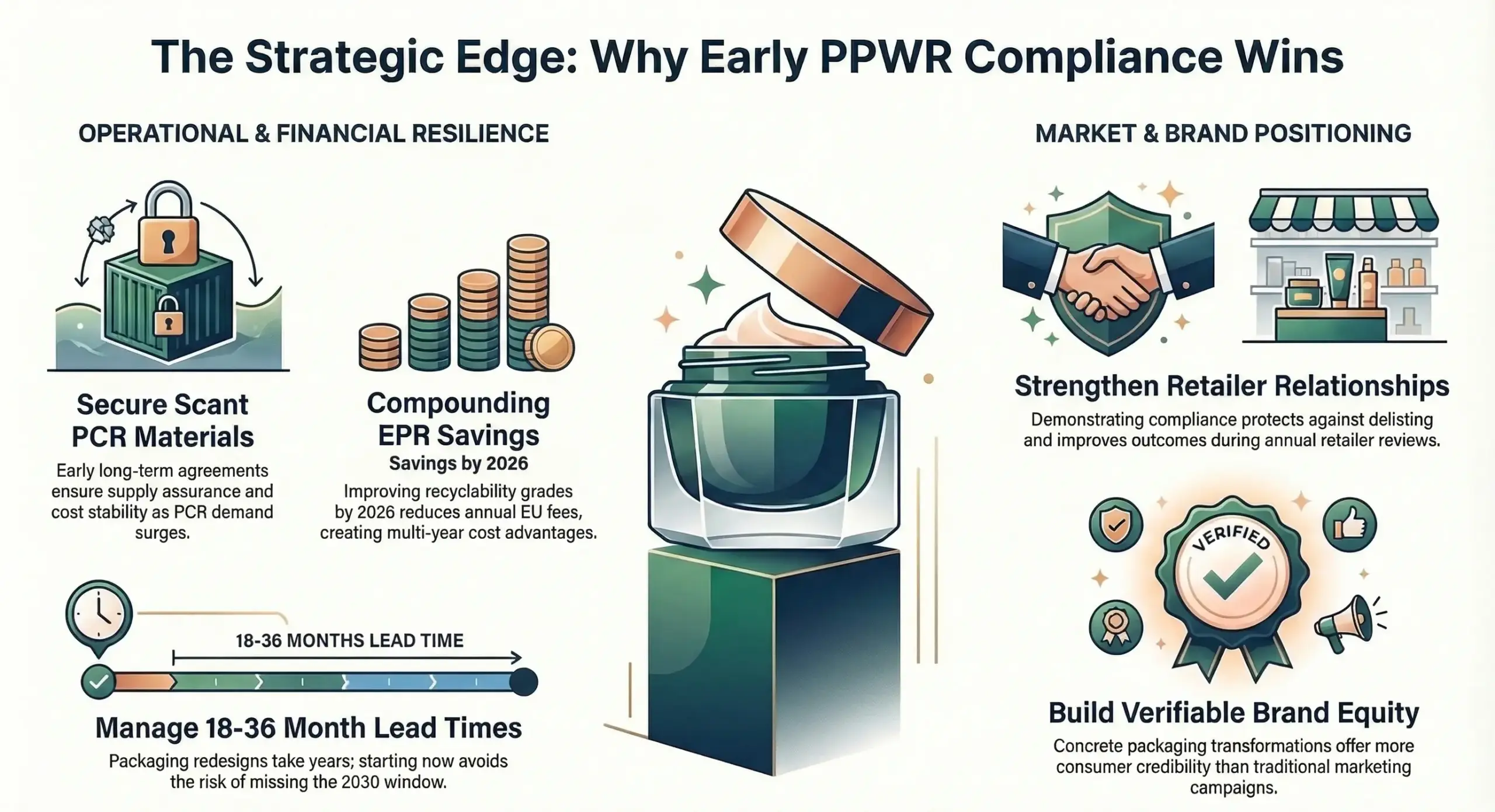
Supply chain security. Cosmetics-grade PCR material is already scarce relative to projected 2030 demand. Brands that secure long-term supply agreements with compliant resin suppliers now will have cost stability and supply assurance that late movers won’t.
Lower EPR fees, year after year. Every improvement in recyclability grade reduces your annual EPR contributions across the EU. That saving compounds. Brands that have redesigned for recyclability by 2026 will pay less than brands that scrape to compliance by 2030.
Retail relationships. Major EU retailers are already asking suppliers about PPWR compliance as part of their onboarding and annual review processes. Being able to demonstrate compliance — and ideally to exceed minimum requirements — strengthens those relationships and reduces the risk of delisting.
Brand equity. Consumers, particularly in Europe, are increasingly skeptical of sustainability claims that aren’t backed by verifiable action. A genuine packaging transformation driven by PPWR compliance gives brands something concrete to talk about. That’s more credible than almost anything you can communicate in a campaign.
Development lead time. Packaging redesign in cosmetics takes 18–36 months from brief to market. If you haven’t started redesigning your highest-risk formats, the window to be ready for January 2030 is narrowing faster than it might appear.
8. What You’re Still Waiting For (And How to Plan Anyway)
To be fair, not everything about PPWR is settled. There are some genuinely open questions that are creating real planning uncertainty.
The Design for Recycling criteria — the technical rules that will formally define recyclability grades — haven’t been published yet as finalized delegated acts. The European Commission is still working on them. In the meantime, CEFLEX and RecyClass guidelines are the best available proxy and are widely used for planning, but the final PPWR criteria may not be identical.
How void space ratios will be calculated for cosmetics-specific formats — particularly airless dispensers and pump systems where air space is functional, not wasteful — is still being worked through.
How small packaging formats will be treated for labeling and recyclability assessment purposes is also pending clarification.
None of this uncertainty is a reason to wait. The direction of travel is clear, the major requirements are fixed, and the planning proxies are good enough to make real design decisions. The brands using “we’re waiting for final criteria” as a reason to delay are, in most cases, using uncertainty as an excuse.
Engage through your trade associations — Cosmetics Europe, FEBEA, the British Beauty Council — to monitor delegated acts and ensure the final criteria reflect what’s technically feasible in cosmetics packaging. But do that in parallel with compliance work, not instead of it.
9. A Practical Readiness Roadmap
Here’s how to structure your PPWR preparation. This isn’t meant to be a project management template — it’s a common-sense sequence for getting from where most brands are today to where they need to be.
Right now: Do the audit. Map every SKU’s packaging components against PPWR requirements. What’s the material of each component? What’s the likely recyclability grade? How much PCR content is currently in each? Where are the gaps against 2026, 2028, and 2030 requirements? Without this baseline, you’re guessing.
Before August 2026: Get your legal house in order. Complete EPR registrations across your EU market footprint. Prepare Declarations of Conformity. Appoint an authorized EU representative if you’re a non-EU brand. Set up batch/serial traceability for packaging. This is administrative work, but it has hard legal deadlines.gleisslutz+1
2025–2029: Run the design transformation program. Prioritize your highest-risk packaging formats — multi-material luxury formats, metallized bottles, dark-pigmented plastics — and start redesign work now. Work closely with suppliers on material options, tooling, and recyclability assessment. Build PCR content sourcing into your materials procurement strategy.
2027–2028: Prepare for labeling compliance. Complete the material composition data collection across your portfolio. Update artwork workflows. Design the label architecture for each component, including small formats where space is constrained. Be ready for the August 2028 deadline.
Ongoing from 2030: Build compliance into operations. Annual PCR content reporting, recyclability grade maintenance, EPR fee submissions, and monitoring of evolving PPWR delegated acts all need to be embedded into normal business operations — not treated as one-off projects.
10. The Bottom Line
PPWR is going to change how cosmetics packaging is designed, sourced, labeled, and financially accounted for in Europe. That’s not an overstatement — it’s just what the regulation says.
The good news is that nothing about this is impossible. Mono-material cosmetics packaging exists and performs. Cosmetics-grade PCR materials are available and improving. EPR management is a solved operational challenge for brands willing to invest in it. The 2030 deadlines are tight but achievable for organizations that start now.
What doesn’t work is waiting. Not waiting for final DfR criteria, not waiting to see how enforcement plays out, not assuming that a sustainability story can substitute for actual packaging changes. The regulation is clear, the dates are fixed, and the commercial consequences of non-compliance — delistings, market access loss, EPR penalties, reputational damage — are real.
The brands that come out of this well will be the ones that treated PPWR as a design brief, not a legal threat. The ones that asked “how do we build packaging we’re genuinely proud of that also meets every requirement” rather than “what’s the minimum we have to change.” That’s a harder question, but it’s also the more interesting one — and in the long run, the more commercially rewarding one.
All requirements, thresholds, and timelines referenced in this article are drawn from Regulation (EU) 2025/40 and publicly available compliance guidance from Cosmetics Europe, CEFLEX, RecyClass, and regulatory consultancies active in this space. As delegated acts under PPWR are finalized, specific technical criteria should be verified against official Commission publications.
FAQs
What is the first PPWR deadline cosmetic brands need to hit?
August 12, 2026 is the general application date — and it’s a hard deadline with no grace period. By that date you need an EU Declaration of Conformity for every packaging type, EPR registrations in every EU member state where you sell, and — if you’re a non-EU brand — an authorized EU representative appointed. Missing this date means you can’t legally distribute your products in unregistered markets.
What happens to non-compliant packaging from January 1, 2030?
From 1 January 2030, only packaging with recyclability grades A, B, or C can be placed on the EU market. Grades D and E are banned outright. This means any cosmetic plastic packaging that can’t be properly sorted and recycled through real-world EU recycling infrastructure — multi-material luxury formats, metallized bottles, carbon-black pigmented plastics — cannot legally be sold in the EU after that date.
What are the recyclability grades and how are they determined?
Grades run from A (best) to E (worst) and are assessed on three factors: whether the packaging is made from materials compatible with recycling technologies, whether sorting infrastructure can correctly identify and separate it, and whether it is genuinely recycled at meaningful volumes across the EU. Packaging must achieve at least grade C to remain on the market from 2030, and only grades A and B will be permitted from 2038.
How much recycled content does cosmetic plastic packaging need to contain by 2030?
30% post-consumer recycled (PCR) content for contact-sensitive PET packaging (e.g., serum and toner bottles)
10% PCR content for other contact-sensitive plastic packaging (e.g., PP caps, HDPE tubes)
35% PCR content for non-contact plastic packaging (e.g., outer wrapping, transport packaging)
These thresholds increase again significantly by 2040.
Why is cosmetic packaging classified as "contact-sensitive" and why does it matter?
Because cosmetic products come into direct contact with skin, the PPWR classifies cosmetic packaging as contact-sensitive. This doesn’t exempt you from recycled content targets — it means the PCR material you use must meet higher safety and quality standards to avoid contamination risk. In practice, you’ll need cosmetics-grade or food-grade PCR, which is more expensive and harder to source than standard recycled material.
Do PPWR requirements apply to non-EU cosmetic brands selling into Europe?
Yes, fully. Any brand placing packaged products on the EU market — regardless of where it is headquartered — must comply. Non-EU brands must appoint an authorized EU representative by August 12, 2026, who takes on legal responsibility for PPWR compliance on their behalf. Without this, the brand has no legal basis for EU distribution.