


Some supplier relationships look impressive from the first purchase order. This was not one of them.
When we first connected with this fast-growing European personal care brand, the project was small, the decision process was slow, and several details were still changing. The initial requirement was below the normal MOQ for some plastic components. The formula had not been completely finalized, cash flow needed careful management, and the launch schedule could still move.
It would have been easy to treat the inquiry as a low-priority opportunity.
Instead, it became one of those projects that reveals what a packaging partnership is really made of. Over time, we worked through inconsistent colors, a leaking dropper system, repeated sample approvals, structural corrections, and increasingly demanding lead times. None of these problems disappeared after one email or one revised sample.
That is precisely why this case matters. The strongest supplier relationships are not defined by the absence of problems. They are defined by what happens after the problems become impossible to ignore.
1. A Fast-Growing Brand Still Finding Its Operational Rhythm
The client was a relatively young European brand operating in a specialized personal care category. Its early growth came primarily through its own website and social media. As demand increased, the company began moving into local retail channels.
From the outside, brands at this stage often appear to be advancing with complete confidence. Their visual identity looks polished, social content is consistent, and new product launches seem carefully planned. Inside the business, however, many important decisions are still evolving.
Sales forecasts may change after a successful campaign. A formula adjustment can affect the packaging schedule. Retail opportunities can create deadlines that did not exist when development began. At the same time, the brand must protect cash flow and avoid committing too much capital to inventory.
Packaging sits at the center of these pressures.
For a growing personal care brand, packaging is never only a container for the formula. It shapes how the product appears online, how it feels in the consumer’s hand, and whether the brand looks coherent on a retail shelf. It also affects filling, transportation, product stability, and launch timing.
The client’s expectations reflected all of these concerns:
– Bottles and accessories needed to look visually unified.
– Different SKUs had to feel like members of the same product family.
– Functional components could not leak or fail.
– Repeat production needed to remain consistent.
– Delivery schedules had to keep pace with accelerating demand.
Each requirement was reasonable. Meeting all of them together, particularly at an early stage and a limited order quantity, was the real challenge.
2. The Two-Year Gap Between First Contact and the First Bulk Order
Our first contact began in January 2023. The first true bulk order did not arrive until two years later.
The initial requirement was approximately 5,000 units. For several plastic packaging items, that volume did not reach the standard MOQ. The brand was also working through the familiar constraints of an emerging business: limited purchasing flexibility, an unfinished formula process, and launch plans that could change as the market responded.
From a short-term sales perspective, this was not a fast-converting project. It required repeated communication without any guarantee that the commercial opportunity would grow.
But a quotation only shows the value of the current order. It does not always reveal the direction of the brand behind it.
We could see that the client was building momentum. More importantly, the team cared deeply about packaging details and understood that a stable product line could not be created through rushed decisions. The relationship was worth developing, even when the immediate order did not look especially attractive.
This early stage taught us something that is easy to forget in B2B packaging sales: the supplier willing to support a brand during uncertainty is more likely to remain relevant when that brand reaches its real growth phase.
Patience alone, however, would not be enough. The project soon presented its first serious test.
3. The Color Looked Right Alone, but Wrong Together
One of the earliest issues was color consistency between the bottle and its matching components.
The client did not want the parts to look approximately similar. They wanted the complete package to read as one intentional product. In the first sample rounds, that visual unity was missing. The bottle moved in the correct color direction, but the matching components showed noticeable differences when assembled.
For a brand that depends heavily on social media presentation and retail shelf impact, this is not a harmless detail. Consumers may not be able to explain why a package looks less refined, but they can sense when the cap, collar, bottle, and accessories do not belong together.
The request sounded simple: make every component the same color.
The manufacturing reality was more complicated.
Different packaging materials absorb, reflect, and transmit light differently. Surface finish, wall thickness, opacity, pigment concentration, and molding conditions can all influence the final appearance. A color that looks correct on one plastic component may appear warmer, darker, or duller on another.
The client was evaluating one visual result. The factory was managing a cross-material color-control problem.
4. Changing the Sample Approval Sequence
The project began moving more efficiently after we changed the sample confirmation process.
Instead of developing every component in parallel, we confirmed the main visual component first. That approved part then became the physical reference for the remaining accessories. The matching components were calibrated against something real rather than against a color code viewed in isolation.
The revised process followed a clearer sequence:
- Select the component that carries the strongest visual weight.
- Confirm its color, finish, and appearance first.
- Use the approved physical sample as the master reference.
- Match secondary components against that reference.
- Inspect the new samples at the factory before sending them overseas.
This approach required additional work upfront. Both the bottle and its accessories needed separate rounds of checking. Yet it reduced the risk of pushing several incorrect components forward at the same time.
Local inspection was especially important. Photographs can help communicate general direction, but lighting, camera settings, screens, and compression can all change how a color appears. When a visual difference was already obvious at the factory, there was no reason to spend international courier time sending the sample to the client for a predictable rejection.
By moving quality judgment closer to production, we reduced unnecessary back-and-forth and gave the client stronger samples to evaluate.
5. From One Attractive Sample to a Repeatable Packaging System
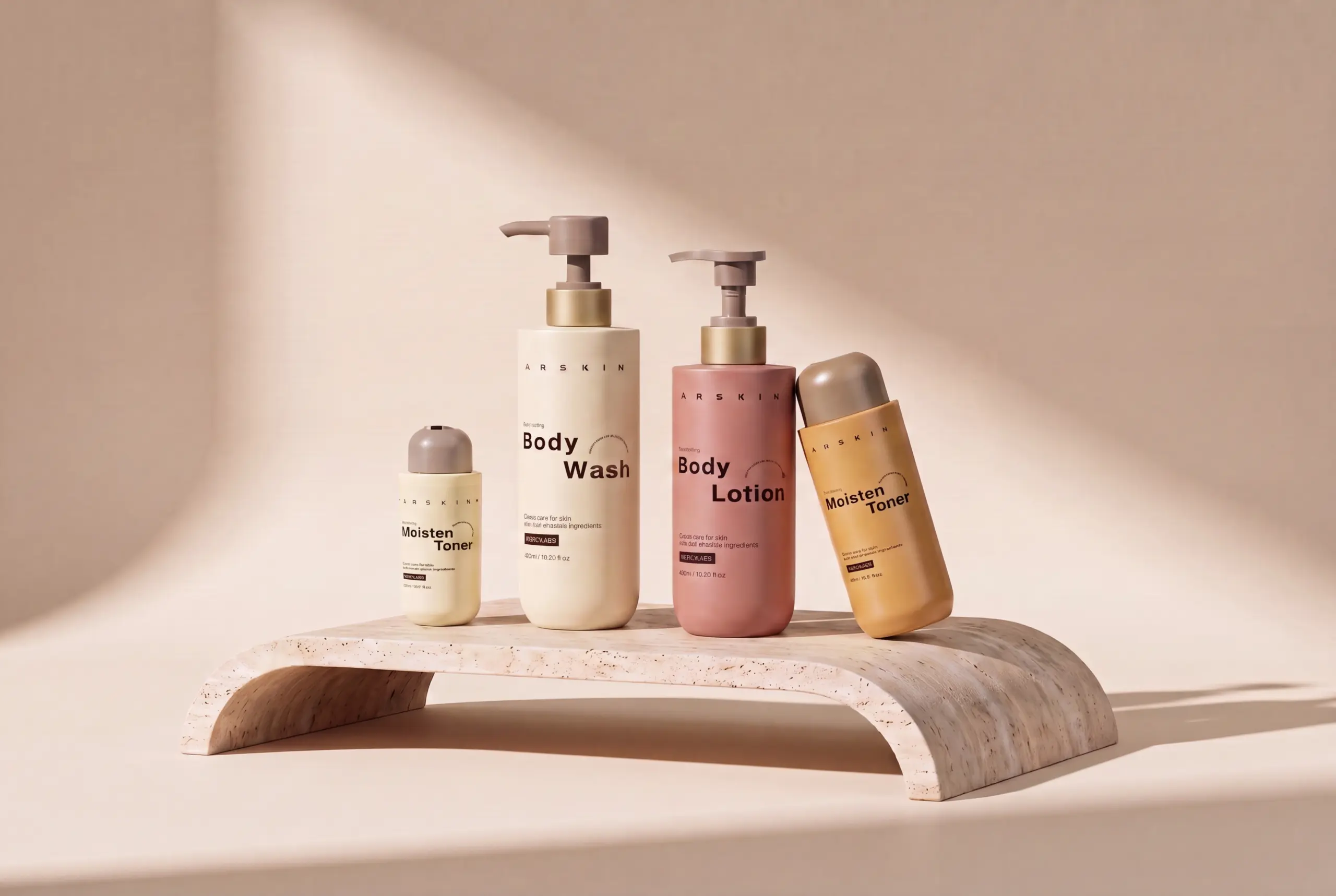
The final product line developed a much more controlled visual language. The containers felt clean, rounded, and consistent in tone. Different formats and accessories looked connected rather than assembled from unrelated packaging families.
That distinction is more important than it may seem.
Almost any supplier can produce one carefully selected sample that photographs well. A growing brand needs something more difficult: a visual identity that can be reproduced across multiple SKUs and repeated manufacturing runs.
Color consistency was therefore not simply a sample correction. It became part of building a scalable personal care packaging system.
The real question was no longer, “Can this bottle look good once?” It became, “Can the brand preserve this appearance as the product range and reorder frequency expand?”
The answer gradually became yes. Then a more technical problem emerged.
6. The Red Dropper Bottle That Started Leaking
One of the client’s stronger-performing products used a red dropper bottle. The SKU reordered approximately every two to three months, so any packaging failure around it carried wider consequences than a problem with a slower-moving product.
During the earlier stage of the cooperation, the dropper bottle developed a leakage issue.
This was not a cosmetic complaint. Leakage affects the consumer experience, transportation reliability, product cleanliness, and confidence in the formula itself. A leaking bottle can damage the label or carton before the consumer even opens the package. Once that happens, the packaging problem becomes a brand problem.
The failure did not appear to come from one visibly defective part. It involved the interaction between mold precision, component dimensions, fit, and sealing stability.
This is where packaging development can become deceptive. A small group of samples may perform perfectly. Once production moves into a larger and more realistic environment, variations that were invisible in the sample set begin to appear.
Every molded component has an acceptable dimensional tolerance. The bottle neck may sit near one end of that range, while the closure or dropper assembly sits near the opposite end. Each part may technically pass inspection on its own, yet the assembled system can still perform inconsistently.
Testing several good-looking samples is therefore not enough. The real question is whether the structure, tolerance window, and component fit remain stable throughout mass production.
7. Treating Leakage as an Engineering Problem
The client expected the next production batch to be controlled properly, as any brand should. At the same time, the discussion did not become a simple contest over blame.
That mattered.
On our side, replacing affected units or offering an explanation would only address the immediate service issue. It would not prevent the same failure from returning. The leakage needed to be treated as a structural and engineering problem.
The review focused on several connected factors:
– Bottle-neck dimensions and sealing surfaces
– Dropper and closure compatibility
– Mold precision and production consistency
– Acceptable tolerance ranges
– Assembly fit and sealing pressure
– Performance under realistic batch conditions
The issue was eventually brought under control through repeated technical correction, component matching, and observation during production.
That sentence sounds simple when written after the fact. The actual work was not. Functional packaging failures rarely disappear because one person identifies one obvious mistake. More often, the solution comes from narrowing several small variables until the complete system becomes stable.
The experience strengthened the partnership because both sides stayed focused on the next reliable production result. Accountability remained important, but it was paired with cooperation rather than punishment.
8. When Lead Time Became a Sales Issue
During the early stage, color consistency and structural performance dominated the project. As the brand grew, lead time became the larger concern.
This change was natural. Once a brand begins entering retail and selling at a faster rate, packaging is no longer only a product-development task. It becomes part of sales execution.
The client generally expected a lead time of around 30 to 40 days. Yet the complete process involved more than production. Sampling, international shipment, overseas review, feedback, revision, and final approval could extend the actual cycle to 45 or even 50 days.
For an established retail schedule, that difference is significant. It can affect a product launch, a retailer commitment, a filling arrangement, or the availability of inventory during an important sales period.
Simply asking the factory to work faster would not solve every delay. Some of the lost time was sitting inside the approval chain.
Shipping samples overseas and waiting for feedback could add another seven to ten days. If the sample contained an issue that could already have been identified at the factory, those days produced no value.
9. Moving Quality Control Closer to Production
As trust developed, more early-stage checking was handled locally.
Color, finish, and overall appearance were reviewed at the factory before samples entered the international confirmation process. On-site visits and defined checkpoints helped filter out avoidable errors before they consumed more time downstream.
This did not remove the client’s approval authority. It made that approval process more efficient.
The goal was not to claim an unrealistically fast lead time. It was to decide which problems should be solved near production and which decisions genuinely required the client’s direct confirmation.
That distinction created a better cross-border workflow:
– Obvious production deviations were stopped locally.
– Stronger samples were sent for client approval.
– International courier cycles were used only when necessary.
– Feedback became more focused and actionable.
– Repeat orders benefited from approved physical references.
In packaging, speed is not always the result of producing faster. Sometimes it comes from preventing weak work from moving to the next stage.
10. From Reactive Orders to Proactive Replenishment
Another change happened quietly as the cooperation matured. The working rhythm moved from responding to individual purchase orders toward anticipating replenishment needs.
As sales increased, the reorder pattern of certain SKUs became easier to read. That allowed us to remind the client earlier, before the production and delivery window became dangerously tight.
This kind of support is especially valuable for a fast-growing personal care brand. Internal attention is usually directed toward marketing, sales, product launches, retail expansion, and customer service. Tracking the purchasing deadline of every bottle, cap, pump, or dropper can easily fall behind.
A supplier cannot replace the brand’s inventory planning. It can, however, contribute useful production visibility.
By combining reorder history with known manufacturing lead times, the supplier can help the brand answer an important question: when must the next decision be made to keep the order normal?
That is a much healthier conversation than asking how quickly an emergency order can be rescued.
Proactive reminders also marked a change in the relationship itself. The cooperation was no longer defined only by manufacturing what the client requested. It began to include helping the client maintain a more stable purchasing rhythm.
That is often the point where a packaging supplier stops being transactional and becomes operationally valuable.
11. The Commercial Growth Followed the Operational Trust
Over time, the commercial development became clear.
The product range expanded to approximately eight SKUs. The restocking frequency, initially once every two or three months, gradually increased to nearly once a month. The initial bulk order was valued at approximately RMB 70,000. Annual order value subsequently reached RMB 1.5 million, rising to RMB 3.5 million in the first half of 2026.
One detail revealed the client’s confidence more clearly than any total volume: the second order was placed before the first bulk batch had officially launched.
For a growing brand managing cash carefully, that decision is rarely based on optimism alone. It indicates confidence that the supply side can support the next phase without becoming the point of failure.
The growth did not happen because the project avoided difficulty. It happened after the difficulties were handled seriously:
– Color mismatch led to a staged approval process.
– Dropper leakage led to deeper structural and tolerance control.
– Long approval cycles led to stronger factory-side inspections.
– Lead-time pressure led to earlier replenishment reminders.
Each resolved issue reduced uncertainty around the next order. Reduced uncertainty made it easier for the client to commit. That commitment then gave production more continuity and allowed the relationship to deepen.
Scale followed trust, not the other way around.
12. What This Packaging Collaboration Really Proves
I would not describe this as a large-account success story from the beginning. That would make the journey sound cleaner than it was.
It was a relationship built during the uncertain stage, when the order was small and the outcome was unclear. Confidence grew through color revisions, structural corrections, factory visits, approval delays, and difficult conversations about what needed to change.
For the client, packaging was never an isolated purchasing item. It was part of the brand image, product experience, launch calendar, and retail performance.
For us as the supplier, long-term value did not come from completing one shipment. It came from helping make a critical part of the client’s growth more stable.
That is why this case remains representative of a real personal care packaging partnership. Problems were not avoided, and trust was not assumed. Both were worked through over time.
When packaging goes wrong, the easiest response is to search for someone to blame. The more valuable response is to understand what the failure is teaching you about the system.
That is where stronger packaging begins. Often, it is where stronger partnerships begin too.
FAQs
Why can bottles, caps, collars, and accessories look different even when they use the same Pantone color?
Pantone references do not guarantee identical results across different materials. Resin type, opacity, wall thickness, surface texture, gloss level, pigment concentration, and molding temperature can all change the perceived color. Buyers should approve colors using physical samples under controlled lighting rather than relying only on digital images. One dominant component should be selected as the master color reference, with all secondary components matched against it.
What should be included in a packaging color approval standard?
A professional approval standard should identify the master sample, material, finish, transparency, viewing environment, acceptable color tolerance, and comparison method. The buyer and supplier should retain signed samples from the same approval round. Photographs can support communication, but they should not replace physical standards for sensitive colors. Repeat orders should be inspected against the retained master rather than against memory, screen images, or a Pantone code alone.
How can buyers prevent endless packaging sample revisions?
Do not develop every component independently without a fixed visual reference. Approve the primary bottle or jar first, then match the closure, collar, pump, and accessories in sequence. Consolidate feedback from design, purchasing, product development, and management into one controlled response. Each sample round should have a defined objective, decision owner, acceptance criteria, and deadline. This prevents contradictory feedback and unnecessary international courier cycles.
What should a buyer investigate when a dropper bottle leaks?
Leakage should be treated as a complete packaging-system failure, not automatically blamed on one component. The investigation should examine bottle-neck dimensions, thread engagement, sealing surfaces, wiper fit, bulb and pipette assembly, closure torque, mold consistency, formula viscosity, filling conditions, and transportation orientation. Buyers should provide affected samples, batch numbers, photographs, storage conditions, and failure rates so the supplier can identify patterns rather than make assumptions.
How can international buyers reduce packaging approval lead time without increasing quality risk?
Move preliminary inspection closer to production. The supplier should check color, finish, decoration, dimensions, assembly, and obvious defects before samples are shipped internationally. Buyers can also classify approvals into three categories: physical sample required, remote confirmation acceptable, and inspection report sufficient. Retained standards should be used for repeat orders. This approach shortens the approval chain without removing the buyer’s final control over critical specifications.
How should a growing brand determine when to reorder packaging?
Use usable inventory, average consumption, forecast growth, confirmed promotions, production time, approval time, transportation time, and a safety buffer. Do not calculate the reorder date from factory production time alone. Customized components with longer decoration or material schedules may need earlier decisions. Suppliers should provide lead-time updates and production constraints, while buyers retain responsibility for sales forecasts and inventory targets. A shared rolling forecast can reduce emergency orders, stockouts, and expensive expedited shipping.