
This case study recounts the story of a Polish contract manufacturer and private-label company that faced a genuine compliance crisis when pre-market testing revealed excessive heavy metal levels in a batch of products already filled and ready for launch at a German supermarket chain. Ultimately, the product never reached store shelves. This article focuses on the events that unfolded in the weeks following the discovery of the contamination. Today, the client is negotiating a repeat order for the same product line for 2027—an impressive outcome that most suppliers would struggle to achieve after encountering such compliance issues so close to a retail launch.
There’s also a regulatory timing issue buried in here that’s worth understanding on its own, separate from this one client. The batch in question was manufactured and prepared for launch in the window when the EU’s new Packaging and Packaging Waste Regulation, Regulation (EU) 2025/40 (PPWR), had already come into force but wasn’t yet generally applicable. That gap — rule exists on paper, enforcement hasn’t caught up everywhere yet — is exactly where this incident happened, and it’s exactly the gap a lot of suppliers shipping into the EU are still sitting in right now.
1. Part One: The Client and the Original Deal
Who They Are
The client is a Polish-based contract filler — an OEM/ODM operation filling liquid and cream cosmetic and personal-care products for other brands — that also runs its own house brand. It has an in-house design team, so packaging structure, print files, and branding calls all get made internally rather than farmed out to an agency. Its finished goods move through global retail, heavily weighted toward supermarket chains, both the physical stores and the retailers’ own online storefronts.
This kind of client is easy to underestimate. A “filler plus own brand” company sits in an odd spot: it has the manufacturing literacy of an OEM operator — it understands tooling costs, MOQs, production timelines — but it also carries the brand-owner’s liability the moment something fails a check before launch. It’s not a pure trading company reselling someone else’s finished goods, and it’s not a pure private-label brand outsourcing everything to a third party. It’s buyer and seller of risk at the same time, and that dual position shaped how this whole situation played out.
The inquiry that started the relationship converted into a deal worth over one million RMB in its first year, split across at least two purchase orders totaling more than 300,000 RMB, covering roughly 30,000 units for one SKU and 50,000 for another.
The first order was deliberately simple. No new mold, no custom bottle shape, no specialty surface finish. The client asked to reuse existing bottle tooling and an existing color formulation, and just print their logo on it. That’s about the lowest-friction cosmetic packaging deal there is: no new tooling to amortize, no extended sampling cycle to validate a new structure, fast turnaround because the only variable is the print file. For a first-time buyer testing out a new supplier, that’s a sensible way to de-risk the relationship. For the supplier, it’s a sensible way to earn trust before being asked to fund custom development.
Worth flagging for anyone managing similar accounts: this client also represents a segment that shows up a lot in cosmetic packaging — some buyers purchase only the “naked bottle” or “white bottle,” undecorated, and handle labeling in-house or through a separate decorator. This client did both: fully custom-branded bottles for some SKUs, bare bottles for others where their design team applied labels downstream. Knowing which service tier a given SKU falls into matters enormously for who owns compliance responsibility, which becomes a central issue later.
2. Part Two: The Crisis
What Happened
The core product involved in this incident was manufactured last year and had already undergone filling and packaging, ready to be sold—both in-store and online—through a major German supermarket chain before the end of the year. However, the product was subjected to a spot check prior to its official launch. In accordance with standard EU cosmetic inspection procedures, the finished product and its packaging were tested separately; while the filled product passed, the packaging failed. Specifically, the printed decorative elements on the packaging—the inks used for labeling and branding—tested positive for heavy metals.
That timing matters a lot to how this story should be read. Nothing had reached a consumer. There was no recall in the strict sense, no product pulled off shelves, no exposure event. What the client actually had was a launch, already scheduled with a major retailer, sitting on a mountain of filled and packed inventory that suddenly couldn’t ship. That’s its own kind of emergency — arguably a more time-pressured one than an after-the-fact recall, because a recall at least has no fixed deadline pressing on it, while a blocked launch does. The retailer’s shelf date doesn’t move just because the supplier needs time to fix an ink problem.
The distinction between the finished product and the packaging also gets lost in casual conversation, so it’s worth being precise about it: a bottle can be made from perfectly safe, cosmetic-grade resin or glass and still fail compliance because of what got printed on top of it. Screen printing and pad printing inks, along with some decorative coatings, have historically relied on pigments and driers that can carry trace lead, cadmium, or chromium compounds for color stability and adhesion. A supplier can pass every test on the bottle substrate itself and still get flagged because nobody separately validated the ink.
Why It Happened Now
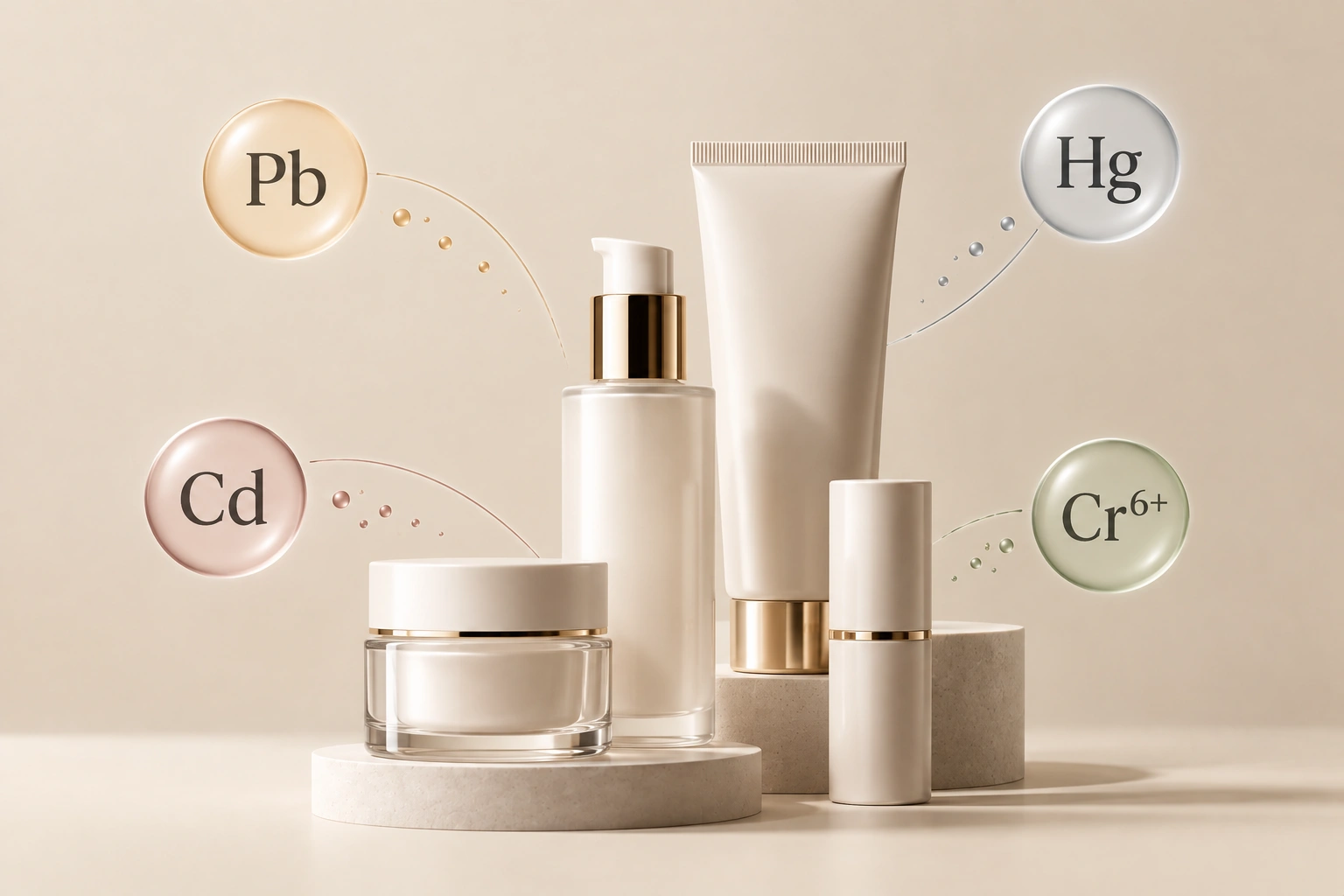
The timing here wasn’t a coincidence, and understanding the regulatory backdrop explains why neither side saw it coming. PPWR — Regulation (EU) 2025/40 — entered into force on 11 February 2025, but its general application date was 12 August 2026. Under Article 5(4), the combined concentration of four restricted heavy metals — lead, cadmium, mercury, and hexavalent chromium — in packaging or packaging components can’t exceed 100 mg/kg, and that limit applies to all packaging types, not just food-contact packaging. The 100 ppm combined threshold isn’t new; it carries forward a limit that existed under the earlier Packaging and Packaging Waste Directive, which PPWR has now replaced with a directly binding regulation enforced identically across all 27 member states, no national transposition needed.
What actually changed is enforcement intensity and market awareness, well ahead of the hard deadline. As PPWR’s application date approached, retailers and their compliance teams across the EU sharply ramped up pre-listing and incoming testing of packaging components — inks, closures, labels, caps — well before goods hit the sales floor, because non-compliant packaging placed on the market after the application date can’t legally stay there, with no grace period for goods made before the deadline once they’re placed on the market after it. Major supermarket chains, well aware of their own liability as “economic operators” under the regulation, started pushing this scrutiny earlier into the supply chain — before listing, before shelf date — rather than waiting for post-market surveillance to catch problems later. This client’s product got caught in exactly that pre-launch tightening: a genuinely compliant, good-faith company, working with a supplier that had never been asked for heavy-metal ink documentation before, ran straight into a retailer that was already testing harder and earlier than either side expected.
The client had no prior history of requesting this kind of certification and no internal expertise flagging ink chemistry as a risk category — reasonably so, since for years incoming checks hadn’t focused there. This wasn’t negligence in any real sense. It was a blind spot shared by a huge number of small and mid-sized brands and fillers supplying EU retail through 2025 and into 2026, most of them watching for PFAS restrictions on food-contact packaging and not yet thinking about heavy-metal ink liability on non-food cosmetic packaging.
3. Part Three: The Response — Why This Became the Case Study Worth Telling
The Golden Window of Crisis PR
The single most consequential decision was speed — specifically, treating the first days after the failed test as a window for in-person crisis management rather than an email-and-invoice problem handled remotely. Company leadership flew to Europe to meet the client face to face instead of managing the fallout through account managers over email. In a relationship that started with a single web inquiry and had never had an in-person meeting, that’s a deliberate signal: it tells the client the failure is being handled at the top of the organization, not delegated down and slow-walked, at the exact moment the client is staring down a launch date they might miss.
That matters because the default response under this kind of pressure — the thing most suppliers actually do — is some version of defensiveness: asking for the client’s own test reports, disputing the methodology, offering a partial credit, or just going quiet while internal teams investigate. Any of those, even if eventually resolved fairly, leaves the client managing the problem alone during the period they’re most exposed: negotiating with a major retailer over a launch delay, watching a shelf slot they fought for possibly slip away, with their own credibility with that retailer on the line. Showing up in person shortens that exposure window and replaces it with visible ownership.
Proving Safety First, Fixing the Root Cause Second
Alongside the in-person visit, migration testing was run to demonstrate the finished product posed no risk to consumers, and it passed on the first attempt. Migration testing checks whether substances in the packaging — here, the ink — could transfer into the product under realistic use and storage conditions. That’s a separate, and arguably more urgent, question from the raw composition of the ink: packaging can fail a bulk-composition heavy metals test and still be shown not to pose meaningful migration risk to the consumer, though that doesn’t exempt it from the compositional compliance requirement itself. Getting a clean migration result gave the client something concrete to bring to their retail partner while the real fix was still underway: proof the already-filled inventory posed no safety issue, even while the packaging itself still needed correcting and requalifying before it could ship.
The actual fix was sourcing and qualifying a replacement ink formulated without the four restricted metals, then remanufacturing the entire affected batch with that ink, testing it, and shipping only once it passed. This is the least glamorous and most expensive part of the story, and also the part that actually solved the problem rather than just managing perception around it. An apology and a clean migration result reassure a client in the short term; only a requalified ink and a remade batch get product back on track for a retail launch and stop the same test from failing again next time.
Who Paid, and Why That Number Mattered More Than It Looked
Othilapak covered the full cost of remanufacturing the batch plus freight to ship the corrected goods to Poland. Neither side disclosed the internal cost of this rework — the 300,000-plus RMB figure earlier is a sales-revenue number for the original order, not a cost figure for the fix — but choosing to absorb both production and freight in full, rather than splitting the cost or offering a partial credit, is the detail that actually rebuilt the relationship.
The internal reasoning was straightforward: the end brand sold through top-tier global retail and represented real long-term account potential, so the math wasn’t “what do we owe on this one order,” it was “what does it cost to keep this account for the next five years.” That’s a judgment call every packaging supplier eventually has to make, and it isn’t always the right call — a small, one-off order from a low-potential buyer might not justify eating a full remanufacturing cost. But for an account already worth seven figures RMB a year, with a brand sitting in major international retail, full ownership of the mistake made more sense than splitting it.
4. Part Four: The Payoff — Trust Rebuilt, Not Just Repaired
The client’s trust didn’t just return to where it was before the failed test — the way it was handled seems to have deepened it. This month, the client signaled intent to place a repeat order for a 2027 project, same product, same packaging configuration as the original. That’s a meaningful signal in packaging sourcing, where switching suppliers after a compliance scare is usually the default, not the exception. Buyers who just went through a blocked launch typically re-tender, spread orders across multiple suppliers, or at minimum push for much harder terms. A client voluntarily coming back to the same supplier for the same product line, about a year after a compliance failure that nearly cost them a major retail launch, says a lot more about the crisis response than about the original transaction.
That said, the new order isn’t unconditional. Any new production run has to pass testing before shipment — a permanent change to how this relationship now operates, and probably the most durable outcome of the whole episode. The client no longer treats compliance testing as optional, or as something to only worry about if a retailer’s incoming check flags it. Testing has moved from an afterthought to a gate, which is exactly the shift a supplier should want every client to make, even though it adds cost and lead time to every future order.
5. Part Five: The Compliance Knowledge Every Cosmetic Packaging Supplier Needs Now
The Four Metals and the Number That Matters
Under PPWR, Article 5(4), packaging placed on the EU market — primary, secondary, and tertiary packaging and all packaging components, regardless of material — can’t exceed a combined concentration of 100 mg/kg (100 ppm by weight) for the sum of lead, cadmium, mercury, and hexavalent chromium. That’s a combined limit across all four substances together, not a separate 100 mg/kg allowance for each one individually, which makes it a tighter practical ceiling than it looks at first glance. The rule applies without prejudice to stricter limits that may already exist under REACH Annex XVII or food-contact material regulations, so suppliers can’t treat the PPWR number as the only bar to clear if some other EU chemical regulation is stricter for a specific material or use case.
This heavy-metals limit is one of the first PPWR obligations to take effect, alongside PFAS restrictions on food-contact packaging, and it applies with no grace period from the general application date of 12 August 2026 — packaging that doesn’t meet it can’t lawfully be placed on the EU market from that date on, no matter when it was made. For suppliers, the timeline detail that actually matters is this: the compliance clock runs from when the packaging is placed on the market, not when it was produced. A batch made and filled in 2025, sitting in a warehouse waiting for a 2026 shelf date, is still on the hook the moment it actually ships to retail.
Certification Is Per Material, Per Component — and It Isn’t Cheap
One thing that catches a lot of overseas suppliers off guard: heavy metals and other compliance certificates in this space are typically issued per material, meaning every distinct component of a packaging assembly — bottle body, cap, pump, label substrate, printing ink, any gasket or liner — needs its own separate test and its own separate certificate, because each is a different substrate with its own risk of heavy-metal contamination from pigments, stabilizers, or coatings. A single certificate covering an entire assembled unit isn’t how European buyers, or increasingly how PPWR-driven market surveillance, actually verifies compliance. European clients now routinely expect this component-by-component documentation as standard practice, and the cumulative cost of testing every component on a multi-part cosmetic package adds up to a real line item, not an afterthought.
That has direct implications for how suppliers price and scope new business, especially with first-time European clients who, like this client before the failed test, may not know yet to ask for this documentation. Offering per-component heavy-metals testing and PPWR documentation proactively as part of a standard quote — instead of waiting to be asked, or worse, waiting for a retailer’s incoming check to catch a failure right before a launch date — is both a real compliance safeguard and an increasingly strong differentiator in conversations with European buyers who’ve started paying close attention to this exposure.
The Real Lesson: Compliance Is Tested at the Loading Dock, Not the Sampling Table
Maybe the most important structural point in this whole case is a timing problem, not a chemistry problem. Packaging compliance rarely gets challenged in any meaningful way during quoting or sampling. At that stage, the conversation is about color match, print registration, bottle weight, price per unit. The moment packaging compliance actually gets tested — in the sense that carries real financial and scheduling weight — is after the product has already been filled, labeled, boxed, and staged for shipment, right as it’s about to enter a retail channel with its own incoming-compliance obligations. By the time a heavy-metals failure surfaces at that stage, the client has already committed capital to filling an entire run, already has a shelf date on the calendar, and has zero room to quietly swap out a bottle design. The cost of a compliance miss grows by an order of magnitude at every stage it stays undetected: catching an ink problem at sampling costs a reprint; catching it after the goods are filled and staged for a retail launch costs a full batch remake, freight, a strained retailer relationship, and a launch date that may or may not survive the delay.
For a supplier in cosmetic and fragrance packaging serving EU-bound clients — especially ones supplying supermarket and mass-retail channels where incoming scrutiny is ramping up under PPWR’s 2026 application date — the strategic takeaway is to push compliance testing and documentation as early into the sales and development process as possible, ideally into sampling and quotation, instead of letting it stay a silent assumption that only surfaces when a retailer’s incoming check flags it right before launch. Clients who don’t yet know to ask for this, exactly like this client before the failed test, aren’t being careless; they’re operating on the assumption that packaging compliance is the supplier’s job to flag. The suppliers who build that into their standard process, instead of their crisis-recovery process, are the ones who’ll keep the next generation of EU retail-facing accounts without ever needing a rescue trip to save a launch date.
6. Closing Perspective
This account’s arc — cold inquiry, fast low-risk first order, a compliance scare caught right before a major retail launch, triggered by regulatory tightening neither side saw coming, a full-cost recovery response, a voluntary repeat order the following year — is worth studying less for the individual events and more for the sequencing. The supplier didn’t win this account back by being cheapest or fastest. It won it back by being the one willing to show up, prove safety first, fix the actual cause, and pay for its own mistake in full, at exactly the moment the client had every reason to walk away and every deadline pressure to do so quickly. As PPWR’s heavy-metal and PFAS restrictions move from newly applicable law into routinely enforced practice across EU retail over the coming months, the suppliers who treat this case as a preview rather than a one-off will be the ones who never need to fly to Europe to save a launch in the first place.
FAQs
Which heavy metals does PPWR restrict in packaging?
PPWR restricts four heavy metals — lead, cadmium, mercury, and hexavalent chromium — with a combined concentration limit of 100 mg/kg across all four substances together, not 100 mg/kg per metal.
Does the PPWR heavy-metal limit apply only to food-contact packaging?
No. The 100 mg/kg combined limit applies to all packaging types and packaging components regardless of material, not just packaging that touches food or cosmetic formulations directly .
Can printing ink alone cause a packaging compliance failure?
Yes. A bottle made from fully compliant, safe resin or glass can still fail testing if the printed decoration — the logo or branding ink — contains restricted heavy metals used historically for pigment stability and adhesion.
What is migration testing, and how is it different from a heavy-metals composition test?
Migration testing checks whether substances in the packaging could transfer into the product itself under real storage and use conditions. A product can pass migration testing (proving no consumer risk) while the packaging still fails the compositional heavy-metals limit and requires correction.
Why do European retailers require separate compliance certificates for each packaging component?
Because each component — bottle, cap, pump, label, and ink — is a distinct substrate with its own contamination risk from pigments, stabilizers, or coatings. European buyers increasingly expect component-by-component testing rather than one blanket certificate.
How can suppliers avoid PPWR heavy-metal compliance failures in future orders?
Build heavy-metals and PPWR documentation into the sampling and quotation stage rather than waiting for a retailer’s pre-launch check to catch it, since a compliance miss caught after filling and staging for shipment costs far more than one caught during sampling.