

The heavy-metal ink failure covered in our earlier case study — a Polish filler’s branded bottles getting pulled from a German retail launch over a 100 mg/kg compliance breach — wasn’t an isolated scare. It was an early signal of a much bigger shift that’s now fully underway across the EU cosmetic packaging supply chain. Since Regulation (EU) 2025/40, the Packaging and Packaging Waste Regulation (PPWR), became generally applicable on 12 August 2026, cosmetic brands, fillers, and their overseas packaging suppliers have moved from “watching this regulation” to “living inside it”. This blog picks up where the case study left off and maps the fuller reform: what’s binding today, what’s coming into force over the next few years, and how brands should be restructuring supplier relationships now to stay ahead of it.
1. From Directive to Regulation — Why the Legal Form Itself Changed the Game
Before getting into the specific rules, it’s worth understanding why PPWR hits differently than the law it replaced. The old Packaging and Packaging Waste Directive (94/62/EC) was a directive, meaning each of the 27 EU member states had to transpose it into their own national law, which created gaps, inconsistent enforcement, and years of lag between EU-level intent and on-the-ground reality. PPWR is a regulation, which means it applies directly and identically in every member state the moment its provisions come into force, with no national transposition step and no room for a country to water down enforcement. The directive was formally repealed on 12 August 2026, the same day PPWR’s general provisions became applicable.
That legal mechanics detail explains something a lot of overseas suppliers are only now discovering: a client in Poland, Germany, France, or Spain is now working under exactly the same packaging rulebook, with the same numeric thresholds and the same documentation requirements, regardless of which member state they sell into. There’s no more “well, this country’s authorities are more lenient” calculation to make. For a supplier managing multiple EU accounts, this is actually good news in the long run — one compliance standard to build toward, instead of 27 slightly different ones — but it also means there’s nowhere to hide a weak link in the supply chain.
2. What’s Binding Right Now, as of Late 2026
Heavy Metals and Restricted Substances
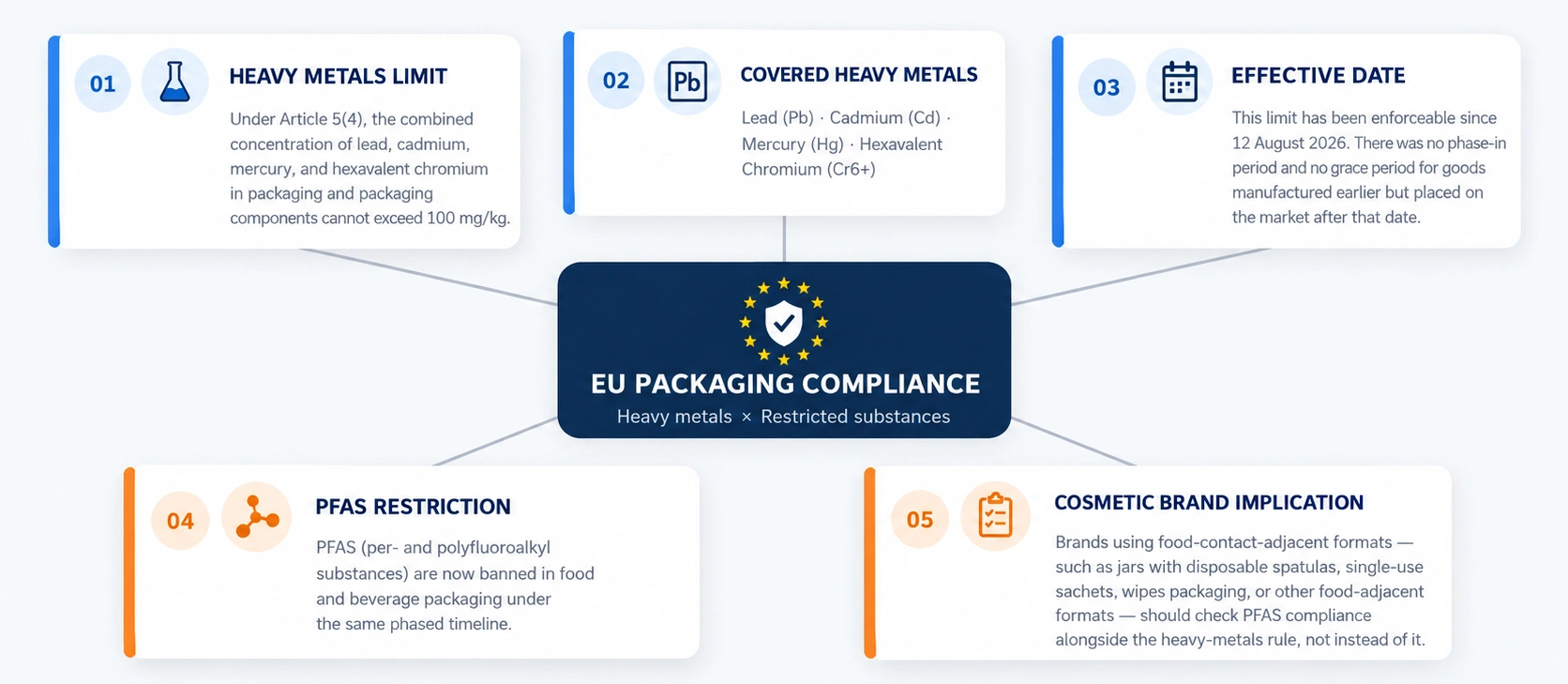
This is the rule our case study client ran into, and it remains the most immediately enforceable substance restriction in PPWR. Under Article 5(4), the combined concentration of lead, cadmium, mercury, and hexavalent chromium in packaging and packaging components cannot exceed 100 mg/kg, applying to all packaging types regardless of material or whether it’s food-contact. This limit had no phase-in period tied to the general application date — it has been enforceable since 12 August 2026 with zero grace period for goods manufactured earlier but placed on the market after that date.
Layered on top of the heavy-metals limit is a newer restriction that specifically affects any cosmetic brand using food-contact-adjacent packaging formats, such as jars sold with disposable spatulas or single-use sachets: PFAS (per- and polyfluoroalkyl substances) are now banned in food and beverage packaging under the same phased timeline. While most decorative cosmetic packaging isn’t food-contact, brands using multi-material sachets, wipes packaging, or any format that could be classified as food-adjacent need to check this restriction alongside the heavy-metals rule, not instead of it.
The Declaration of Conformity
Since August 2026, every producer placing packaging on the EU market must hold a Declaration of Conformity (DoC) for that packaging and be able to present it to authorities on request. This is a structural shift in how compliance gets proven. It used to be common practice for a brand or filler to rely on informal assurances from a supplier — a verbal confirmation, an old test report, a general statement that “our factory follows EU standards.” That is no longer sufficient. The DoC is a formal, packaging-specific document, and authorities can request it at any point after the product is placed on the market, not just during an active investigation.
Design for Recyclability Is Already Live — Even Though Grading Isn’t
Here’s a detail that catches a lot of people off guard: the underlying design-for-recyclability obligation in Article 6(1) has applied since 12 August 2026 to all packaging placed on the market, transport packaging included. It is in force now, not a 2030 obligation waiting on anything. What’s still pending is the letter-grade scoring system (A, B, C) that will translate that obligation into a measurable score — those specific criteria are set through a delegated act the Commission must adopt by 1 January 2028. In practice this means a brand can already be found non-compliant on the general recyclability duty today, even though the formal grading methodology that will make compliance easy to prove or disprove doesn’t exist yet. Design decisions being locked in right now — whether a metal pump spring can be separated from a plastic body, whether an adhesive label survives a wash-and-sort step, whether an ink or varnish system contaminates a recycling stream — are exactly the decisions the eventual grading criteria will judge retroactively.
The 40% Empty Space Rule for E-Commerce and Transport Packaging
From 12 August 2026, e-commerce parcels, grouped packaging, and transport packaging shipped within the EU cannot exceed 40% empty space, counting void fillers like bubble wrap, air cushions, paper crinkle, foam peanuts, and wood wool as “empty”. This figure tightens further to a formal 50% maximum empty-space ratio from 1 January 2030, backed by a standardized calculation methodology.
3. 2027 and Beyond — the Multi-Year Reform Runway
PPWR isn’t a single deadline; it’s a staged rollout stretching out to 2040, built on a sequence of delegated and implementing acts the European Commission is legally required to publish on a fixed schedule. Understanding that sequence matters enormously for anyone planning packaging tooling, ink sourcing, or material contracts more than a year or two out, because by the time a rule’s enforcement date arrives, the sourcing and design decisions behind it usually needed to be made two or three years earlier.
| Milestone | Date | What It Requires |
|---|---|---|
| General application; DfR obligation live | 12 August 2026 | Heavy-metals limit, Declaration of Conformity, 40% empty-space cap, general design-for-recyclability duty become enforceable |
| Packaging minimization measurement standards | By 12 February 2027 | Commission instructs CEN to develop harmonized standards for calculating and measuring packaging minimization; conformity to these standards creates a legal presumption of compliance |
| Reuse target methodology | By 12 February 2027 | Delegated act refining reuse categories, minimum reusable-packaging trip counts, and methodology for calculating reuse targets |
| Design for Recycling delegated act (Article 6(4)) | By 1 January 2028 | Commission finalizes the exact assessment methodology behind Grades A (≥95%), B (≥80%), and C (≥70%) — covering material separability, sortability, and recyclate output quality |
| Harmonized labeling | From August 2028, or 24 months after the related implementing acts, whichever is later | EU-wide packaging labels indicating material composition and sorting instructions become standard |
| Packaging minimization enforced | From 1 January 2030 | Packaging adding only perceived volume — double walls, false bottoms, unnecessary layers — is barred from the EU market absent a narrow design-right or trademark exemption |
| Recyclability grading enforced; sub-Grade-C barred | From 1 January 2030 | Packaging below 70% recyclable (Grade D/E) cannot be placed on the EU market [ |
| Minimum recycled content (PCR) targets | From 1 January 2030 | Contact-sensitive PET packaging needs 30% post-consumer recycled content; other contact-sensitive plastics need 10% |
| Formal 50% empty-space ratio | From 1 January 2030 | Tightened void-space limit for e-commerce, grouped, and transport packaging |
| Grade C packaging phased out | 2038 | Only Grade A and B packaging (≥80% recyclable) remains permitted on the EU market |
| Higher recycled-content targets | From 1 January 2040 | Contact-sensitive PET packaging requirement rises to 50–65%; other plastics to 25% |
Why 2027 Is the Year That Actually Matters Most for Planning
It’s tempting to treat everything before 2030 as low-priority since the hard market-access deadlines land later, but that reading gets the sequencing backwards. The 12 February 2027 deadline for packaging minimization standards, and the parallel reuse-target methodology due the same date, are the moments when the Commission converts vague obligations (“reduce packaging to the minimum necessary”) into measurable, auditable criteria. Once CEN’s harmonized standards exist, any packaging that doesn’t conform loses the legal presumption of compliance and shifts the burden onto the brand to prove its packaging is still justified — a materially harder position to be in.
Similarly, the Design for Recycling delegated act due by 1 January 2028 is the single most consequential piece of pending legislation for cosmetic packaging specifically, because cosmetics as a category is unusually prone to multi-material construction: glass jars with metal-look injection-molded caps, internal liners, pump mechanisms with metal springs, printed shrink sleeves, and foil-lined closures. Early indications point to the methodology assessing four factors — material separation efficiency, collection efficiency, processing efficiency, and output quality of the resulting recyclate. None of the exact thresholds are published yet, but the assessment categories are already known well enough to start designing against them. Waiting until the delegated act is formally adopted in 2028 to start adjusting packaging architecture leaves only two years before the 2030 market-access deadline — not nearly enough runway to requalify tooling, retest recyclability, and requalify supply chains for a portfolio of any real size.
Recycled Content: The Deadline That Looks Distant but Isn’t
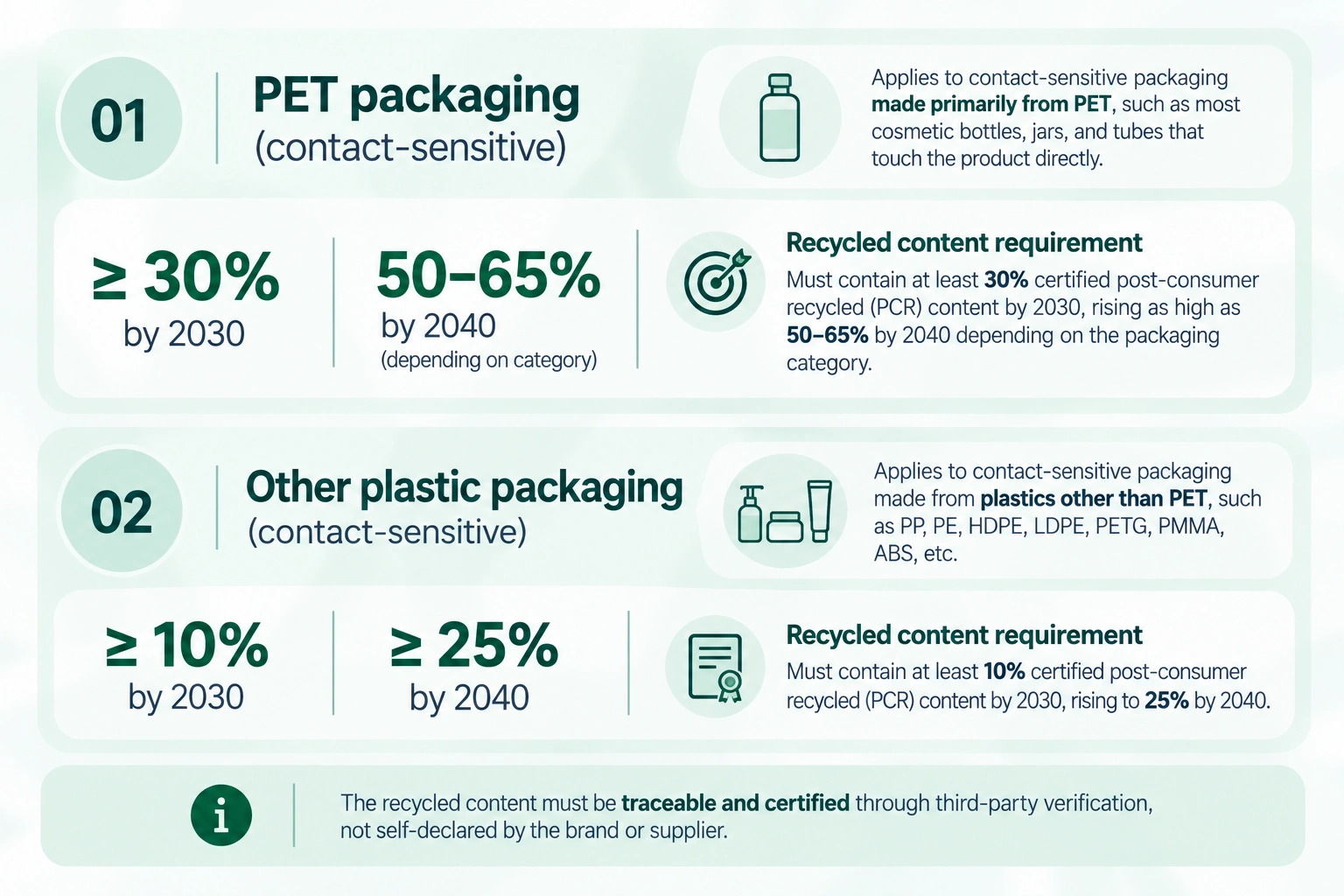
The 2030 recycled-content targets look far off, but the sourcing decisions that determine whether a brand can actually hit them have to be made years in advance, because qualifying a new resin supply chain, verifying post-consumer recycled (PCR) content, and running production trials with recycled-content resin all take real lead time. Under Article 7, contact-sensitive packaging — which includes most cosmetic bottles, jars, and tubes that touch the product directly — made primarily from PET must contain at least 30% certified post-consumer recycled content by 2030, rising as high as 50–65% by 2040 depending on the packaging category. Contact-sensitive packaging made from other plastics needs 10% by 2030, rising to 25% by 2040. Critically, this recycled content must be traceable and certified through third-party verification, not self-declared by the brand or supplier.
4. How Brands Should Restructure Supplier Collaboration
The regulatory sequence above only matters if it changes how brands actually work with their packaging suppliers. Waiting for each deadline to arrive and then scrambling — which is essentially what happened to the client in our case study — is the expensive way to do this. There’s a cheaper, earlier path, and it looks different from how most brands have historically managed supplier relationships.
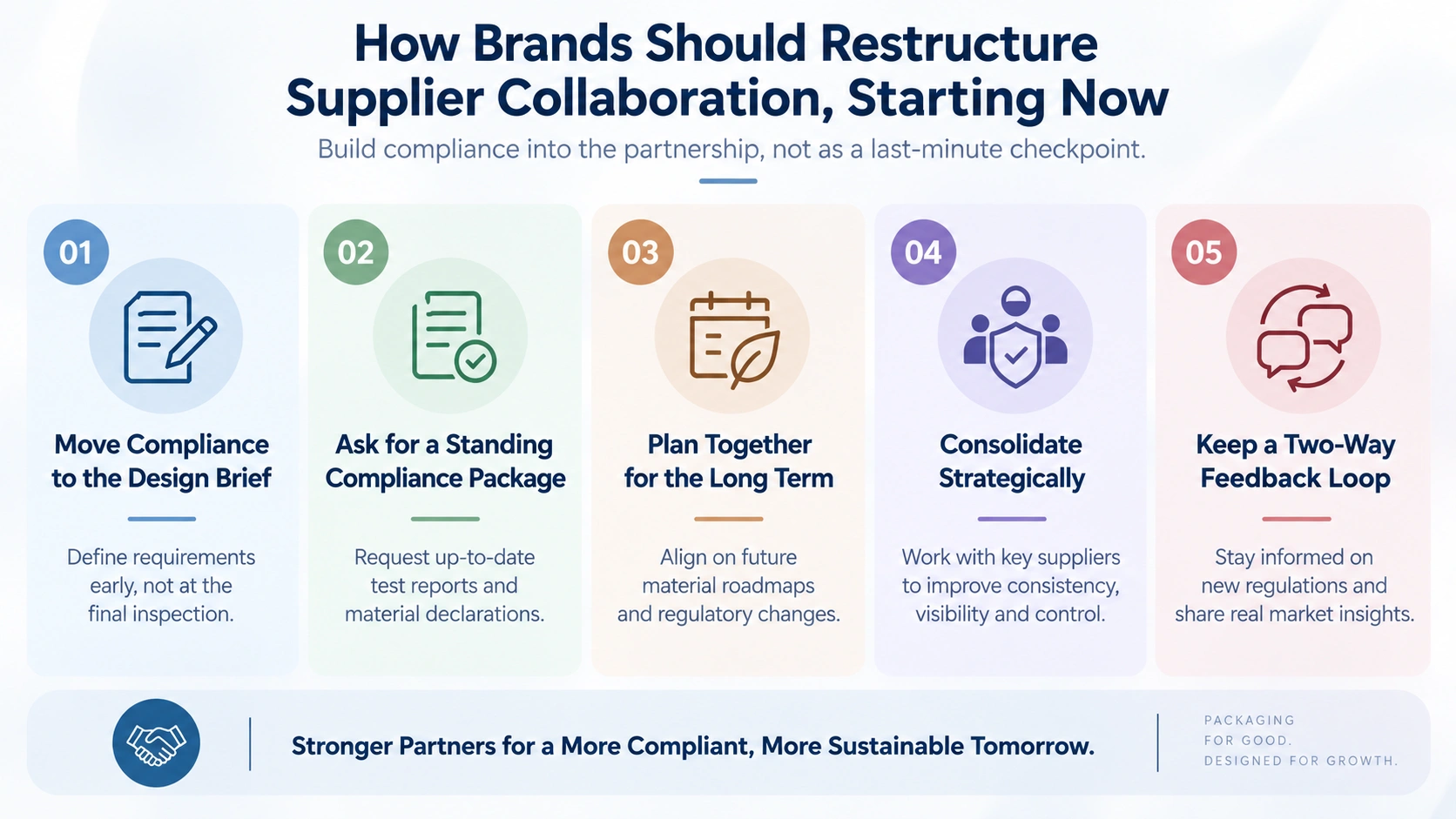
Move Compliance Conversations to the Design Brief, Not the Final Inspection
Historically, a brand would finalize bottle shape, cap design, and decoration, then send it to a supplier for costing and production, with compliance treated as a late-stage checkbox — something confirmed just before shipment, if it came up at all. That sequence needs to invert. Heavy-metals ink certification, PFAS-free confirmation for any food-adjacent format, and an early read on how a proposed structure will likely score under the still-developing Design for Recycling criteria should all be part of the initial design brief conversation with a supplier, before tooling is committed. A supplier that can flag “this metal spring inside the pump will hurt your recyclability grade once the 2028 criteria land” during concept review is saving a brand a redesign cycle it would otherwise be forced into under time pressure two years later.
Ask Suppliers for a Standing Compliance Package, Not a One-Time Certificate
Because the Declaration of Conformity, heavy-metals test reports, and PFAS documentation now need to be current and presentable to authorities on request — not produced retroactively — brands should ask suppliers to maintain a standing, per-SKU compliance file that gets updated with every production run, not just issued once at the start of a relationship. This is the direct, practical lesson from the case study: the crisis happened partly because no one had built this documentation habit before it was urgently needed. A supplier willing to build and maintain this file as a standard part of the account, rather than a one-off request, is signaling the kind of operational maturity a brand needs from a long-term EU-facing partner.
Bring Suppliers Into Multi-Year Material Roadmaps, Not Single-Order Negotiations
Because post-consumer recycled content sourcing and mono-material redesign both require multi-year lead time, brands with SKUs expected to still be on shelves in 2029 or 2030 should be having roadmap conversations with suppliers now — not at next year’s reorder. That means sharing rough volume forecasts and expected shelf-life horizons for key SKUs so a supplier can start qualifying PCR-content resin suppliers, testing mono-material pump alternatives, or piloting simplified closure architecture well ahead of the deadline, rather than being asked to deliver a compliant redesign on a compressed timeline once the rule is fully binding.
Treat Supplier Consolidation as a Compliance Risk-Management Tool
A brand sourcing bottles from one supplier, caps from another, and pumps from a third multiplies the number of Declarations of Conformity, heavy-metals certificates, and recyclability assessments it has to track and reconcile — and multiplies the number of places a single weak link can create the kind of surprise the case study describes. Consolidating packaging component sourcing with fewer, more compliance-capable suppliers, or working with a single supplier who can coordinate testing and documentation across an entire assembled unit, reduces both the administrative burden and the risk of one untested component undermining an otherwise compliant package.
Build a Two-Way Feedback Loop on Emerging Delegated Acts
Because so much of PPWR’s real technical detail is still being finalized through delegated and implementing acts due between now and 2028, brands benefit from suppliers who actively track this pipeline and flag relevant developments proactively, rather than brands having to monitor EU regulatory trackers themselves. In practice, this means asking a supplier directly: which of our current SKUs are most exposed once the Design for Recycling delegated act lands, and what would it take to move them into a safer position now? A supplier that can answer that question with specifics — not just “we’ll comply when required” — is functioning as a genuine sourcing partner rather than a vendor executing purchase orders.
5. Cosmetics-Specific Watch Points
PPWR applies to cosmetic packaging the same way it applies to any other consumer packaging — there’s no separate, lighter-touch cosmetics annex — but a few provisions specifically reference the sector. Article 25 restricts single-use packaging for cosmetic products supplied in the accommodation sector, targeting the small shampoo bottles and mini toiletries long provided in hotel rooms. This is narrower than it sounds — it targets a specific distribution channel, not cosmetic packaging broadly — but suppliers serving hospitality-amenity brands need to track it as a distinct compliance thread from retail packaging.
More broadly relevant, the regulation converges in 2026 with an unrelated but simultaneous compliance shift: new fragrance allergen disclosure requirements apply to newly placed cosmetic products from 31 July 2026, with a longer transition runway for stock already on shelves. This isn’t a PPWR provision, but it lands in the same compliance calendar, and brands managing both packaging redesigns and label content changes at once are dealing with two regulatory clocks that happen to be ticking together. A supplier who can flag both issues in the same client conversation — the ink needs heavy-metals testing, and the label copy needs allergen disclosure review — is offering more value than one who only catches the packaging half.
6. Closing Perspective
The heavy-metal ink failure in our earlier case study happened at the exact inflection point PPWR was designed to create: a regulation that existed on paper for over a year before enforcement actually caught up with it in the market. That same pattern is about to repeat on a larger scale with recyclability grading and recycled-content mandates, except this time the industry has advance warning most suppliers didn’t have in 2025 and 2026. The brands and suppliers treating the 2027 and 2028 delegated-act deadlines as the real planning horizon — rather than waiting for the 2030 market-access date to force the issue — are the ones who’ll turn this multi-year rollout into a routine sourcing update instead of a repeat of the scramble a Polish filler and its supplier had to run through under a live launch deadline.
FAQs
How can a brand determine if a supplier possesses genuine PPWR compliance capabilities, rather than just offering verbal assurances?
The key is whether the supplier can proactively provide third-party test reports broken down by material and component, rather than a generic declaration of “compliance with EU standards.” You can request independent test records for specific parts (such as the metal spring inside a pump head or the liner inside a cap); the ability to provide data segmented by component is the most direct indicator of a supplier’s compliance maturity.
Should brands source all packaging components (bottle, cap, pump head) from a single supplier or distribute orders among multiple suppliers?
From the perspective of managing PPWR compliance risks, the more suppliers involved, the greater the volume of declarations of conformity and test reports that must be tracked and verified; a failure at any single link can compromise the compliance of the entire packaging unit. If a supplier has the capability to coordinate testing and consolidate documentation across multiple components, centralized sourcing can significantly reduce the administrative burden of compliance management.
How frequently should brands review supplier compliance documentation, rather than simply checking it once at the time of contracting?
It is recommended to conduct reviews for every production batch or, at a minimum, annually. Key checks should include whether test reports for critical components have expired and whether there have been changes to the supplier’s raw materials or ink sources. The heavy-metal ink issue mentioned in the case study largely stemmed from the fact that neither the client nor the supplier had established a practice of “batch-by-batch review,” meaning the problem was only discovered during testing at the retail stage.
How can brands clearly define supplier liability for PPWR non-compliance within contracts or procurement agreements?
Brands can include explicit clauses in procurement agreements stipulating that the supplier is responsible for the compliance of the components they provide. If a product fails testing due to issues with the supplier’s raw materials or manufacturing processes, the supplier must bear the costs for reworking, re-testing, and associated shipping. In the case study, the supplier’s decision to voluntarily cover all costs was a relationship-management move that went beyond standard liability obligations; however, explicitly outlining such expectations in the contract can minimize future ambiguity.
If a supplier proactively offers "PPWR compliance consulting services," how can the brand verify that this isn't just a marketing pitch?
You can ask suppliers to provide recent, real-world examples—such as sample test reports for specific components—or details on the concrete steps they are taking to prepare for upcoming legislation (e.g., design-for-recyclability scoring criteria) scheduled for 2027–2028. Suppliers who provide specific details, rather than offering vague assurances like “we will continue to monitor regulations,” are generally more trustworthy.
What PPWR-related questions should brands include in their Request for Quotation (RFQ) when evaluating new suppliers?
It is recommended to explicitly list the following in the RFQ: whether the component has undergone heavy metal testing and if a report is available; whether the inks are PFAS-free; the supplier’s ability to provide a Declaration of Conformity; their capacity to meet recycled plastic content requirements (where applicable); and whether they have a product-line strategy to address future recyclability classification standards. Standardizing these questions in the RFQ allows you to screen out suppliers with inadequate compliance capabilities during the quotation phase, rather than discovering the issue only after problems arise.