
1. A Case Study in Design Partnership, Market Adaptation, and Compliance-Led Growth
A single unanswered B2B inquiry became a five-year partnership, supports a fast-growing skincare brand across multiple markets, and increasingly centers on one strategic reality: packaging is no longer just about appearance, protection, or cost. For ambitious beauty brands, packaging has become a market-access decision. In Europe in particular, the Packaging and Packaging Waste Regulation (PPWR) is changing how brands must think about material selection, recyclability, component design, and long-term packaging architecture.
This case study shows how a supplier relationship evolved into a full design and compliance partnership. It also demonstrates a broader lesson for indie beauty brands: the right packaging partner does not simply manufacture bottles. It helps translate different end-market requirements into different packaging solutions, so that growth in one region does not create barriers in another.
2. The Beginning: A Message That Nearly Disappeared
It started with a one-line inquiry on a major global B2B platform. The prospective buyer, a small indie skincare founder from an emerging European market, sent a short message asking about a dropper bottle. A reply went out within hours. Then nothing.
In many supplier organizations, that lead would have been marked cold and archived. Instead, the sales lead did something uncommon. Using only the founder’s name from the inquiry, she searched the open web and reconstructed a picture of the person behind the message: personal Instagram activity, early brand imagery, preferred tones, and the visual language the brand was trying to build.
By the time the next follow-up was sent, the conversation had changed. The founder was no longer being approached as a generic prospect. She was being approached as a creative decision-maker with a specific aesthetic and a specific ambition.
The follow-ups continued. They were short, visual, and specific. Each message referenced something concrete from the founder’s existing brand expression. The tenth message finally got a reply.
The reason was simple: the founder had been overwhelmed by dozens of suppliers contacting her at the same time and had lost track of which conversations were worth continuing. Persistence broke through only because it was paired with relevance. The communication did not feel like chasing. It felt like preparation.
That first exchange would become the foundation of a long-term lesson: in modern beauty packaging, responsiveness wins attention, but research-driven specificity earns trust.
3. Understanding the Client Behind the Inquiry
The founder did not come from the beauty industry. Her family had spent two decades operating a chemical raw materials factory, an industrial business with technical depth but no consumer-facing brand identity. She saw a gap in her domestic market: women were willing to pay for better skincare, but local options rarely matched international quality and presentation standards at a fair premium price.
She co-founded a skincare brand with her husband. She would lead creative direction and branding. He would oversee operations and manufacturing, drawing on the family factory’s experience. Their target consumer was clear from the beginning: women aged 20 to 35 in the domestic premium tier, willing to pay about forty US dollars for a 50 ml serum.
What made the brand commercially interesting was not only the target demographic. It was the founder’s refusal to make packaging look like the rest of her market.
In her home market, mass skincare brands often relied on plastic bottles, paperboard cartons, and other cost-led formats. Glass was less common and carried a premium, often associated with imported luxury products. She decided to build her entire core range around glass as a differentiation strategy.
That decision created a serious sourcing challenge. Using glass across a product line required a packaging partner capable of managing scale, color consistency, structural durability, and cross-border shipping risk. Many local suppliers could not reliably support that level of execution. Sourcing from China became the practical answer.
At the same time, another layer of the story was quietly developing. The founder was also building herself into a regional influencer. Media appearances, a growing social following, and a personal brand increasingly intertwined with the product brand would later become part of the company’s commercial engine. But at the beginning, she was simply a founder asking about a 30 ml bottle.
4. The Full-Series Strategy That Won the First Order
The founder originally asked for two bottle sizes: 30 ml and 40 ml dropper bottles for two serum launches. Instead of quoting only those two items, the sales lead made a more strategic move.
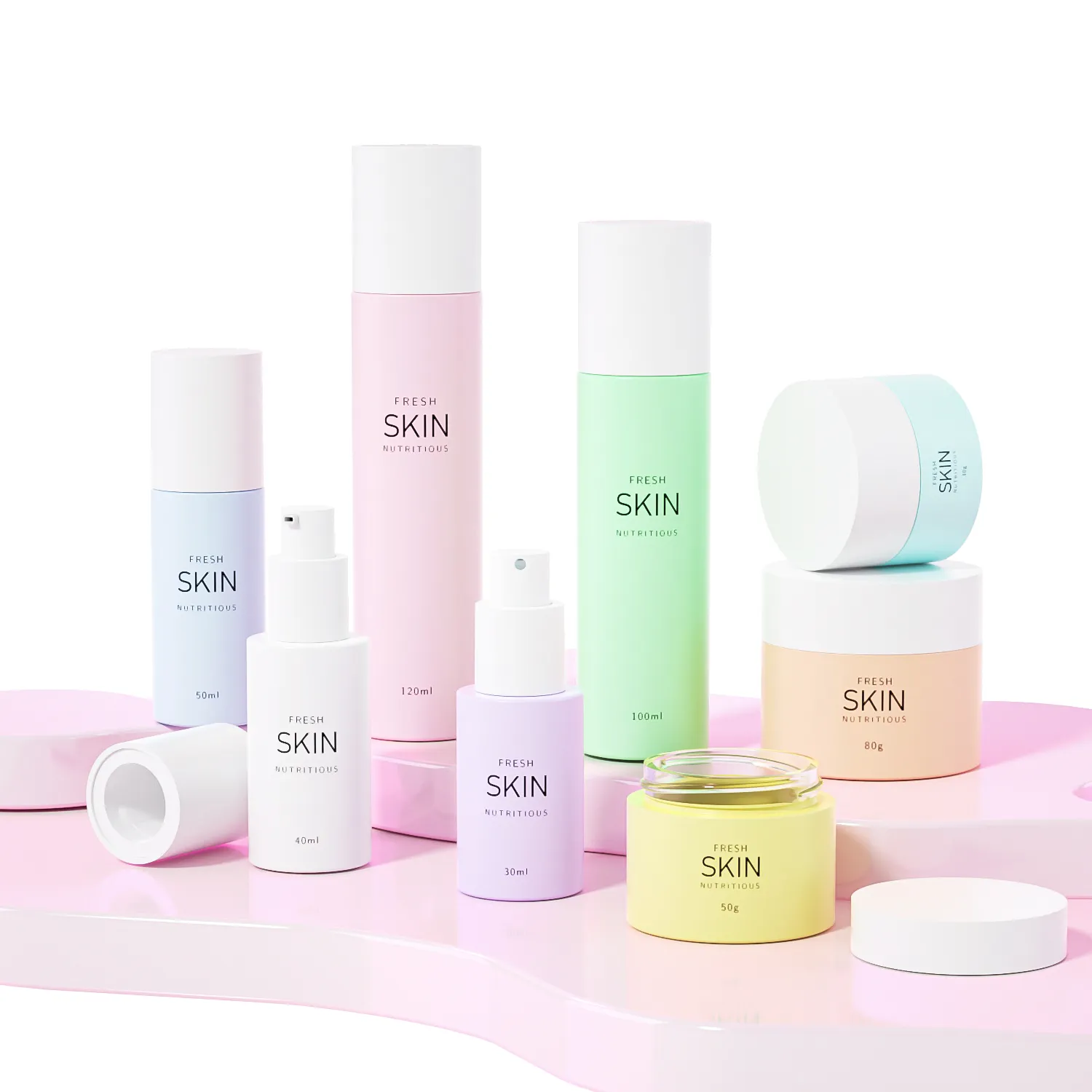
An existing mold family was pulled and staged as a complete retail-ready set: 30 ml, 40 ml, 50 ml, 60 ml, 100 ml, and 120 ml. The photo was sent with a short message: this is what your shelf could look like in two years.
That decision changed the nature of the conversation. Indie beauty founders rarely think in isolated SKUs for long. They think in category systems, shelf impact, line architecture, and future launches. A coordinated bottle family communicates premium intent and signals a brand that looks ready for retail expansion rather than just product testing.
The founder fell in love with the system before committing to the first unit.
Then came the harder issue: color confirmation without physical sampling. During the disruption-heavy logistics environment of 2021, international sample shipping was too unreliable to support her launch schedule. She wanted to review bottle color in real time. Traditional sampling could not solve that problem.
A live, factory-floor video color-matching process was proposed instead. Over one week, the team produced twelve candidate shades, narrowed them to five finalist palettes, and manufactured a full six-size bottle set in each finalist color family. Sixty bottles were reviewed remotely through real-time collaboration.
The first direction failed. The founder initially leaned toward bright, almost fluorescent gradients. The team believed that approach would weaken the premium position she was trying to build and said so directly.
The second round introduced softer, more muted tones: cleaner, more elevated, and more coherent as a long-term brand system. Approval came immediately. That color direction would later evolve into the Morandi-inspired visual language that became the brand’s signature.
The first order that followed still surprises new colleagues when they hear the story. The founder placed a six-figure US-dollar purchase order before a single physical sample had reached her hands. No factory audit had taken place. No in-person meeting had happened. No third-party QC had been arranged. Trust was built entirely through responsiveness, visual fluency, and a form of design empathy that made the supplier relationship feel collaborative rather than transactional.
5. From Supplier to Full-Case Design Partner
What began as a sourcing conversation became, over the next eighteen months, a full design partnership. Concept sketches could be turned around in an hour. Photorealistic 3D renders followed in two. Color refinement became an ongoing discipline rather than a one-off sampling exercise.
None of this design work was billed as a separate service. It was treated as the foundation of a long partnership. The goal was not to monetize every hour of design support. The goal was to become indispensable to the brand’s product development process.
The scope expanded quickly. The collaboration moved from two serum bottles into a broader SKU ecosystem covering serums, toners, lotions, essences, body lotions, sunscreens, cleansing balms, cleansing oils, folding cartons, and custom shipping cartons.
The shipping cartons were especially important because the brand’s sustainability commitments were not cosmetic. The packaging system had to move toward foam-free, single-layer kraft structures that could still protect glass across e-commerce and wholesale distribution.
By Year Five, the relationship had become structural. About 90 percent of the brand’s primary packaging was being supplied through the partnership. The only major items sourced elsewhere were large aluminum cans used for product formats outside the supplier’s manufacturing scope. Each purchase order now covered roughly 20 to 25 SKUs, reflecting a product pipeline that had become both more ambitious and more dependent on packaging consistency.
At that point, changing suppliers would no longer mean merely finding a better unit price. It would mean reconstructing five years of design files, color standards, component knowledge, and packaging engineering logic.
6. Seven Crises, Seven Lessons
Long partnerships are not built on flawless production runs. They are built on how problems are handled when failures happen under real market pressure.
Crisis 1: Rollerball bottles that wouldn’t dispense. The brand launched a new rollerball-format product. Consumer complaints emerged within weeks: no product was dispensing. Root cause: an internal sealing film inside the rollerball housing had failed to release properly during demolding at the component sub-factory. We replaced the entire affected batch at our cost, redesigned the rollerball internal structure, and added goodwill bonus units to the next purchase order.
Crisis 2: Caps cracking on retail shelves. ABS outer caps on one of the brand’s bestselling formats began visibly cracking — not at the filling facility, but weeks later on retail shelves. Root cause: chemical incompatibility between the cosmetic formulation and the ABS polymer used in the cap. The solution became one of our most-cited internal engineering cases: a dual-layer cap construction pairing a PP inner liner — chemically inert to the formulation — with an ABS outer shell for aesthetic finish. Zero recurrence in the three years since.
Crisis 3: Glass necks fracturing under normal use. Consumer reports of glass necks snapping when the dropper assembly was screwed in. Root cause: neck wall thickness below the threshold required to handle real-world end-user torque, especially in cold ambient temperatures. We redesigned the neck geometry, increased the glass weight specification, and tightened QA inspection protocols at the supplier level.
Crisis 4: Twenty thousand wrong pumps. A production floor mis-pick at one of our component partners caused approximately 20,000 mist-spray pumps to be substituted with standard pumps on a shipment. The client’s filling line halted mid-run, triggering downstream delays across the launch calendar. We covered full reshipment costs, reimbursed freight charges, and rewrote the pump-segregation standard operating procedure at the affected supplier site.
Crisis 5: Base cracking from wall inconsistency. A subsequent batch failed at the bottle bottom rather than the neck — a different failure mode revealing a different root cause: inconsistent base-wall thickness from a secondary glass sub-supplier we had added during a peak volume period to manage capacity. We mandated a reinforced base-thickness specification, consolidated production back to our primary glass manufacturer, and absorbed the unit cost premium of that consolidation.
The lesson this crisis made explicit: ask any packaging supplier how many sub-suppliers handle your components at any given time. Multiple sub-suppliers introduce thickness variances, colorimetric drift, and dimensional inconsistencies that only manifest at scale — after tens of thousands of units are in the market.
Crisis 6: A competitor approached — and our network protected the relationship. In the aftermath of Crisis 2, the client quietly began soliciting samples from a competing Chinese factory. We learned about this not through the client, but because the competing factory’s component supplier was a longstanding partner of ours. They declined to take the sampling job and informed us of the inquiry.
We didn’t raise it with the client. We didn’t confront or pressure. We responded by accelerating the PPWR engineering commitment described in Crisis 7, and by doubling down on the design collaboration that distinguished us from the alternative. The client never raised the competing factory again.
Supply chain network density is an invisible competitive moat that takes years to build. It is also one of the strongest arguments for prioritizing supplier longevity over tactical price optimization.
Crisis 7 / Opportunity: PPWR compliance as a loyalty driver. In Year 4, the client began planning expansion into the European Union market. This triggered immediate exposure to the EU Packaging and Packaging Waste Regulation — a regulatory framework requiring mono-material recyclable packaging across cosmetics categories by 2030, with significant implications for mixed-material closures of exactly the type common across the brand’s range.
We did not wait for the client to raise this challenge. We approached her with a proactive proposal: we would absorb the full tooling development cost for a new generation of mono-material PP closures that met PPWR specifications, at no charge to the client. She would pay only for unit production at commercial volume.
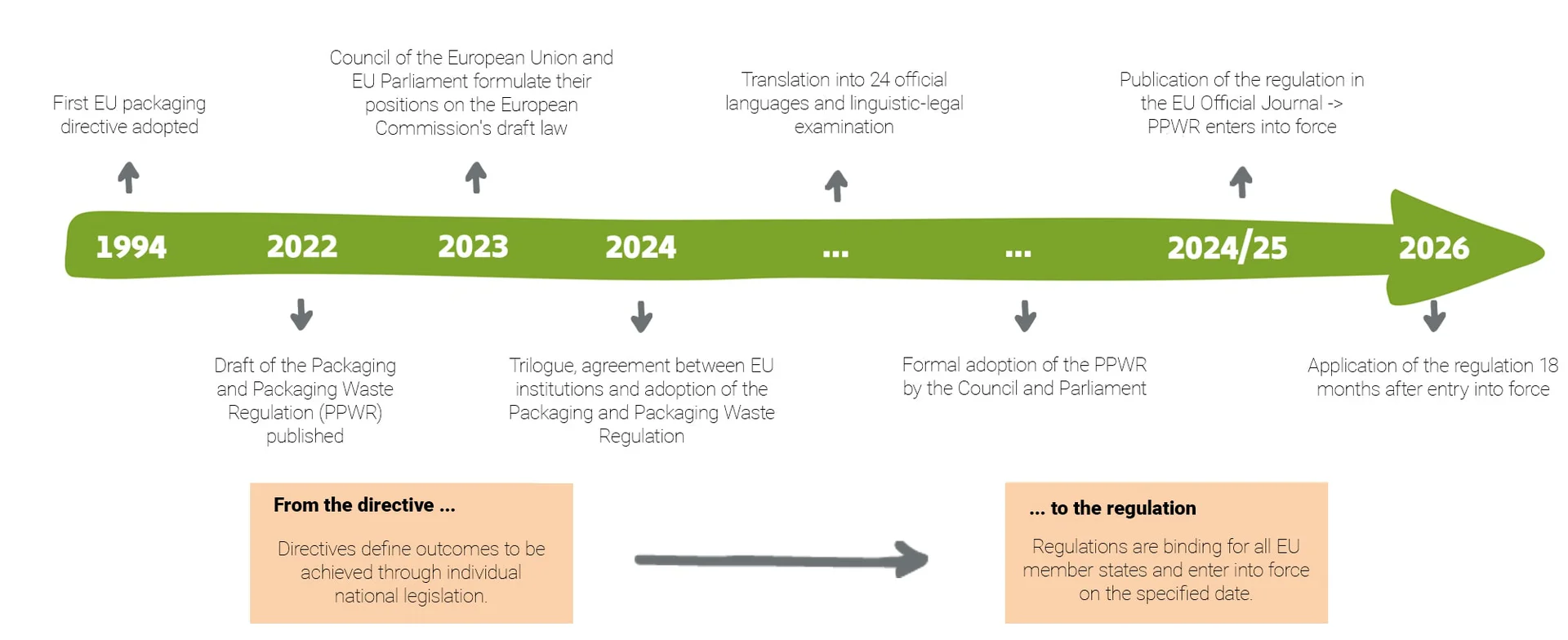
7. PPWR Is Not a Compliance Burden — It Is Your Passport to the EU Market
When the founder began planning EU expansion in Year Four, the conversation changed. The issue was no longer limited to color systems, shelf aesthetics, or new product launches. The bigger question became whether the brand’s packaging architecture could support entry into a market where regulatory compliance would increasingly define access.
PPWR reshaped that conversation. The regulation places new pressure on packaging design choices that had long been treated as standard in beauty, especially mixed-material components, recyclability performance, material recovery logic, and the use of recycled content in plastic packaging. For cosmetics brands, this means packaging can no longer be designed only for appearance and functionality. It must also be designed for regulatory fit.
This matters most in closure systems. Many premium cosmetic packs rely on multi-material constructions that combine aesthetic appeal with performance, but these combinations can weaken recyclability outcomes under the PPWR framework. A cap that works beautifully in one market may become a liability in another if it reduces sorting efficiency, complicates recycling, or fails to align with future recyclability grading requirements.
That is why the relationship moved from packaging supply into packaging strategy. Instead of waiting for the client to ask how to adapt, a proposal was brought forward proactively: the full tooling cost for a new generation of mono-material PP closures would be absorbed so the brand could move toward EU-ready specifications without carrying the development burden alone.
That decision did more than reduce cost. It changed the founder’s position in distributor conversations. She was able to approach EU market development with a packaging roadmap already underway, while many competing brands were still treating compliance as a future issue. In practice, this turned regulation into a commercial differentiator.
A packaging partner that protects market access is doing more than fulfilling a purchase order. It is reducing strategic risk.
8. Different Markets Require Different Packaging Solutions
PPWR became the clearest example of a broader truth: no beauty brand with international ambitions can rely on a single packaging logic across every end market.
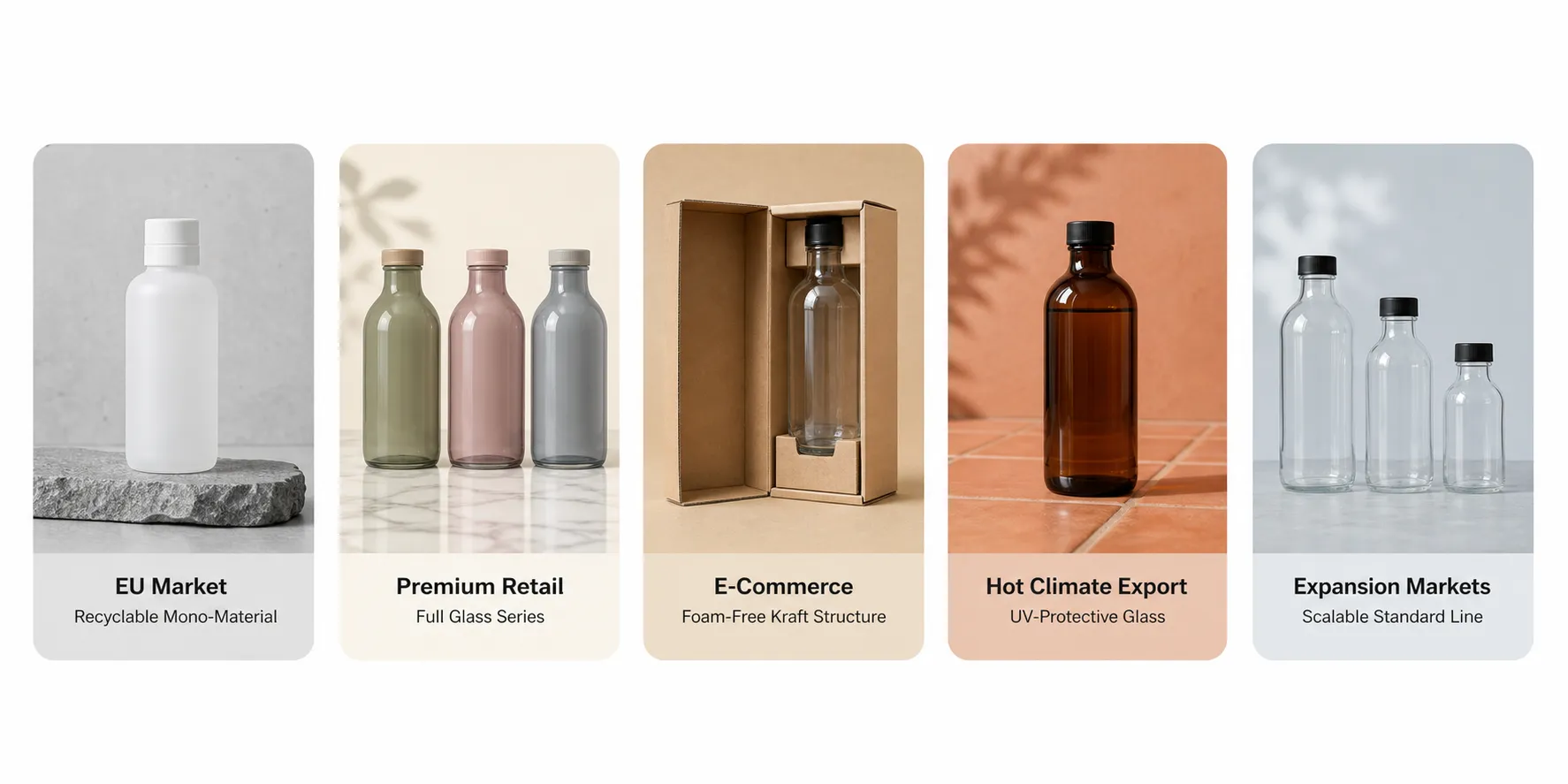
Different regions create different packaging pressures. Europe increasingly rewards recyclability, mono-material thinking, and design choices that support circularity under PPWR. E-commerce-heavy channels put more emphasis on structural durability, weight efficiency, and reduced empty space in transport packaging, an area also explicitly targeted by PPWR’s restrictions on unnecessary packaging volume. Premium domestic retail may still prioritize shelf differentiation, color consistency, and glass-forward presentation. Hot-climate markets often require stronger UV protection, heat tolerance, or more conservative material choices for closures and pumps.
That means the right solution is rarely one universal bottle paired with one universal cap. The right solution is a packaging architecture built around market intent.
For this client, that translated into different packaging strategies for different commercial environments:
| Market | Primary Need | Packaging Response |
|---|---|---|
| EU market | Recyclability, future PPWR alignment, simplified material streams | Mono-material PP closure development, recyclable-oriented component redesign |
| Domestic premium retail | Shelf impact, elevated perception, brand recognition | Coordinated glass bottle family, signature muted color system |
| E-commerce | Damage reduction, shipping efficiency, lower void space | Engineered kraft transit packaging, foam-free structures, optimized secondary pack volume |
| Hot-climate export markets | Stability, durability, aesthetic retention | Higher-protection glass options, performance-focused pump and cap specifications |
| Cost-sensitive expansion markets | MOQ flexibility, faster launches, lower complexity | Shared mold systems, standardized component planning, scalable series design |
This is where packaging strategy becomes commercially powerful. One partner can help a brand preserve luxury cues in one market, reduce transport inefficiency in another, and adapt material systems for regulatory compliance in a third.
9. What PPWR Now Requires From Packaging
For beauty brands entering or expanding in Europe, the most important takeaway is that PPWR is not a distant concept. It introduces practical requirements that should already influence packaging development, especially for brands with multi-year product roadmaps.
The current direction of PPWR places pressure on five major packaging areas:
Recyclability by design. Packaging placed on the EU market will need to meet recyclability performance thresholds, and those thresholds tighten over time from lower to higher grades.
Mono-material preference. Multi-material packaging is not universally banned, but simpler material combinations are easier to recycle and better aligned with future compliance expectations.
Recycled content in plastics. Plastic packaging will increasingly need post-consumer recycled content, which means brands must plan for material sourcing, consistency, and aesthetics earlier in development.
Reduced unnecessary packaging volume. PPWR limits excessive empty space, especially in transport and e-commerce packaging, pushing brands toward more efficient secondary and tertiary pack design.
Substance restrictions and broader compliance controls. Packaging in some applications is also subject to stricter restrictions on substances such as PFAS, reinforcing the need for stronger material governance across the supply chain.
For beauty packaging teams, the implication is straightforward: compliance can no longer be handled at the final sourcing stage. It must be built into format selection, closure structure, carton engineering, and supplier collaboration from the start.
10. What Indie Beauty Brands Should Look For in a Packaging Partner
For founders evaluating packaging suppliers today, this five-year case offers a clear checklist.
A strong partner should pitch a system, not just a SKU. A coordinated bottle family helps define shelf identity and creates room for future expansion.
A strong partner should understand material science, not just aesthetics. Problems such as formula incompatibility with ABS, closure failure, or glass weakness are solvable only when they are recognized early.
A strong partner should be transparent about its supply chain. Too many sub-suppliers often means quality drift that becomes visible only at scale.
A strong partner should be judged by crisis response, not only first-quote pricing. Low price matters less when a launch is delayed by avoidable quality failures.
A strong partner should provide regulatory roadmap support. In Europe especially, PPWR means that compliance readiness will increasingly separate brands that can scale from brands that stall.
FAQs
Why does coordinated bottle family design matter more than quoting individual SKUs?
Because indie beauty founders don’t evaluate packaging in isolation — they visualize shelves, editorial flat lays, and brand launches. A coordinated bottle family across multiple sizes communicates brand maturity and retail readiness before a single consumer sees it. In this case, the supplier photographed a full six-size bottle set and sent it with a note: “This is what your shelf could look like in two years.” That single image changed the entire scope of the first order.
What is PPWR, and why should beauty brands care about it right now?
PPWR (EU Packaging and Packaging Waste Regulation, EU 2025/40) is the European Union’s overarching regulatory framework for packaging recyclability, material composition, and sustainability. It entered into force in February 2025 and begins full enforcement across all 27 EU member states in August 2026. For beauty brands, it directly affects which materials are permissible in closures, what recyclability grade a package must achieve to stay on EU shelves, and how much recycled content plastic packaging must incorporate. Brands planning EU expansion should already be adapting their packaging specifications — not waiting for enforcement to begin.
How does PPWR affect multi-material cosmetic closures specifically?
This is one of the most direct impacts of PPWR on beauty packaging. Many premium cosmetics packs use mixed-material caps — for example, an ABS outer shell combined with a metal or PP inner component — because the combination delivers both aesthetics and functionality. Under PPWR’s recyclability assessment framework, multi-material constructions typically receive lower recyclability grades than mono-material alternatives. Brands that do not proactively redesign toward simpler material streams risk having packaging that fails to qualify for EU market placement as recyclability thresholds tighten toward 2030 and beyond.
What is the difference between a packaging vendor and a packaging design partner?
A vendor processes orders. A design partner helps you build a brand. In practice, the difference shows up in three ways: speed of design support (concept-to-sketch in one hour, 3D render in two versus waiting weeks for a catalog response), proactive problem-solving (flagging material incompatibility risks before they reach retail shelves), and strategic framing (pitching a full bottle family rather than quoting only the two sizes you asked for). In this case, none of the design work was billed separately. It was treated as the foundation of a long-term relationship rather than a fee-generating service line.
How should beauty brands think about packaging across multiple markets with different requirements?
With a market-specific architecture rather than a universal solution. Europe prioritizes recyclability and PPWR compliance. E-commerce channels demand structural durability and reduced void space in transit packaging. Domestic premium retail may still reward glass aesthetics and color differentiation above all else. Hot-climate export markets require heat-tolerant closures and UV-protective glass. Cost-sensitive expansion markets require MOQ flexibility and faster turnarounds. A packaging partner that can adapt the same core design system to different material and regulatory requirements across these environments becomes a strategic asset rather than a commodity supplier.
How did chemical incompatibility between a cosmetic formula and an ABS cap get resolved — and what does this mean for other brands?
The ABS outer caps on a bestselling product began cracking on retail shelves weeks after filling. Root cause: the cosmetic formulation was chemically incompatible with the ABS polymer. The solution was a dual-layer closure — a PP inner liner in contact with the formula, paired with an ABS outer shell for aesthetics. The issue did not recur for three years. For other brands: chemical compatibility between your formulation and your packaging materials should be assessed before bulk production, not discovered after consumer complaints. Ask your supplier specifically whether they test for polymer-formulation interaction.