
I still remember the message I received from a founder — let’s call her Mia — who had spent eight months developing a vitamin C brightening cream she was genuinely proud of.
She’d done everything right: worked with a cosmetic chemist, passed stability testing, built a small but engaged Instagram following. Then she found a “manufacturer” on a sourcing platform, liked what she saw, and placed a 2,000-unit order.
Three months later, the jars arrived. The lids didn’t seal properly. The frosted finish looked streaky under store lighting. And when she asked for help, she discovered she had never spoken to a factory at all. The company she’d been emailing was a trading intermediary, three steps removed from production, with no ability to resolve the issue without reordering from scratch.
Mia’s story isn’t unique. It plays out dozens of times a week in beauty brand communities, DMs, and packaging forums. And almost every time, the root cause is the same: the founder didn’t know the difference between a cosmetic jar supplier and a cosmetic jar manufacturer before they needed to.
Let’s fix that — before it costs you.
1. The Two Roles, Actually Explained
The global cosmetic packaging market was valued at $39.1 billion in 2023, and it’s on a growth trajectory that shows no signs of slowing. That growth has attracted an enormous range of companies — factories, trading houses, distributors, consolidators, and everything in between — all competing for your packaging order. Many of them describe themselves using the same words.
Here’s the core distinction that matters:
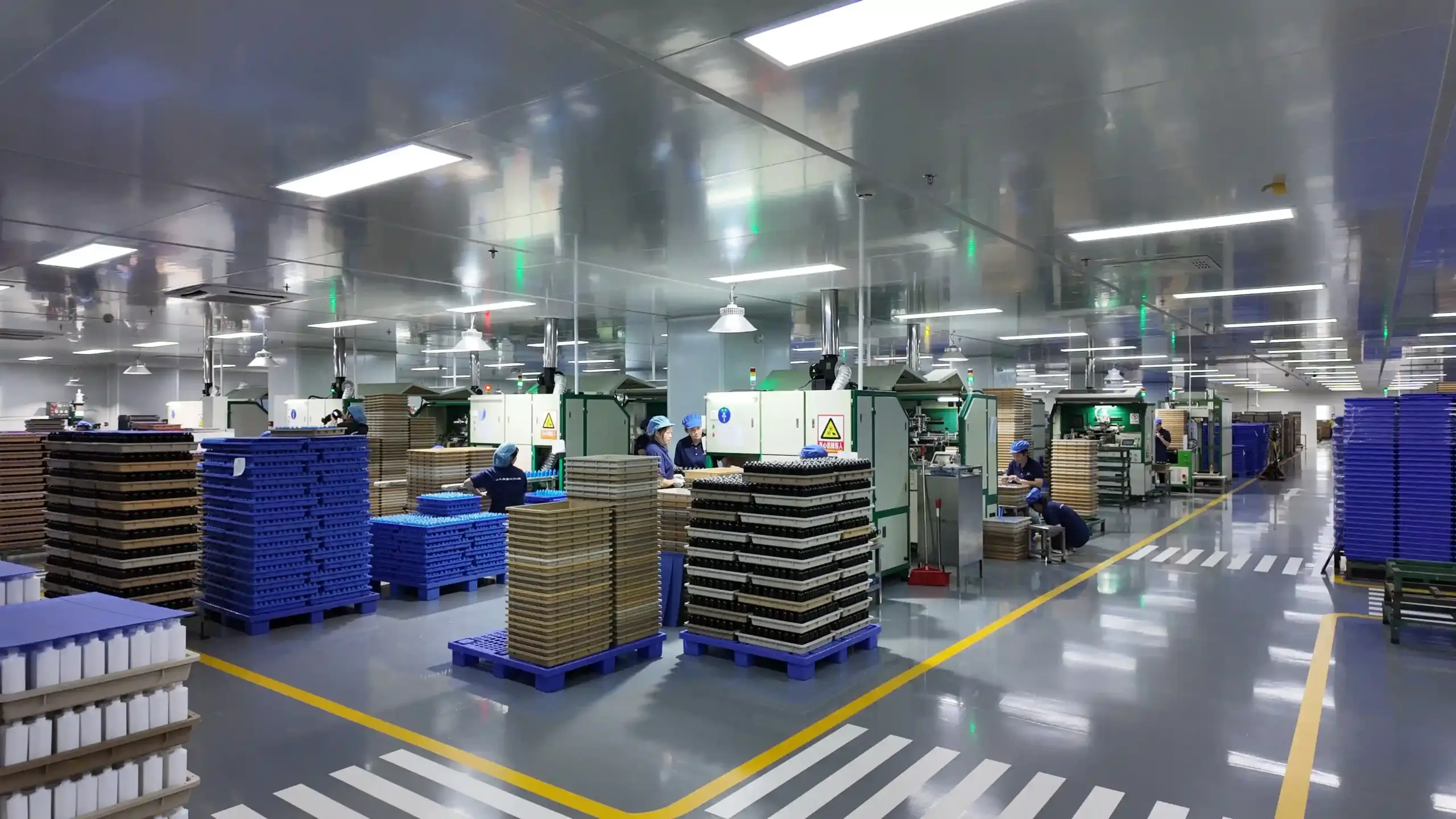
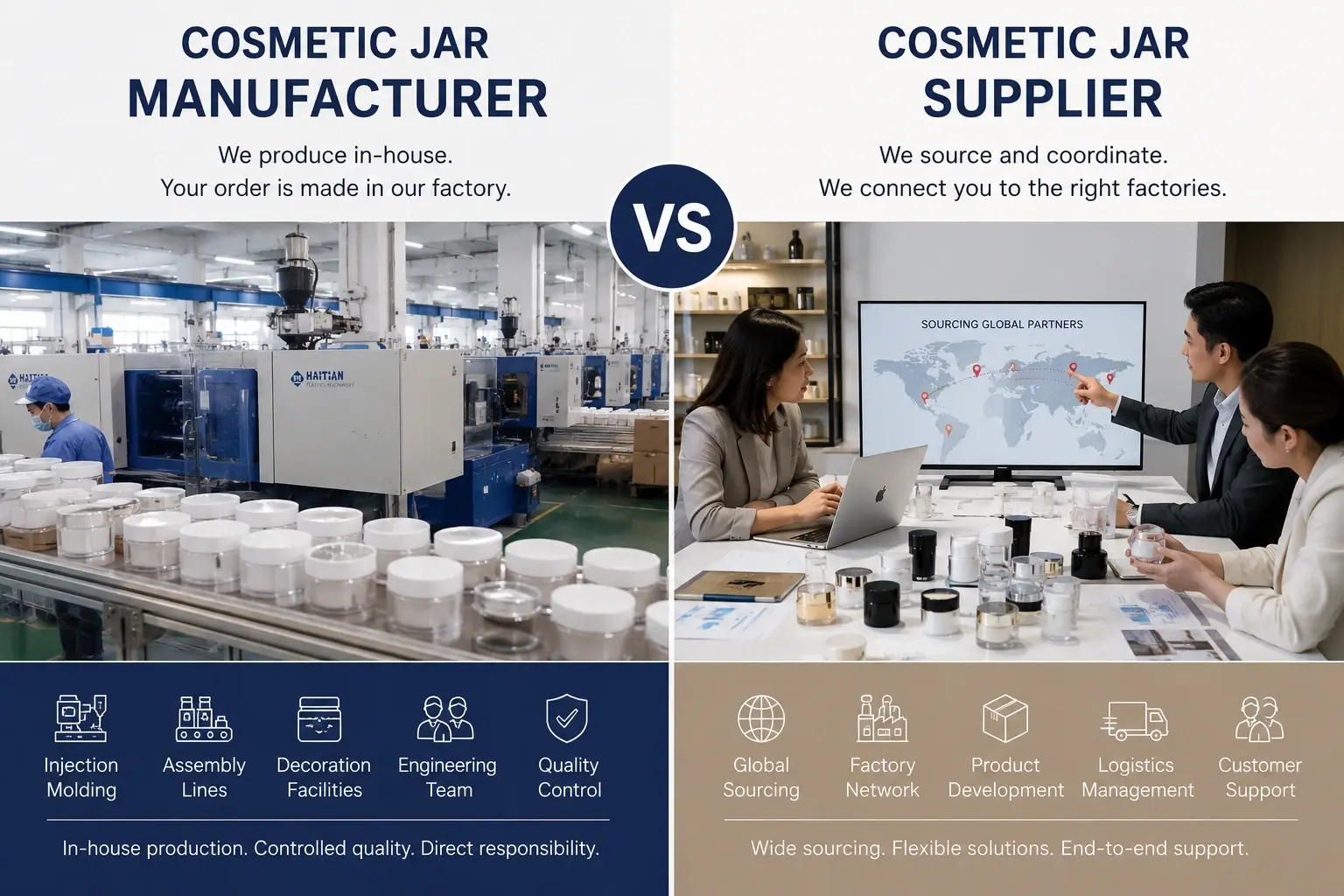
A cosmetic jar manufacturer is a company that directly operates production equipment. They have injection molding machines, assembly lines, decoration facilities, and engineering staff. When you place a custom order, it is being produced in their building, under their quality systems, by their people.
A cosmetic jar supplier is a broader term. A supplier might be a manufacturer — many are — but the word also describes trading companies that coordinate production through partner factories, source inventory from multiple origins, and serve as the commercial and logistical bridge between you and the actual production process.
Neither is inherently better. But they are genuinely different. And if you don’t understand which one you’re talking to, you can’t accurately evaluate their claims, their pricing, their MOQs, or their ability to solve problems when things go sideways.
2. What Makes a True Manufacturer Different
Walk into any legitimate cosmetic jar manufacturer’s facility and you’ll see things that trading companies simply cannot fake: banks of injection molding machines, tooling rooms with CNC milling equipment, walls of sample molds, assembly stations, and QC labs with instruments calibrated to specific tolerances.
But you’re not usually walking into facilities. You’re evaluating from your laptop, through email threads and WeChat messages. So how do you actually tell the difference?
They speak the language of production, not just products.
A real manufacturer can tell you — without hesitation — the difference between PMMA and AS resin for a clear jar. They can explain why a 0.8mm wall thickness is too thin for drop testing, what gate placement does to visible flow lines, and how anodized aluminum inserts behave differently than electroplated zinc alloy in humid climates. These aren’t questions they look up. They’re questions their engineers live with every day.
Trading companies, by contrast, tend to speak fluently about product availability, lead times, and shipping terms — and go quiet when the conversation gets technical. That’s not a moral failure. It’s a structural one. They’re not designed to answer those questions.
They control the timeline, start to finish.
When a manufacturer tells you a mold will be ready in 18 days, that’s their tooling team’s schedule. When a supplier tells you the same thing, that’s a projection they’ve received from a factory they may or may not have significant leverage over. The difference in reliability is enormous, especially if you’re planning a launch date around that timeline.
Sampling is where you find out fast.
Ask for a custom structural sample — not a stock item, but something with a slight modification to the diameter, the thread size, or the cap mechanism. A manufacturer will route this request to their engineering team and come back with specific questions: Which dimension takes priority? What’s the lid torque target? Do you want a living hinge or snap fit?
A trading company will typically go silent, then return 48 hours later having relayed your message to a factory. The response will be less specific. Sometimes it will be a stock item that’s “close” to what you asked for.
3. The Supplier Advantage: Why Experienced Trading Companies Aren’t the Enemy
Here’s what the sourcing guides often get wrong: they treat “trading company” like a dirty word.
It isn’t.
For a brand launching its first product — or even its third — working with an experienced cosmetic packaging supplier can be significantly smarter than trying to navigate factory relationships directly. Let me explain why.
Suppliers compress complexity.
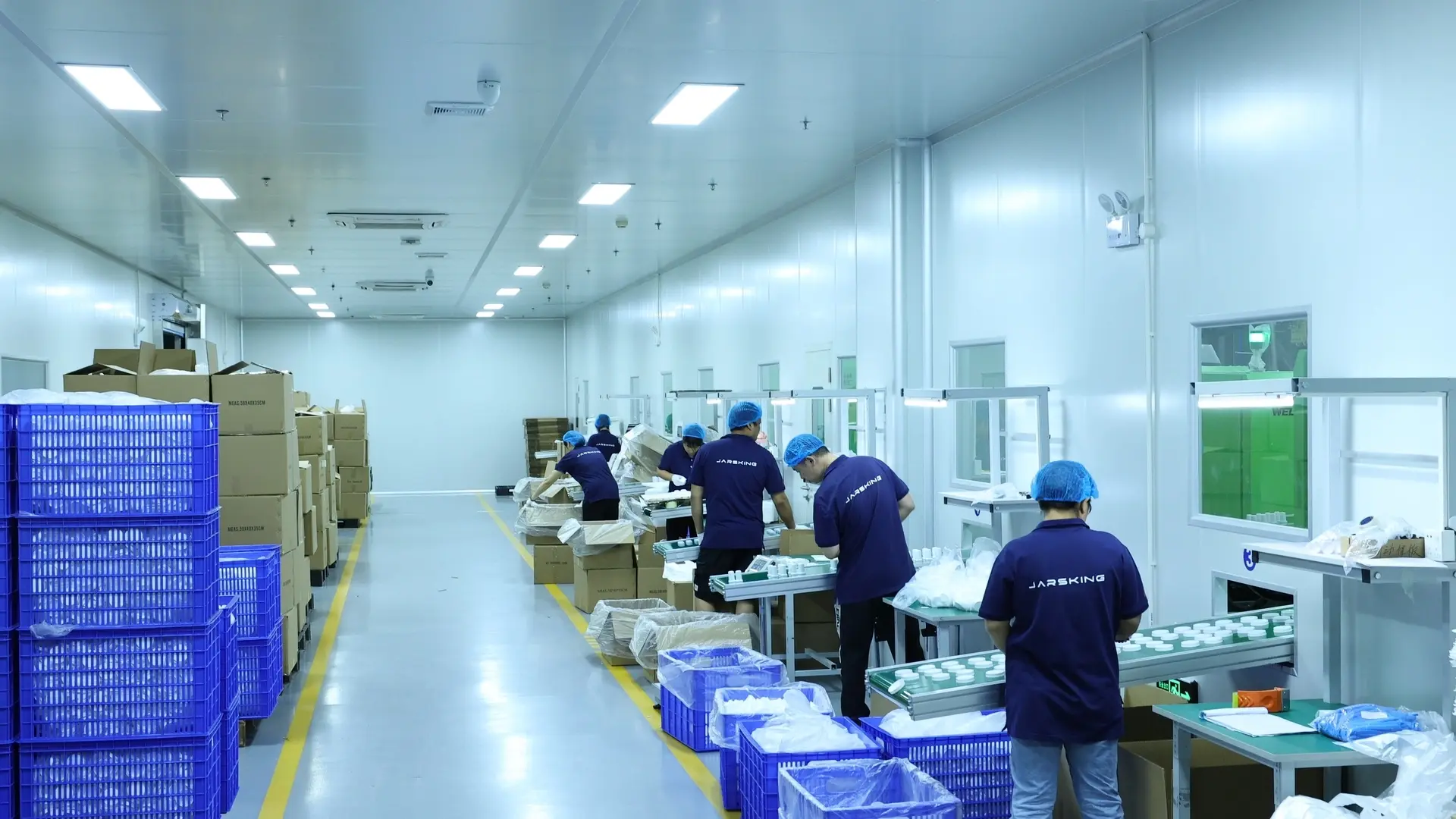
Imagine your skincare line needs four packaging components: a glass serum bottle, a PETG moisturizer jar, an aluminum lip balm tube, and a kraft-board outer box. Finding four separate manufacturers, vetting each one, managing four production timelines, coordinating four separate QC processes, and consolidating four shipments — that’s a full-time job. An experienced supplier does all of that for you, sourcing each component from their established factory network and delivering it in one consolidated shipment.
For a brand doing under $500,000 in revenue, paying a small service premium for that consolidation often makes far more financial sense than the cost of the time and mistakes involved in managing four factory relationships directly.
Suppliers often unlock lower effective MOQs.
Custom production requires minimum runs because factories need to set up molds, calibrate machines, and prepare materials — and they don’t want to do all that work for 300 units. But suppliers often aggregate orders across multiple clients or tap into factory overstock, which means they can offer quantities that a factory wouldn’t entertain directly. For a new brand testing the market with a 500-unit launch run, this flexibility can be the difference between launching and waiting another year.
Communication is genuinely better — and that matters more than you think.
Packaging development involves dozens of micro-decisions: artwork approvals, color corrections, cap torque adjustments, print placement, sample revision rounds. Every one of those touchpoints requires clear, responsive communication. Many of the most technically capable Chinese factories have limited English-speaking staff, not because they’re unprofessional, but because their business has historically been domestic or conducted through intermediaries.
An experienced supplier has built their entire operation around bridging that gap. They know how to translate your brand language into factory-floor instructions. That’s not a small thing.
4. The Compatibility Problem That Quietly Destroys Launches
Before we go any further into the supplier-versus-manufacturer debate, there’s a more fundamental issue that derails more beauty brands than either of those decisions.
Your formula may be incompatible with your jar.
This sounds obvious. It isn’t. Certain ingredients — high-concentration essential oils, AHAs, retinol derivatives, ethanol-based serums, vitamin C formulations — interact with packaging materials in ways that aren’t immediately visible. A jar that looks perfect on day one may show micro-crazing in the plastic after 60 days of product contact. A lid seal that appears tight may slowly degrade when exposed to citrus-based actives. A beautiful matte-white coating may begin to lift when in contact with an oil-heavy formula.
The #1 mistake new brands make with cosmetic packaging is selecting containers based on aesthetics rather than testing for actual protection and formula compatibility. It doesn’t matter whether you sourced from a manufacturer or a supplier — if you haven’t run compatibility testing, you’re launching on assumption.
The right protocol is simple: fill your samples with the actual formula at your production concentration. Seal them. Store half at room temperature, half at 40°C. Turn them upside down. Shake them. Examine them at 30, 60, and 90 days. Only then do you have real data. It’s tedious. It’s worth it.
5. A Direct Comparison: What Each Partner Actually Offers
| What You’re Evaluating | Manufacturer | Supplier / Trading Company |
|---|---|---|
| Production control | Direct, in-house | Outsourced to partner factory |
| Custom mold development | Yes — in-house tooling team | Via third-party factory (slower) |
| MOQ flexibility | Higher — often 1,000–5,000+ units | Lower — sometimes 200–500 units |
| Unit pricing at volume | Lower — fewer middlemen | Slightly higher — service margin included |
| Communication responsiveness | Varies — technically strong, commercially slower | Generally faster, more customer-service-oriented |
| Quality oversight | Direct control, in-line inspection | Dependent on factory management |
| Product range | Narrow — specialized by category | Broad — can source across categories |
| Best for | Established brands, custom OEM, scale | Startups, mixed sourcing, lower risk entry |
The honest summary: manufacturers give you depth, suppliers give you breadth. Which one you need depends entirely on where you are in your brand’s journey.
6. Pricing: What “Factory Direct” Actually Means in Practice
There’s a phrase you’ll see everywhere in cosmetic packaging sourcing: factory direct pricing. It implies that working with a manufacturer will always be cheaper than working through a supplier.
Sometimes that’s true. Sometimes it isn’t.
Direct manufacturer pricing is genuinely lower on a per-unit basis — at scale. If you’re ordering 5,000 units of a single custom jar style, going directly to the factory that produces it eliminates the trading company margin. The savings can be meaningful, especially across a year’s worth of orders.
But factory pricing often comes with hidden costs that new brands don’t account for. Mold development fees can range from $1,500 to $8,000 USD depending on the complexity of the design. Sample rounds may each cost $200–$400. Technical revisions extend the timeline by weeks. And if you’re managing four separate factory relationships instead of one consolidated supplier, your internal time cost rises fast.
Beauty brands facing rising packaging costs in 2026 — driven by raw material prices, energy costs, and new sustainability compliance requirements — need to think about total sourcing cost, not just unit price. A supplier who charges a 10% service premium but saves you two months of production delays, three rounds of miscommunication, and a failed launch is delivering better value than the cheapest factory quote.
7. How China Fits Into This Picture in 2026
China remains the undisputed center of global cosmetic packaging manufacturing. The combination of deep supply chains, specialized industrial clusters, competitive labor, and decades of accumulated technical knowledge creates an ecosystem that no other country has yet matched at scale.
In regions like Zhejiang, Guangdong, and Shanghai, there are hundreds of cosmetic jar manufacturers with real factories, genuine engineering capability, and growing international experience. Companies like Othilapak have built integrated manufacturing and supply operations that serve major global beauty brands. Newer players are investing in sustainable material lines, airless systems, and premium decoration techniques that would have been considered luxury-tier just five years ago.
At the same time, the reality is that quality varies enormously. The same sourcing platform page that lists a legitimate, ISO-certified factory will also list a trading company with three employees and a catalog of stock photos they sourced from other manufacturers’ websites. The vetting process is your responsibility.
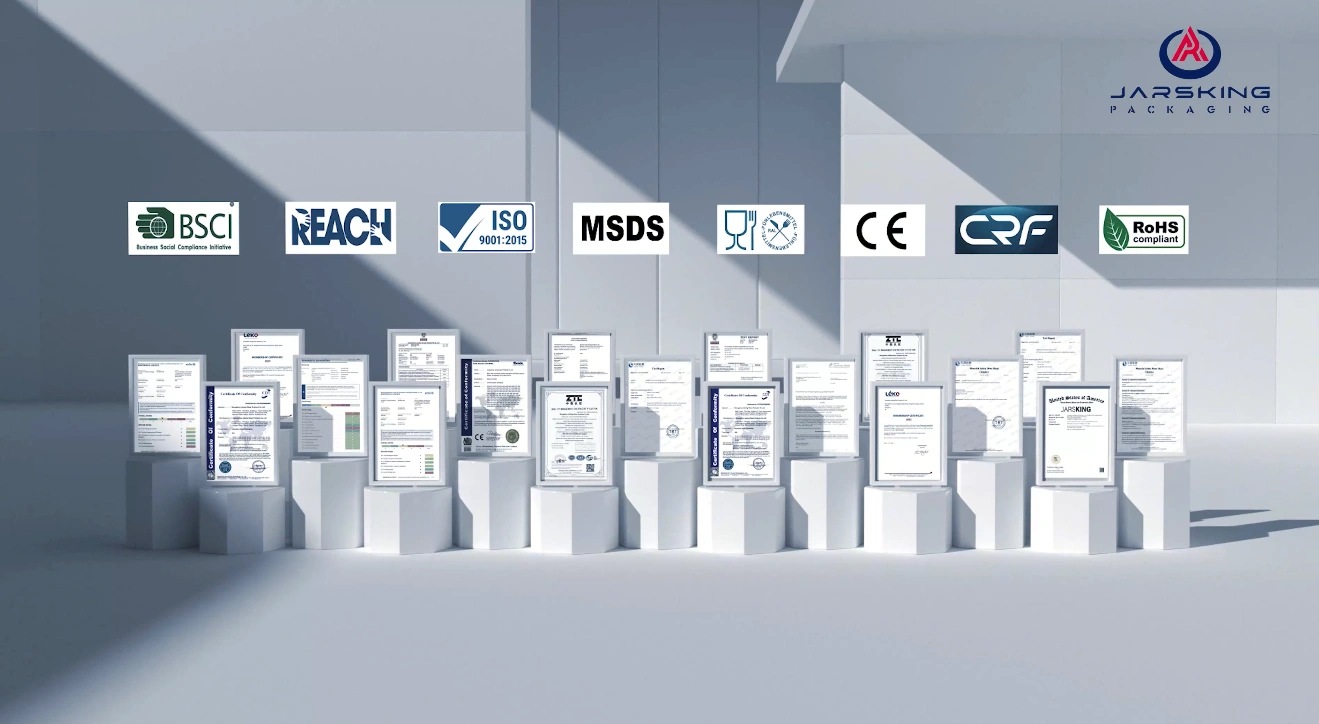
When evaluating any Chinese partner — manufacturer or supplier — look for:
BSCI, ISO 9001, or equivalent certifications that have been verified, not just claimed
Export experience with brands in your specific market (EU, US, and Australian markets have different compliance requirements)
Documented sampling processes with defined revision rounds and technical sign-offs
Material composition documentation — especially important if you’re selling in the EU, where ingredient contact regulations have tightened significantly
8. When to Choose Each — An Honest Framework
If you’re still unsure which type of partner is right for your brand right now, here’s a practical way to think about it.
Go with a supplier if:
You’re launching your first or second product. Your order quantities are under 2,000 units per SKU. You need multiple packaging components sourced together. You don’t have in-house experience managing international factory relationships. Speed to market matters more than maximizing unit cost efficiency.
Go directly to a manufacturer if:
Your brand has a clear, stable product line with proven market demand. You’re ordering 3,000+ units per SKU. Custom packaging is a core part of your brand differentiation strategy — you need shapes, finishes, or structures that stock packaging can’t provide. You have the internal capacity (or a dedicated sourcing agent) to manage factory-level communication. You’re planning for long-term OEM cooperation, not one-off orders.
There’s no shame in starting with a supplier. Some of the best-positioned indie beauty brands in the world built their packaging infrastructure by working with experienced trading companies during their early years, then gradually transitioned to direct factory relationships as volume and confidence grew. That’s not a compromise. That’s smart sequencing.
9. The Question Nobody Asks Before It’s Too Late
Here’s the thing about packaging sourcing: most of the decisions that cause real problems were made during the first conversation, before anyone had enough context to ask the right questions.
Before you send your next packaging inquiry — whether to a manufacturer or a supplier — consider asking these:
Do you own the molds for this product, or will I need to develop new tooling? A factory with proprietary molds can move fast. If molds need to be made, that’s time and cost you need to plan for.
What is your quality inspection process, and at what production stage does it happen? The difference between in-line inspection during production and final inspection before shipment is significant. Problems caught at production stage are fixable. Problems caught at the loading dock are often not.
Can I receive a filled compatibility sample — not just an empty jar? This seems obvious. It is almost never asked.
What happens if the production batch doesn’t match the approved sample? A manufacturer will have an internal corrective action process. A supplier should be able to articulate their factory partner’s protocol. If either can’t answer this clearly, that’s meaningful information.
10. Your Packaging Is a Promise
The most important thing I can tell you about cosmetic jar sourcing is this: your packaging is not a commodity decision. It’s a brand decision.
When a customer picks up your moisturizer from a shelf — or lifts it out of a shipping box — the weight of the jar, the smoothness of the lid, the softness of the texture, the way the label sits flush or doesn’t, the sound the cap makes when it closes: all of it communicates something about whether you can be trusted. Before they’ve read a single ingredient. Before they’ve applied a single drop.
That first physical impression is built in a factory, by people using tools you’ll likely never see. Your job is to find the right partner — whether that’s a manufacturer who gives you direct production access and full customization capability, or a supplier who gives you flexibility, consolidated sourcing, and reliable communication — and then invest in that relationship before you need it, not after something goes wrong.
Because the beauty brands that get packaging right aren’t the ones who found the cheapest price on a sourcing platform.
They’re the ones who asked better questions, tested before they committed, and chose partners who understood that what they were producing wasn’t just a container.
It was the opening line of a conversation with every customer who would ever hold it.
Looking to develop custom cosmetic jars for your skincare brand? Start by requesting samples with your actual formula, and always confirm whether your partner owns the production equipment — or the relationship to someone who does.
FAQs
What is the difference between a cosmetic jar supplier and a manufacturer?
A cosmetic jar manufacturer directly produces packaging in its own factory — operating injection molding machines, assembly lines, and decoration equipment under one roof. A supplier is a broader term: some suppliers are manufacturers themselves, but many are trading companies that source jars from multiple factories and handle logistics, communication, and export coordination on your behalf. The key difference is who actually makes the product.
How do I know if a company is a real cosmetic jar manufacturer or just a trading company?
Ask technical questions. A real manufacturer can speak in detail about mold structures, material tolerances, wall thickness, gate placement, and decoration limitations — without hesitation. Trading companies tend to excel at customer service and pricing discussions but go quiet when conversations get deeply technical. You can also request a factory video walkthrough, ask for production certifications like ISO 9001 or BSCI, or request a third-party factory audit before placing a large order.
Can I get custom cosmetic jars through a supplier, or do I need to go directly to a factory?
You can get custom cosmetic jars through a supplier — many experienced trading companies have established relationships with factories that offer OEM and ODM services. However, the level of customization and the speed of technical problem-solving will generally be better when working directly with the manufacturer. For minor customization (color changes, logo printing, label design), a good supplier is often sufficient. For unique shapes, proprietary mold development, or exclusive structural designs, going directly to a factory gives you stronger control.
What questions should I ask before placing a cosmetic jar order?
Before committing to any order, ask: Do you own the production molds, or will new tooling need to be developed? What is your quality inspection process and when does it happen during production? Can I receive a filled compatibility sample with my actual formula? What is your corrective action process if the production batch doesn’t match the approved sample? What are your lead times for sampling, production, decoration, and shipping separately? The answers reveal far more about a company’s real capability than any product catalog or website.
How do I test if my skincare formula is compatible with a cosmetic jar?
Fill sample jars with your actual formula at your full production concentration. Seal them and store half at room temperature and half at 40°C. Turn them upside down and shake them periodically. Inspect the jars, lids, seals, and formula appearance at 30, 60, and 90 days. Look for any warping, discoloration, lifting of coatings, leaking, or changes in the formula’s color, smell, or texture. This compatibility testing is essential for products containing essential oils, AHAs, vitamin C, retinoids, or alcohol-based ingredients.
Is sourcing cosmetic jars from China still a good option in 2026?
Yes — China remains the world’s leading cosmetic packaging manufacturing hub, offering deep supply chains, advanced decoration capabilities, competitive pricing, and strong OEM expertise that few other countries can match at scale. That said, quality varies significantly between factories and suppliers, and rising raw material costs and sustainability compliance requirements have made vetting more important than ever. The brands that get the best results from Chinese sourcing are those who invest time in finding and verifying the right partner, rather than defaulting to whoever quotes lowest on a platform listing.