

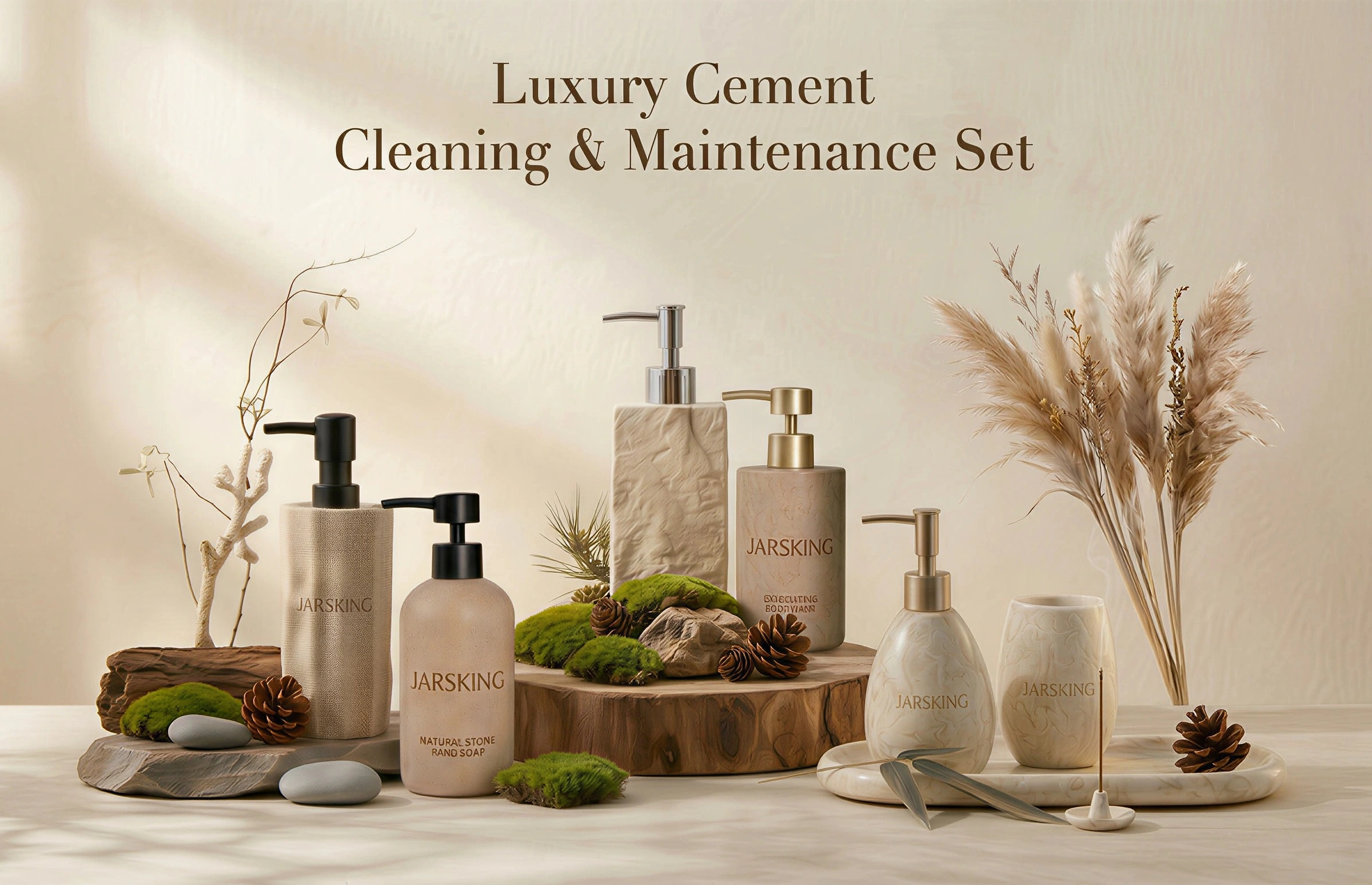

There’s a reason a hotel bathroom feels different from a home one, even when the fixtures are almost identical. It’s not the tile, and it’s usually not the lighting. It’s the small stuff sitting on the counter — the weight of the soap dispenser, the cool feel of the toothbrush cup, the way everything on the tray looks like it was quarried from the same slab of stone. That’s not accidental. It’s a deliberate design category, and it’s one of the fastest-growing segments in bathroom packaging today.
1. Why Stone-Inspired Bathroom Accessories Are Becoming a Global Trend
Bathrooms stopped being purely utilitarian spaces years ago, and 2026 has pushed that shift even further. According to the National Kitchen & Bath Association’s 2026 Bath Trends Report, 77 percent of design professionals say homeowners now actively want hotel and resort-inspired aesthetics in their own homes. That’s not a small preference shift — it’s a near-consensus among the people who design bathrooms for a living.
Design coverage of 2026 backs this up from multiple angles. Bathroom trends this year are defined by a resurgence of untreated natural finishes, including stone, alongside handmade and textured surfaces that reject the cold, clinical look bathrooms had for the past two decades. Warm neutrals now dominate color choices, with off-white leading at 58 percent among designers, followed closely by light brown and tan tones at 54 percent. This palette shift matters enormously for accessories, because a stone-look soap dispenser only reads as “luxury” if its color temperature matches the warmer, earthier direction the whole room has moved toward.
Soap dispensers, toothbrush holders, soap dishes, tumblers, and matching trays finished in terrazzo, marble, sandstone, or concrete textures have quietly graduated from novelty gift-shop items into essential decorative elements. Unlike plastic accessories, which compete almost entirely on price, these premium collections compete on a different set of attributes entirely:
Sophisticated, gallery-worthy appearance that photographs well
A tactile, weighted feel that signals quality the moment someone picks it up
Long-term durability that outperforms thin injection-molded plastic
Seamless compatibility with contemporary interior schemes
Sustainable material options that reduce single-use plastic waste
For brands, this represents a genuine repositioning opportunity — a chance to move out of the crowded, margin-thin plastic accessory market and into higher-value retail and hospitality channels where perceived quality justifies real price premiums.
2. Why Consumers Actually Prefer These Collections
Two forces drive this purchase decision: pure function and lifestyle expression. A coordinated stone-look set solves a problem that mismatched accessories create constantly — visual chaos on a small counter surface. Instead of buying a soap dispenser here, a toothbrush cup there, and a random soap dish from a different aisle entirely, today’s buyer wants the complete ensemble:
Soap dispenser
Toothbrush holder
Tumbler
Soap dish
Tray
Storage container
Assembled together, these pieces create a hotel-inspired appearance while genuinely improving bathroom organization — everything has a place, and everything visually belongs together. The earthy neutral palettes common to stone-look collections (sand, ivory, beige, stone grey, cream, taupe) also blend effortlessly across a wide range of interior styles, including Scandinavian, Japandi, Minimalist, Modern Luxury, and Organic Contemporary aesthetics, all of which remain dominant design languages heading into 2027.
Bathrooms are also increasingly framed by designers as personal sanctuaries rather than functional rooms — spaces meant for restoration, not just cleaning. That reframing changes what people are willing to spend on. A soap dispenser isn’t just dispensing soap anymore; it’s part of a daily ritual, and rituals justify better materials.
3. Materials Used in Premium Bathroom Accessories
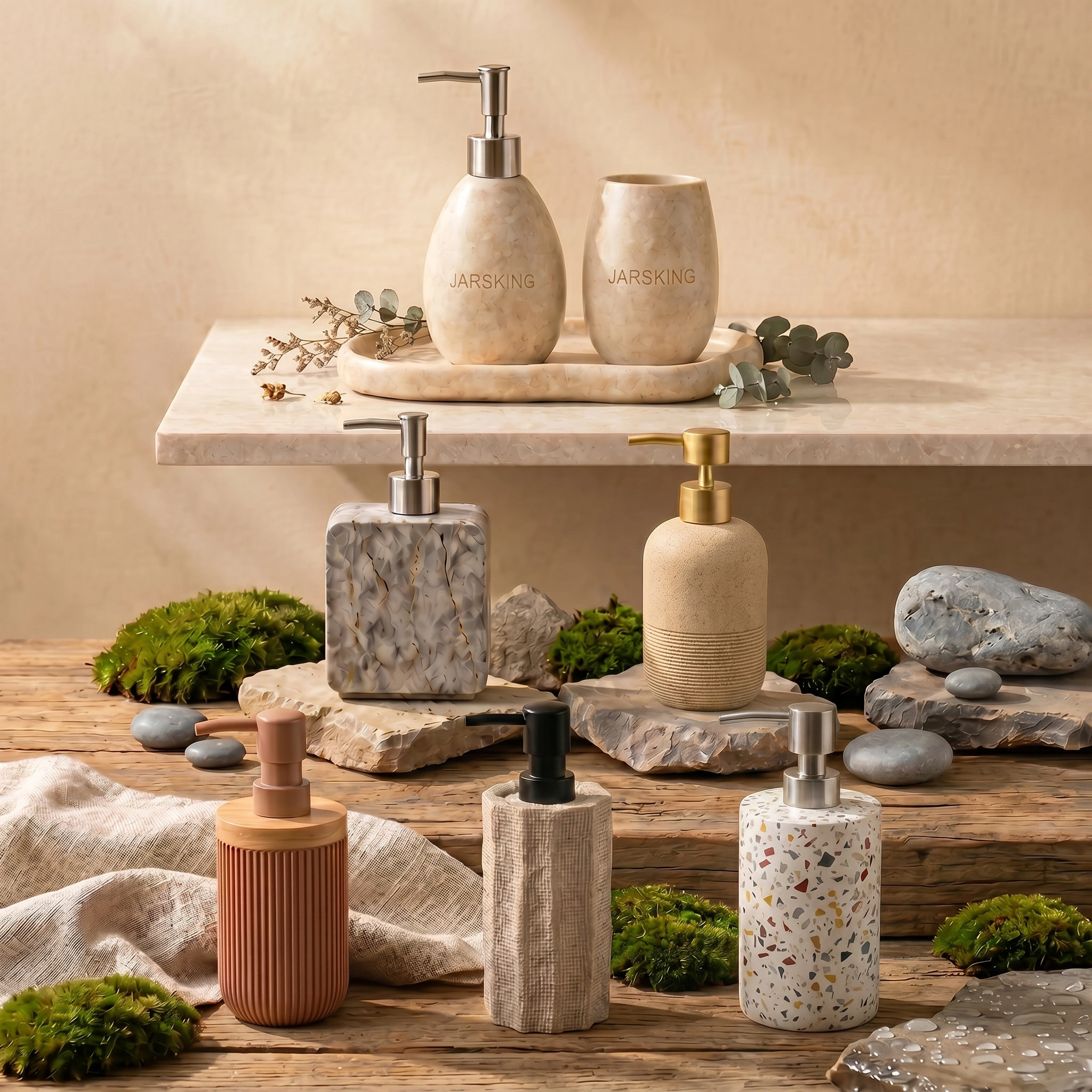
Here’s a detail most marketing copy glosses over: the vast majority of these “stone” products aren’t stone at all. They’re engineered composites built to replicate stone’s visual and tactile qualities while solving the problems real stone creates — excessive weight, fragility during shipping, high cost, and inconsistent color from batch to batch.
Polyresin
Polyresin has become the workhorse material for premium bathroom accessories, and the reasons are almost entirely practical. It molds with exceptional precision, reproduces fine surface detail down to subtle veining, and resists water without absorbing moisture the way porous ceramic does. Its advantages include:
Excellent molding capability for complex, sculptural shapes
A heavy, premium feel that reads as quality in the hand
Strong water resistance suited to constant humidity exposure
High-fidelity detail reproduction for marble and terrazzo effects
Compatibility with matte, satin, and gloss finishes
Compared to ceramic, polyresin survives shipping and daily impact considerably better while still delivering the weighted, substantial feel consumers associate with genuine stone. This durability advantage is a big part of why hospitality buyers, who deal with breakage rates across hundreds of rooms, have shifted so heavily toward resin-based collections.
Terrazzo Composite
Terrazzo’s comeback isn’t a passing aesthetic fad — it’s a material with genuine historical depth. It traces back to Renaissance-era Venice, where craftsmen embedded marble fragments into cement flooring as a more affordable alternative to full mosaic work. Modern terrazzo composite for bathroom accessories follows the same basic logic: recycled mineral particles or stone chips embedded within a resin base, producing a speckled pattern where no two pieces are ever perfectly identical.
Today’s terrazzo has moved beyond its traditionally porous cement base into more moisture-appropriate composite formulations specifically engineered for bathroom use. Flooring and surface designers now describe terrazzo as a refined material choice for modern residential interiors rather than a nostalgic mid-century reference. Applied to bathroom accessories, that same design credibility transfers directly — a terrazzo soap dispenser reads as intentional and current, not retro or kitschy.
Cement Effect Composite
Concrete-inspired accessories chase an industrial-luxury look without the practical headaches of real poured concrete, which is heavy, porous, and prone to cracking around pump mechanisms under repeated torque. Manufacturers instead formulate lightweight cement-effect composites that reproduce concrete’s matte, slightly rough texture while holding up reliably to daily pump use.
These finishes pair particularly well with black metal fixtures and warm wood furniture — a combination that has become something of a signature look for what designers are now calling organic modern or “quiet luxury” bathrooms. The appeal is partly about texture and partly about restraint; a cement-effect dispenser doesn’t shout for attention the way a glossy, ornate design might.
Artificial Marble
Artificial marble blends stone powder with resin binders, achieving marble’s classic elegance while gaining something real marble can’t offer: manufacturing consistency. Natural marble varies dramatically from slab to slab, which is a problem when a customer orders a coordinated six-piece set and expects every piece to visually match. Artificial marble solves this by letting manufacturers guarantee identical veining patterns across an entire production run.
Its advantages include:
Consistent color across large production batches
Lower material waste compared to quarrying and cutting natural stone
A genuinely luxury appearance at a fraction of natural marble’s cost
Better impact resistance than brittle natural stone
Easier mass production for retail-scale demand
4. Popular Surface Finishes
Surface finish quietly does more work than most buyers realize — it’s frequently the single biggest factor in how expensive a product feels before anyone reads the price tag.
| Finish | Visual Character | Tactile Feel | Best Suited For |
| Matte | Understated, glare-free | Soft, resists fingerprints | Minimalist and Japandi bathrooms |
| Sandstone texture | Natural, subtly rough | Carved-stone tactility | Organic contemporary interiors |
| Terrazzo | Playful, speckled, unique per unit | Smooth with visible texture variation | Eclectic or expressive styling |
| Marble effect | Classic white with subtle veining | Cool, smooth, high-gloss | Timeless, formal luxury bathrooms |
| Ribbed texture | Vertical or horizontal grooves | Improved grip, added visual depth | Contemporary or industrial-leaning spaces |
5. Product Categories in Stone Bathroom Collections
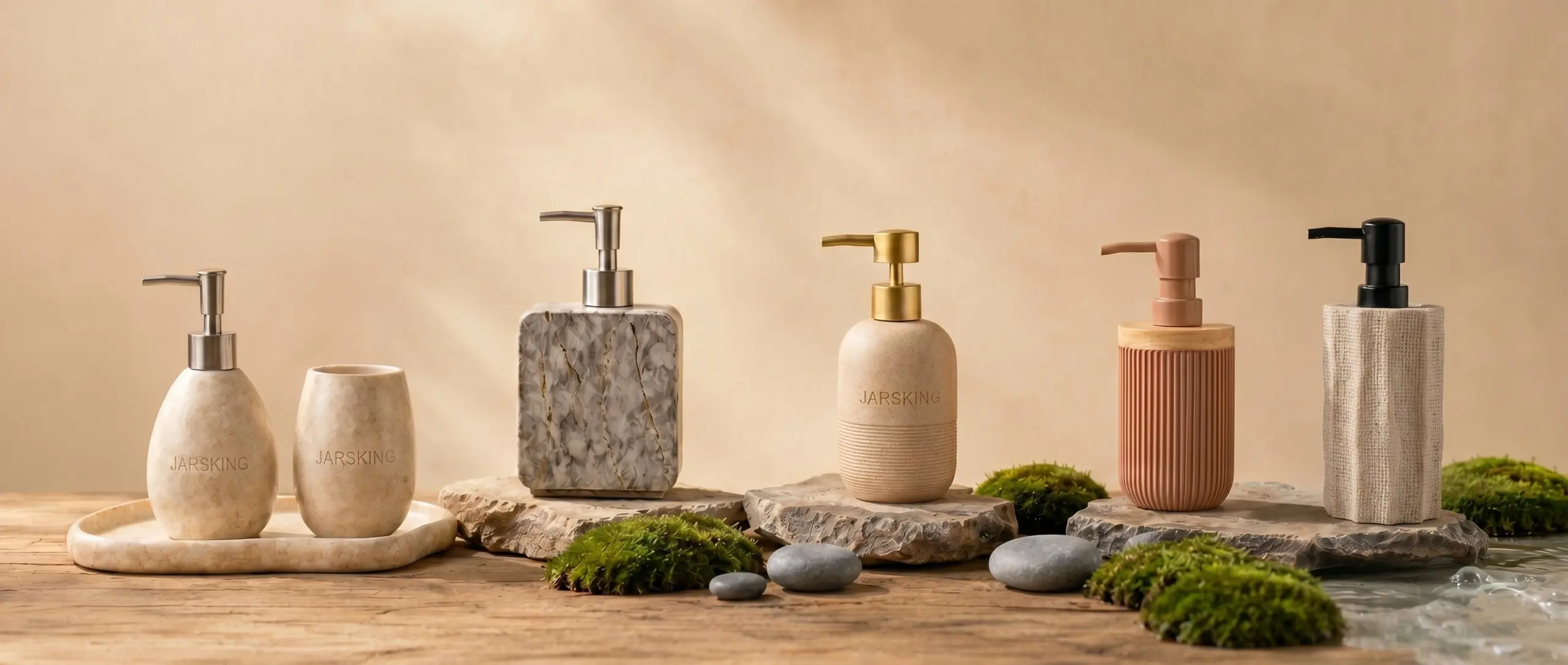
Soap Dispenser
The soap dispenser is almost always the centerpiece of the collection, and for good reason — it’s the object people physically interact with multiple times daily, so pump reliability matters just as much as bottle aesthetics. Premium designs typically feature stainless steel, brass, matte black, or gold pumps, refillable bottle bodies, and leak-resistant mechanisms, with capacities generally ranging from 250 ml to 500 ml. A dispenser that looks stunning but jams after two months of use will sink a brand’s reputation faster than almost any other product in the line.
Toothbrush Holder
Available in single, double, or family-size configurations, toothbrush holders increasingly include drainage openings — a small but meaningful hygiene upgrade that prevents standing water from pooling and breeding mildew, a persistent complaint with older solid-bottom designs.
Tumbler
The bathroom tumbler has become quietly multi-purpose, serving as a rinsing cup, makeup brush holder, razor stand, or general cosmetic organizer depending on the household. That flexibility is a large part of why it’s included in nearly every coordinated set, regardless of the primary use case a brand markets around.
Soap Dish
Bar soap never actually disappeared despite the rise of liquid dispensers, and its dish has evolved considerably alongside modern material science. Contemporary designs feature drainage grooves, elevated platforms, and removable inner trays that let water escape rather than pool beneath the bar — directly addressing the soggy, disintegrating soap problem that plagued flat ceramic dishes for decades.
Bathroom Tray
The tray functions as the quiet unifier of the entire collection. It holds the dispenser, toothbrush cup, perfume, candles, essential oils, and skincare products together as one cohesive visual grouping rather than a scatter of unrelated objects — often the exact difference between a counter that looks intentionally styled and one that simply looks cluttered.
6. Design Trends Influencing Modern Bathroom Accessories
Several distinct forces are shaping where this category heads next.
Minimalism continues to dominate, with clean cylindrical and rounded silhouettes consistently outselling heavily ornamented designs. Earth-tone palettes — sand, ivory, beige, stone grey, cream, taupe, olive, warm white — reinforce the calming, spa-like atmosphere buyers actively seek out, a shift confirmed by the 2026 trend data showing warm neutrals overtaking the cold-white bathrooms that dominated the previous decade. Natural textures, whether wood, stone, linen, or terrazzo, create a tactile richness that plastic simply cannot replicate convincingly, no matter how sophisticated the mold.
Metallic accents, particularly brushed brass and stainless steel pump heads, add just enough shine to elevate a matte stone body without tipping into gaudy territory. Warmer metals are specifically displacing cool chrome finishes as bathroom design moves toward a more inviting, less clinical feel overall. Gold finishes pair especially well with beige and sandstone bases, echoing the warm-metal shift happening across faucets and fixtures more broadly.
There’s also a broader material trend worth noting: 2026 design coverage increasingly emphasizes “drenching” a room in a single cohesive material family rather than mixing too many textures. That principle translates directly to accessories — a bathroom finished in warm stone tones benefits far more from a matching terrazzo or sandstone accessory set than from accessories chosen independently of the room’s material story.
7. Sustainability in Bathroom Accessory Design
Environmental credibility is no longer an optional marketing layer — it’s becoming a baseline expectation for any brand positioning itself as premium. Manufacturers across the personal care packaging space are investing in recycled mineral fillers, water-based coatings, recyclable outer packaging, refillable dispenser systems, and materials specifically engineered for a long product life rather than a short replacement cycle.
This matters more than it might initially seem. Consumers increasingly expect brands to substantiate sustainability claims with concrete specifics rather than vague, feel-good language — verified recycled content percentages, transparent material sourcing, and credible supply chain disclosure are becoming the real baseline for trust. A stone-look bathroom set built to last years rather than get discarded after a season fits neatly into that expectation without a brand needing to lean hard on “eco-friendly” language at all. The durability itself becomes the sustainability argument.
8. Why Hotels and Luxury Apartments Choose Stone Bathroom Sets
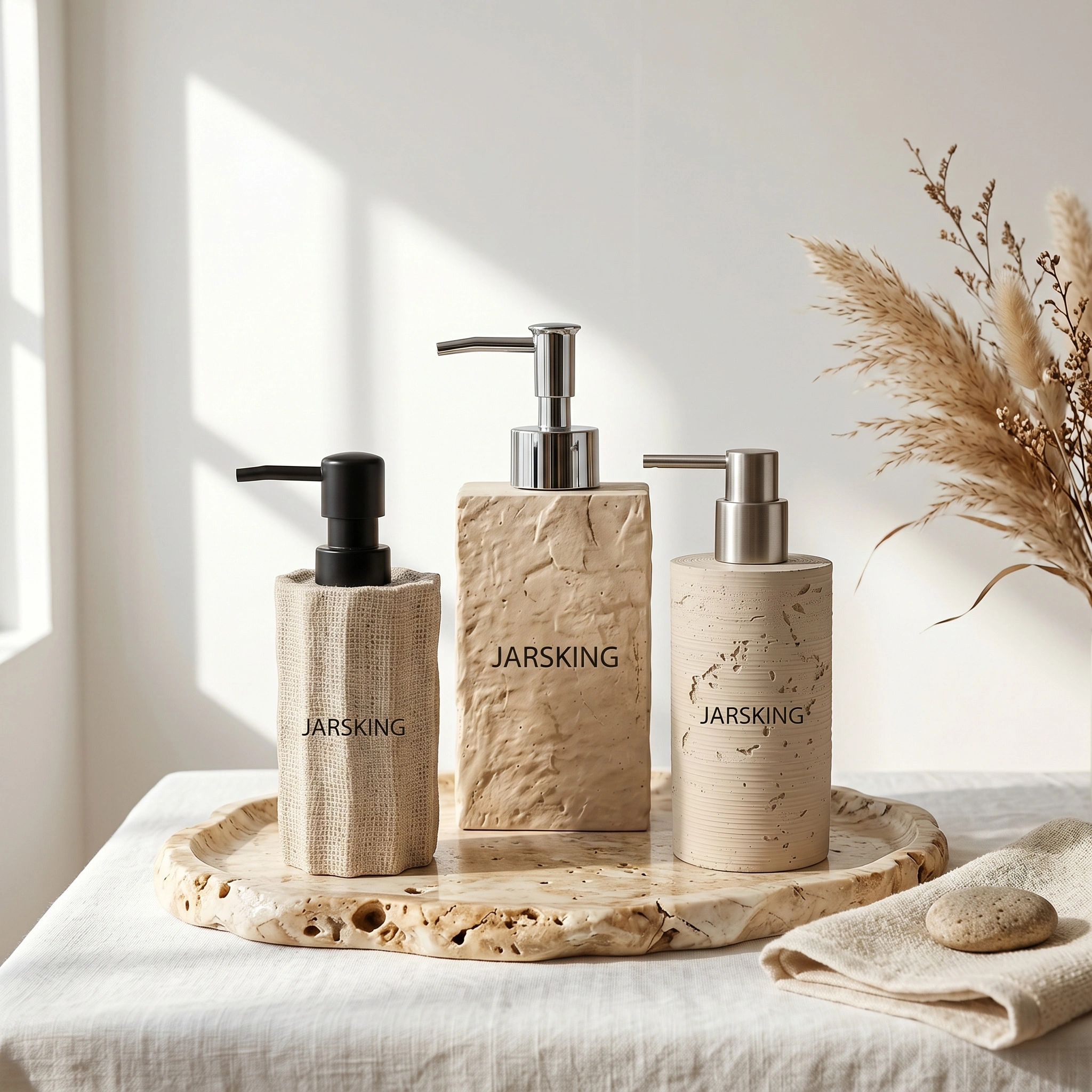
Hospitality buyers face particularly demanding requirements — products need to photograph beautifully for marketing while surviving daily wear across hundreds of guest rooms. Stone-look accessories satisfy both requirements simultaneously:
High-end appearance that performs well in marketing photography
Better durability than ceramic, which chips and cracks under commercial-scale use
Lower long-term replacement costs despite higher upfront unit pricing
Easy cleaning thanks to sealed, non-porous surfaces
Coordinated design consistency across an entire property
Reliable quality across large bulk production orders
That combination explains why boutique hotels, luxury apartment developments, resorts, wellness spas, and premium short-term rental properties keep gravitating toward this category. Guests notice these details, often without consciously realizing why a bathroom feels more expensive than others they’ve stayed in — and that subconscious impression can genuinely influence repeat bookings.
9. Manufacturing Considerations
Sourcing well in this category requires understanding a handful of technical details that separate strong factories from mediocre ones.
Mold design determines whether wall thickness stays consistent across thousands of units — inconsistent molds create weak points and uneven weight distribution that customers notice immediately. Surface treatment with protective coatings improves stain resistance, moisture resistance, and long-term color stability, all critical in a room that experiences daily humidity exposure. Pump selection is frequently underestimated in importance; premium pumps are tested for thousands of dispensing cycles, and a cheap pump mechanism can undermine an otherwise beautifully designed bottle within just a few months of use. Quality inspection protocols should cover surface defects, color consistency, dimensional accuracy, pump functionality, leakage resistance, and packaging integrity before any unit ships to a customer.
10. Customization Options
Private label brands increasingly demand full customization rather than settling for stock catalog designs. Common customization requests include:
Logo printing via laser engraving, silk screen printing, pad printing, UV printing, or embossing
Pantone-referenced or sample-matched color control
Custom texture development for exclusive marble veining patterns, terrazzo chip combinations, or sand-effect surfaces
Pump finish selection across chrome, matte black, brushed gold, rose gold, gunmetal, or satin nickel
Packaging upgrades including gift boxes, kraft paper boxes, magnetic rigid boxes, and protective e-commerce packaging
11. Choosing the Right Manufacturer
Price alone shouldn’t be the deciding factor when sourcing this category. It’s worth evaluating manufacturers across a broader set of criteria:
Depth of experience specifically in resin and composite manufacturing
In-house mold development capability rather than reliance on third parties
Consistent, batch-to-batch color control across production runs
Surface finishing expertise across multiple texture types
Genuine flexibility on customization requests, not just token options
Reasonable minimum order quantities for smaller or emerging brands
Compliance with international quality standards
Proven export experience and logistics reliability
Packaging capability that matches the product’s intended market position
Stable, scalable production capacity for growing order volumes
A manufacturer that performs well across these dimensions dramatically shortens development timelines and protects a brand from the quality inconsistency that plagues cheaper, less experienced suppliers — inconsistency that, in this category especially, shows up immediately in mismatched colors or uneven textures across a “matched” set.
12. Future Trends in Luxury Bathroom Accessories
This category shows no signs of slowing — if anything, it’s becoming more technically ambitious. Expect continued movement toward bio-based composite materials replacing petroleum-derived resins, recycled terrazzo surfaces made from reclaimed stone waste, antimicrobial coatings for high-touch surfaces, smart refillable dispenser systems, modular storage that adapts to varied bathroom layouts, sustainable packaging solutions extending through the entire supply chain, integrated home fragrance accessories built into the same collection line, and increasingly personalized color programs tailored for private label partners.
Large-format material “drenching,” where a single stone-inspired material family covers walls, countertops, and accessories together, is also likely to intensify as a design principle heading into 2027. That trend rewards manufacturers who can offer coordinated accessory lines matched precisely to popular surface materials rather than generic stock finishes.
As wellness-focused living continues shaping how people design their homes, bathroom accessories are settling into a genuinely dual role — practical daily tools and legitimate lifestyle statements. Stone-look collections built from marble, terrazzo, sandstone, and concrete-effect materials now define what a modern, design-conscious bathroom actually looks like, balancing everyday durability with real visual sophistication.
For brands, retailers, hoteliers, and interior designers, this represents a genuine opportunity rather than a passing trend to chase. Consumer demand for coordinated, design-led living spaces isn’t fading, and manufacturers who combine smart material science with flexible customization and reliable production are the ones best positioned to capture the next several years of growth in this premium segment.
FAQs
Are these accessories waterproof and bathroom-safe?
Yes, quality composites are sealed with protective coatings that resist moisture, staining, and daily humidity exposure — a key reason they’ve replaced porous ceramic in many premium collections.
Do stone-look accessories cost more than plastic sets?
Generally yes, upfront, but they last longer, resist cracking and fading better, and reduce replacement costs over time — especially important for hotels ordering in bulk.
What soap dispenser pump types are typically used?
Common options include stainless steel, brass, matte black, and gold pumps, usually paired with refillable, leak-resistant bottles in 250 ml to 500 ml sizes.
Why do hotels prefer these sets over ceramic accessories?
Stone-look composites resist chipping and cracking better than ceramic, clean easily, and maintain consistent quality across large bulk orders — all critical for hospitality use.
What interior styles pair best with stone-look accessories?
Their neutral, earthy palettes work especially well with Scandinavian, Japandi, Minimalist, Modern Luxury, and Organic Contemporary bathroom designs.
What should buyers check before choosing a manufacturer?
Look for strong mold development capability, consistent color control, flexible customization, reasonable minimum order quantities, and proven export/quality inspection experience rather than choosing based on price alone.