

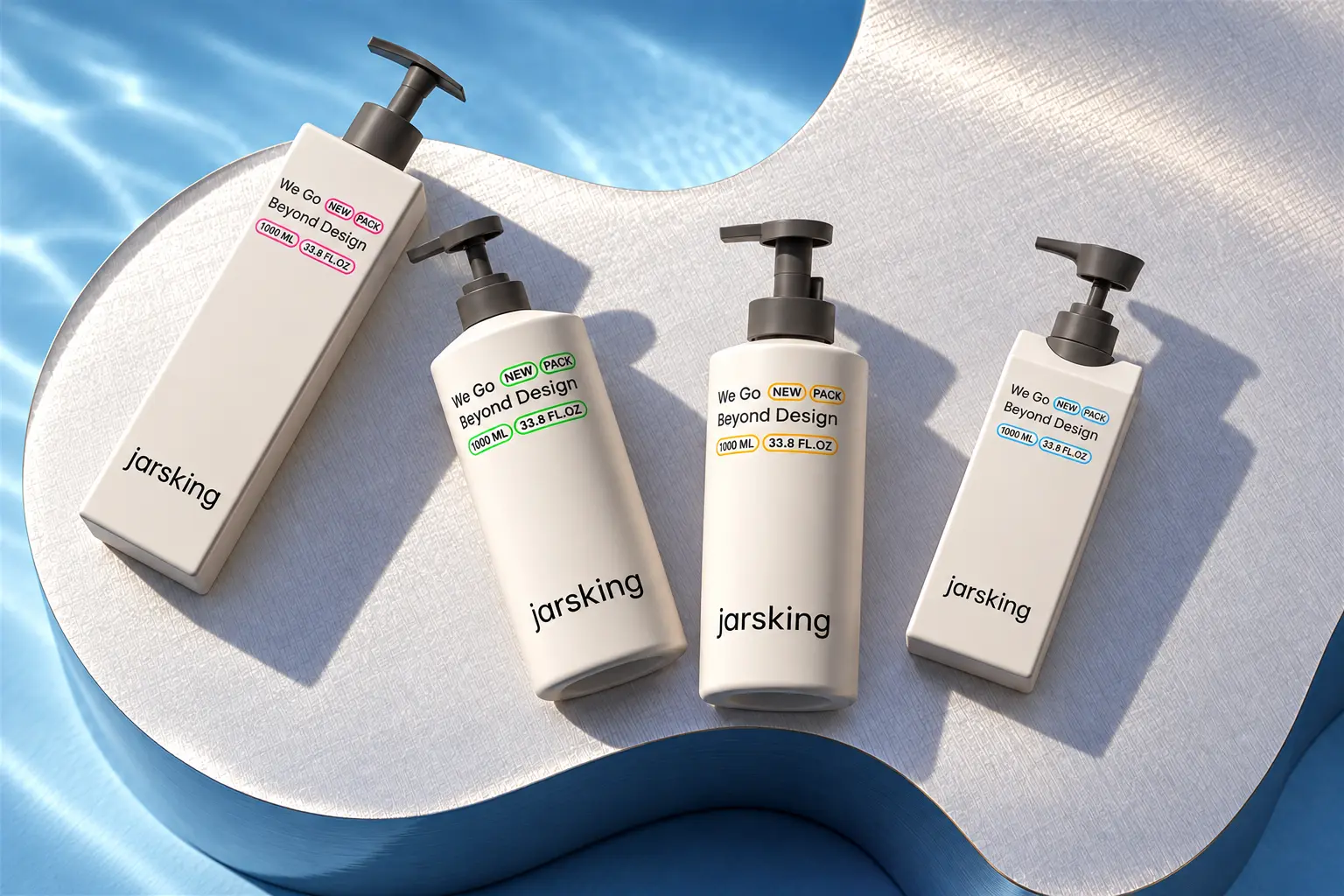

Cosmetic packaging costs are best reduced by reviewing the complete pack—not only the bottle resin.
A finished package may include the container, closure, pump or applicator, liner, decoration, assembly, tooling, quality checks, logistics, and inventory commitment. When a quotation changes, the right response is not automatically to use less material or select a lower-cost component. It is to identify which parts of the package protect the formula, support reliable use, and make the product recognisable to the customer.
The goal is not the lowest possible component price. The goal is a package that remains commercially viable without shifting cost or risk into product failure, rework, inventory, or a weaker customer experience.
1. Start With a Like-for-Like Cost Review
Before changing a package, confirm that the quotation comparison is genuinely equivalent.
Ask whether both quotations include the same:
- Bottle, jar, tube, closure, liner, pump, or applicator
- Material grade, colour, wall construction, and component source
- Decoration method, artwork setup, and assembly work
- Inspection standard and responsibility for testing
- Quantity, packaging configuration, Incoterm, and delivery scope
- Tooling, sampling, and change-control requirements
A lower price can be valid. It can also result from a different material, thinner construction, less decoration, a different closure, reduced inspection, or an excluded logistics cost.
The first question should therefore be: what changed in the specification—not simply what changed in the price?
2. Separate What Must Be Protected From What Can Be Simplified
Cost reduction is more effective when the team first agrees on the requirements that cannot be compromised.
For most beauty and personal-care packs, those requirements fall into three groups:
| Requirement | What it protects | Typical evidence needed |
| Product protection | Formula stability, sealing, compatibility, leakage control | Filled-pack review under agreed conditions |
| Reliable use | Dispensing, opening, closing, grip, evacuation, transport performance | Functional and handling assessment |
| Brand recognition | Shelf presence, recognisable shape, key colour or decoration | Design review against approved brand direction |
Everything else should be open to review.
For one brand, the essential element may be a distinctive bottle silhouette. For another, it may be a soft-touch finish, a heavy-wall glass base, or a precise dispensing experience. The point is to distinguish a feature that does real work from one that has remained in the specification simply because it was present in the first approved sample.
This gives procurement, design, product development, and operations a common basis for discussion.
3. Review the Cost Drivers of the Complete Package
A cosmetic package is a manufactured system. The container may use one material, the closure another, and the dispensing system several additional components. Decoration, assembly, tooling, and logistics can materially affect the landed cost even when the resin price is unchanged.
The practical cost levers are usually these:
| Cost lever | Potential opportunity | Main risk | What to verify |
| Material efficiency | Reduce unnecessary mass or simplify construction | Reduced rigidity, deformation, leakage, breakage | Filled-pack, transport, and handling performance |
| Material selection | Use a different resin, glass specification, or recycled-content option | Formula interaction, appearance variation, supply constraints | Formula compatibility, representative samples, material documentation |
| Closure or dispenser | Select a simpler cap, pump, liner, or assembly | Leakage, poor dispensing, customer frustration | Performance with the finished formula |
| Decoration | Reduce colours, processes, assembly steps, or complex finishes | Loss of recognition or decoration failure | Brand hierarchy, adhesion, abrasion, filling-line suitability |
| Tooling strategy | Use an existing platform before developing a custom mold | Reduced structural differentiation | Whether stock geometry can meet functional and brand requirements |
| Purchasing plan | Improve unit economics through an appropriate order plan | Excess inventory, obsolete artwork, specification changes | Forecast confidence, storage, release schedule, change control |
A cost review should not assume that every lever is suitable for every project. It should identify the one or two changes that offer meaningful value without compromising the approved product experience.
4. Lightweighting Is an Engineering Decision, Not a Uniform Thickness Reduction
Reducing material can lower resin consumption and sometimes reduce transport weight. It does not mean every wall can be made thinner by the same amount.
In blow-molded packaging, material distribution depends on the container geometry, mold design, process settings, and production route. A bottle must retain sufficient structure where it is gripped, capped, filled, stacked, transported, and used. A design that looks acceptable as an empty sample may behave differently once filled, stored, or exposed to normal distribution conditions.
Before approving a lighter version, confirm:
- Which areas of the pack carry structural load
- Whether the bottle remains stable during filling, capping, labeling, and case packing
- Whether the closure and neck finish continue to seal correctly
- Whether the filled pack performs in expected shipping orientations
- Whether the revised pack still delivers the intended consumer experience
For an overview of how blow-molding routes affect finished containers, see the University of Michigan’s blow-molding reference.
The best lightweighting project removes material that is not performing a necessary function. It does not simply transfer failure risk to the filling line, the warehouse, or the customer.
5. Do Not Change a Product-Contact System on Price Alone
A lower-cost bottle, pump, liner, gasket, or closure may be a viable option. It must still be evaluated as part of the finished package.
Material names such as PET, PP, PE, HDPE, or glass do not prove compatibility with a specific cosmetic formula. Oils, surfactants, fragrance components, solvents, pigments, preservatives, and active ingredients can affect a package differently depending on concentration, storage conditions, component design, and contact time.
An empty package can confirm appearance, fit, and basic handling. It cannot confirm that the final formula will remain stable or that the complete dispensing system will work throughout the intended product life.
For any proposed cost-saving change to product-contact components, agree in advance on:
- The finished formula and intended fill level
- The bottle, closure, pump, liner, gasket, and dip-tube configuration
- Storage and transport conditions to be assessed
- Leakage, appearance, odor, colour, viscosity, and dispensing checks that matter
- Pass criteria and responsibility for review
- Whether a new sample, test, or production approval is required
A pump that primes once is not necessarily suitable for the complete product life. A cap that fits an empty bottle is not necessarily suitable for the filled package. The relevant question is always whether the proposed assembly works with the actual product under agreed conditions.
6. Simplify Decoration Without Removing Brand Recognition
Decoration is often a legitimate cost-review target because it can involve multiple processes, setup work, additional handling, and yield risk. It should not be removed indiscriminately.
Start with a simple design question: what should a customer notice first?
The answer may be:
- A distinctive bottle proportion
- A signature colour
- A branded closure
- A clear product architecture across several SKUs
- A label format that supports premium or clinical positioning
- A tactile or visual finish that is central to the brand
Once those priority elements are identified, the team can simplify the details around them. A package may not need every combination of coating, metallisation, printing, embossing, foil, label, and secondary component to remain recognisable.
Any revised decoration should also be reviewed for practical performance. Consider whether it remains appropriate through filling, handling, transit, storage, retail display, and normal consumer use.
A lower-cost decoration is only a real improvement if it still looks intentional and remains durable enough for the product’s route to market.
7. Use Stock Platforms and Custom Tooling Deliberately
A custom mold can be worthwhile when the structure creates durable product differentiation or solves a functional problem that a standard platform cannot address.
It may be less appropriate when:
- The formula or capacity is still changing
- The demand forecast is uncertain
- The brand has not yet established its long-term visual direction
- A stock bottle with custom colour, decoration, or closure can meet the launch requirement
- The project needs flexibility more than proprietary geometry
The decision is not “stock is cheap and custom is premium.” The decision is whether custom tooling creates enough long-term value to justify the development, approval, maintenance, and change-control commitment.
Where tooling is used, the agreement should clearly address ownership, storage, maintenance, permitted use, drawing control, and approval requirements for future changes.
8. Treat Recyclability, PCR, and Material Efficiency as One Design Discussion
Sustainability should not be added as a marketing statement after a cost decision has already been made.
A familiar polymer does not automatically make a finished pack recyclable. Closures, pumps, labels, sleeves, inks, adhesives, metallisation, liners, and material combinations can all affect how a package performs in a given recycling stream. RecyClass provides current Design for Recycling Guidelines that address many of these component-level considerations.
The useful questions are:
- What is the main material in the finished pack?
- Which components can be separated by the consumer or recycler?
- Do labels, adhesives, colourants, sleeves, closures, and pumps suit the intended recycling stream?
- Is the proposed recyclability claim appropriate for the markets where the product will be sold?
- Does the PCR declaration apply to the bottle, the closure, or the complete package?
- Is supporting documentation available for the actual production specification?
PCR content and recyclability are different claims. A package can contain recycled material without being widely recyclable in its target market. A package can also be technically compatible with a recycling stream while containing no recycled content.
For products placed on the EU market, Regulation (EU) 2025/40—the Packaging and Packaging Waste Regulation—introduces requirements on packaging minimisation and recycled content. Article 10 requires packaging weight and volume to be reduced to the minimum necessary for functionality by 1 January 2030, subject to its scope and exceptions. Article 7 sets recycled-content requirements by packaging category, material, and format, with timing conditions that must be read alongside the Regulation’s implementing measures. Review the current legal text and obtain market-specific compliance advice before making a regulatory claim. Read the PPWR on EUR-Lex.
9. Match the Purchasing Plan to the Product’s Reality
A lower unit price does not automatically produce a lower commercial risk.
Larger orders may make sense when the specification is stable, demand is predictable, artwork is final, and storage capacity is available. They may be less appropriate for a new launch, an evolving formula, a pending market change, or a package that still needs production approval.
Before increasing an order commitment, review:
- Forecast confidence and replenishment cycle
- Storage capacity and handling conditions
- Artwork and regulatory-label stability
- Formula approval status
- Supplier lead-time assumptions
- Whether component substitutions require approval
- The financial effect of excess or obsolete inventory
If a fixed-price or volume arrangement is proposed, confirm the approved specification, commitment period, release schedule, change conditions, and responsibilities if material or component availability changes.
The objective is useful certainty—not simply more stock.
10. Use a Structured Decision Sequence
When reviewing a cosmetic package for cost improvement, follow this sequence:
- Confirm the existing quotation and proposed alternative are like for like.
- Identify the product, performance, and brand requirements that must remain protected.
- Select only the most promising cost levers.
- Define the technical, commercial, and sustainability implications of each option.
- Validate the proposed final package with the correct assembly and formula.
- Lock the approved drawing, material, components, decoration, inspection criteria, and change-control process.
- Match purchasing commitments to demand, storage, and specification stability.
This approach gives every stakeholder a clearer brief than “make it cheaper.”
11. A Better Role for the Packaging Partner
A useful packaging partner should do more than propose a lower-cost component.
The partner should explain:
- What changes in the package
- What remains protected
- Which assumptions affect the saving
- Whether the change requires a new sample, drawing review, or validation step
- Which documents or approvals need to be updated before production
Sometimes the best recommendation is to simplify a component or decoration process. Sometimes the existing package is worth preserving because the apparent saving would create more risk than value.
Before changing a material, removing a finish, or increasing an order quantity, return to three questions:
- Does the package still protect the product?
- Does it still work reliably for the customer?
- Does it still make the brand meaningfully recognisable?
If the answer to all three is yes, the proposed saving may be worth pursuing. If not, the lower quotation may be moving cost rather than reducing it.
12. The Right Kind of Cost Reduction
Cost pressure does not require a package to become less functional, less distinctive, or less responsible. It requires a clearer view of where value is created and where complexity no longer earns its place.
The best packaging decisions protect the formula, support reliable everyday use, and preserve the brand signals customers recognise. When those priorities guide the review, cost optimisation becomes a disciplined design decision—not a series of compromises.
FAQs
How can I reduce cosmetic packaging costs without lowering quality?
Start by reviewing the complete package rather than changing the bottle material alone. Compare the container, closure, dispenser, decoration, assembly, logistics, and testing requirements to identify where complexity is not adding enough value. Any alternative should still protect the formula, work reliably for the customer, and support the intended brand position.
Does a higher resin price mean my finished packaging price should rise by the same percentage?
Not necessarily. Resin is only one part of a finished packaging cost. The effect depends on how much material is used, which components are affected, the production process, decoration, order quantity, freight, and other commercial terms. Ask the supplier to clarify which specification elements changed before comparing quotations.
Is lightweighting always a good way to lower packaging costs?
No. Lightweighting can reduce material consumption, but a lighter package still needs to remain stable during filling, capping, transport, storage, and consumer use. Review the complete filled pack rather than approving a thinner empty container based on appearance alone.
Can I switch to a lower-cost plastic resin without new testing?
A resin change should not be approved on price alone. Formula ingredients, storage conditions, colour, component design, and contact time can affect how a package performs. Review the proposed bottle, closure, liner, pump, or applicator with the finished formula under agreed conditions before production.
Which packaging features should I protect during a cost review?
Protect the features that preserve formula performance, reliable use, and meaningful brand recognition. These may include a sealing system, pump function, recognisable shape, signature colour, or essential decoration. Features that add little functional or visual value are usually better candidates for simplification.
When does ordering more packaging reduce risk rather than increase it?
A larger order can make sense when the formula, artwork, specification, forecast, and storage plan are stable. It can increase risk when the product is still developing, labels may change, or demand is uncertain. Review inventory exposure, release schedules, and approval controls before committing to a higher volume.