

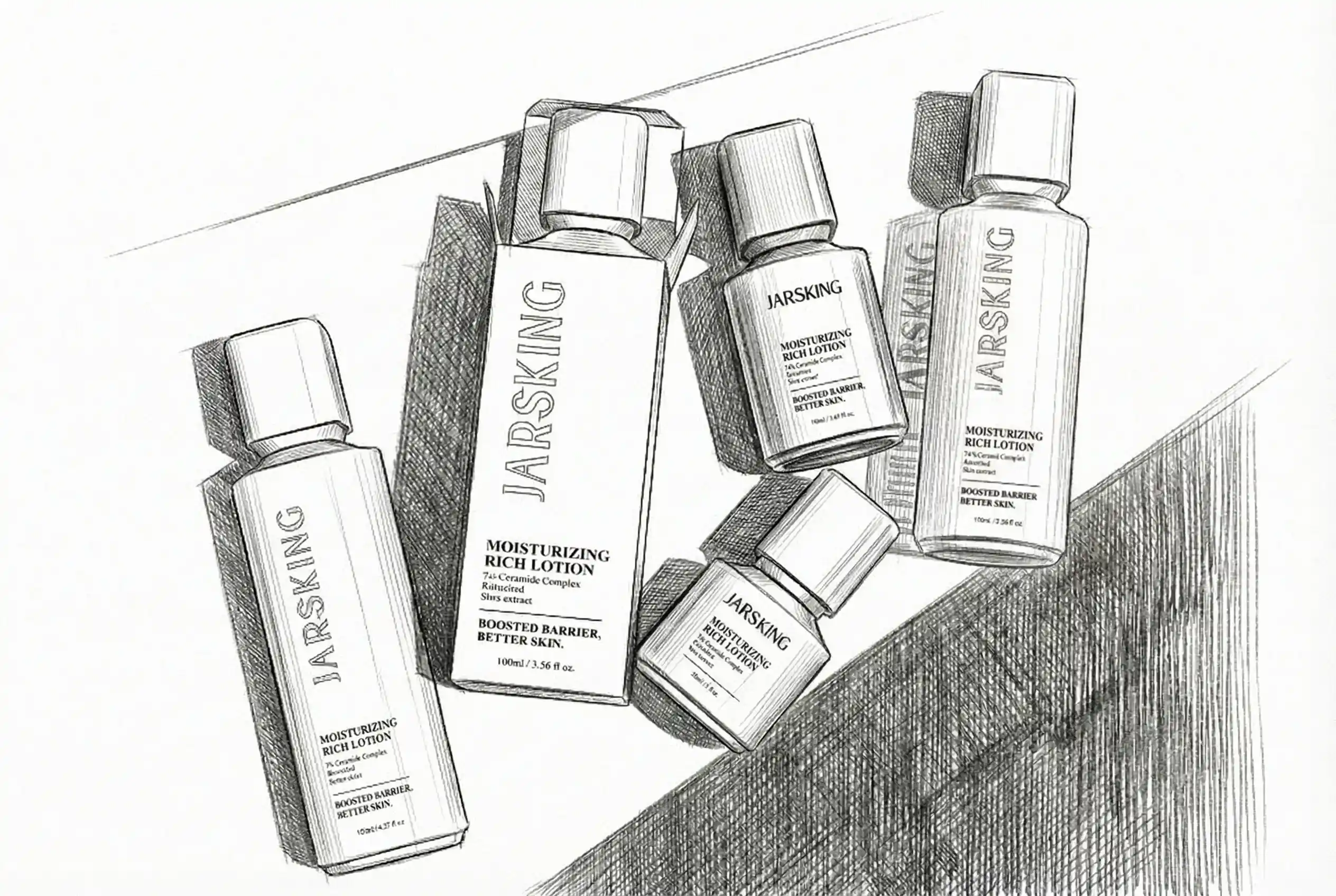
In beauty, the package is the first product the customer ever touches.
Long before a foundation is swatched or a serum absorbs into skin, a customer has already formed an opinion. She’s picked up the bottle, turned it over in her hand, pressed the pump once or twice, and twisted the cap. In that ten-second ritual, before a single drop of product has been experienced, the brand has either earned her trust or quietly lost it.
This is the particular cruelty — and the particular opportunity — of cosmetic packaging. It must perform two jobs simultaneously: protect and deliver the formula inside, and embody the brand promise on the outside. In luxury beauty, those two jobs collapse into one. The packaging is the first impression of quality. And quality, at the level that separates Chanel from a drugstore house brand, is measured in fractions of a millimeter.
Specifically, in increments as small as 0.01mm.
1. Why Cosmetic Packaging Is a Precision Problem
Most people don’t think of a lipstick case or a perfume bottle as an engineering challenge. But consider what a premium lipstick bullet mechanism must do: it must rotate smoothly with consistent resistance, extend the product to a precise height with no wobble, retract fully into the case without crushing the bullet, and close with a satisfying magnetic or friction snap — performing all of this identically across hundreds of thousands of units, in temperatures ranging from a refrigerated store shelf to a sunlit car dashboard.
That is a precision problem. The tolerance between the inner and outer barrel of a lipstick case determines whether the mechanism feels luxurious or loose, controlled or gritty. A gap that is 0.1mm too wide creates perceptible play — a slight wobble that communicates cheapness before the customer has even opened the product. A gap that is 0.1mm too tight creates friction that feels effortful rather than satisfying.
The sweet spot — where smooth meets solid, where control meets ease — lives in a tolerance window that the best cosmetic manufacturers hold to ±0.01mm. That number, one-hundredth of a millimeter, is roughly one-seventh the width of a human hair. It is invisible to the eye. It is unmistakable to the hand.
2. The Premium Beauty Brand’s Silent Currency
Luxury beauty brands understand something that is rarely stated directly: the packaging is the most powerful quality signal they have. A consumer cannot assess a moisturizer’s efficacy in a store. She cannot smell a perfume’s dry-down in fifteen seconds. But she can immediately, instinctively assess whether a jar feels substantial, whether a cap aligns perfectly, whether a dropper dispenses with control, whether a compact closes with authority.
This is why prestige cosmetics companies invest as heavily in packaging development as in formula development. Brands like La Mer, Tom Ford Beauty, and La Prairie spend years and millions on packaging design, materials, and tooling — not as indulgence, but as strategy. When a customer pays $350 for a moisturizer, the jar in her hand must justify that price point every single time she opens it. The lid must seat perfectly. The surface must be flawless. The weight must feel intentional. Any deviation from that standard — any visible seam, any surface depression, any slight asymmetry — creates a moment of cognitive dissonance: this doesn’t feel like it should cost $350.
That moment of doubt is the most dangerous place a luxury brand can put its customer.
3. Parting Lines: The Seam That Tells on You
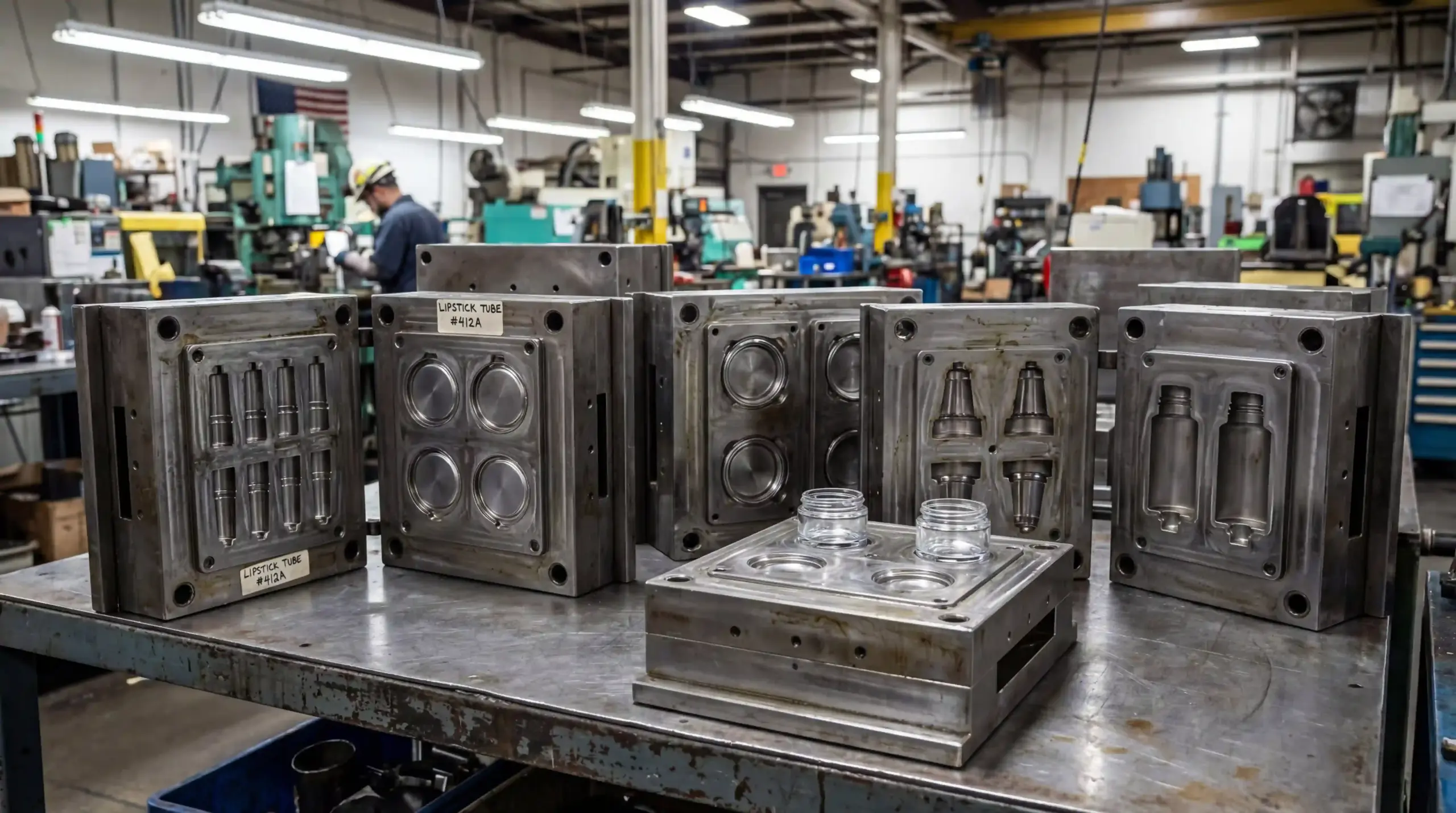
Almost every plastic or resin cosmetic component — caps, bottles, tubes, compacts, mascara wands, lip gloss applicators — is made through injection molding. And injection molding leaves a calling card: the parting line.
In cosmetic packaging, the parting line is particularly consequential because the products are designed to be handled intimately and repeatedly. A foundation bottle is picked up, shaken, inverted, and set down multiple times a day. A lipstick case is opened and closed dozens of times a week. A compact is examined in close proximity to the face, often under natural or bathroom light — some of the most revealing lighting conditions that exist.
Under these conditions, a visible parting line is not a minor blemish. It is a recurring reminder of imprecision. If it runs across the curved barrel of a mascara tube, it catches the light at certain angles, casting a faint shadow line across what should be a smooth, uniform surface. If it bisects the top face of a compact, it interrupts what should be a pristine reflective plane. If it sits on a visible edge with a slight step — evidence that the two mold halves weren’t perfectly aligned — it creates a tactile ridge that the fingertip finds every single time.
For budget cosmetics, these outcomes are acceptable. The value proposition doesn’t include flawless surfaces. But for any brand positioning itself in the prestige or luxury tier, a prominent or mismanaged parting line is a brand-image problem disguised as a manufacturing problem.
The solution isn’t to eliminate the parting line — that’s physically impossible in conventional injection molding. The solution is to control and design it with intention. In high-end cosmetic packaging, this means:
Location strategy: Routing the parting line to the base of a bottle, the inner edge of a compact rim, or the back face of a cap — anywhere the consumer’s primary gaze and primary touch don’t naturally fall
Mold precision: Achieving mold-half alignment at the micron level, so the two surfaces meet with no perceptible step, no ridge, no shadow line
Surface treatment integration: Applying texture, coating, or decoration — a matte finish, a metallic wrap, an embossed logo — so the parting line either disappears into the texture or aligns with a design boundary where a line is expected
Post-processing: Polishing, pad printing, or vacuum metallizing over the parting line zone so it reads as a designed surface rather than a manufacturing artifact
When these measures are taken well, the result is a package that flows. Every surface transitions into every other surface without interruption. The hand moves over the packaging and finds nothing unexpected. That seamlessness is not decorative — it is functional communication, telling the customer, wordlessly and continuously: nothing was overlooked here.

4. The Wall Thickness Story in Beauty Packaging
Inside the walls of every molded cosmetic component, there is another dimension that separates premium from ordinary: wall thickness uniformity.
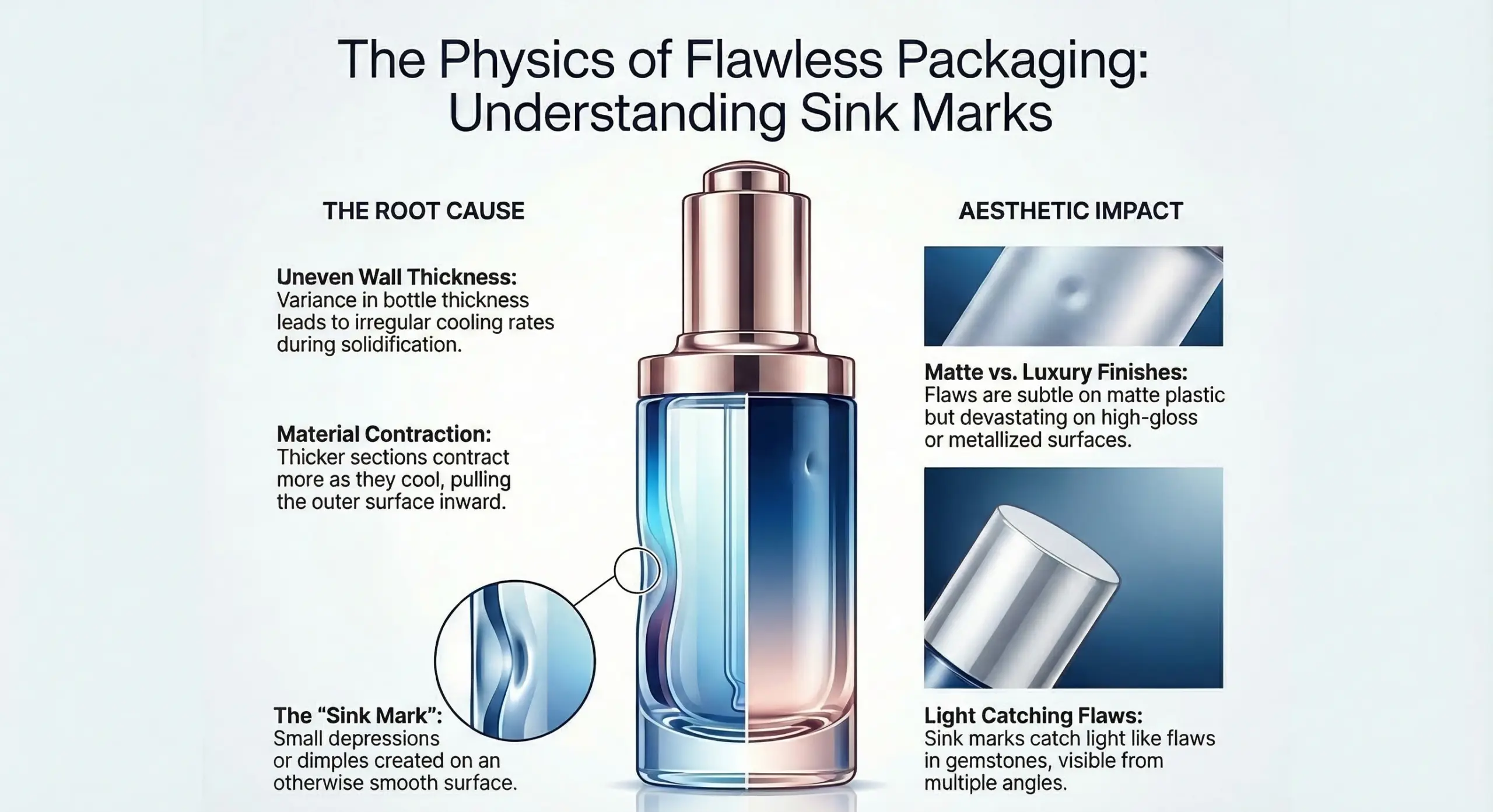
In cosmetic packaging, this matters for both practical and aesthetic reasons. Practically, a bottle or jar with uneven wall thickness will cool unevenly during molding. The thicker sections contract more as they solidify, pulling the outer surface inward and creating sink marks — small depressions or dimples on what should be a smooth surface. On a matte-finish plastic, sink marks may be subtle. On the high-gloss, optically clear, or metallized surfaces that define luxury cosmetic packaging, they are devastating. A single sink mark on the shoulder of a prestige perfume bottle catches light like a flaw in a gemstone, visible from multiple angles, impossible to ignore.
Beyond appearance, uneven wall thickness introduces warping. A jar lid that has cooled with differential internal stress will not sit perfectly flat. When the consumer places it on a counter, it rocks slightly. When she screws it onto the jar, it seats unevenly, perhaps leaving a thin crescent of gap on one side. These are the details that erode the premium experience — not dramatically, not in ways that generate formal complaints, but in ways that accumulate into a vague sense that the product doesn’t quite live up to its price.
Uniform wall thickness, by contrast, is the foundation of consistent cosmetic packaging quality. It ensures that every unit cools identically, shrinks identically, and arrives at the consumer’s hands in exactly the condition the designer intended. For components where transparency is part of the design — a clear acrylic compact window, a glass-look resin bottle — uniform thickness also ensures that light passes through without distortion, so the product inside is viewed through a perfectly neutral, optically consistent lens.
5. Touch Points: Where Precision Becomes Sensory Experience
In beauty, every interaction with packaging is a sensory moment. Precision engineering is what makes those moments feel right.
The cap closure. A perfume cap that seats with a quiet, definitive click communicates security and refinement. That click is the product of tight tolerance between the cap’s inner bore and the bottle neck’s outer diameter — a fit that compresses slightly on engagement and releases cleanly on removal. Too loose, and the cap wobbles or falls; too tight, and it requires effort that feels ungraceful. The premium experience lives in a tolerance window that might span less than 0.05mm.
The pump mechanism. A skincare pump that dispenses a consistent volume with a smooth, controlled stroke — no spitting, no air pockets, no variation between the first pump and the fiftieth — requires internal components machined to tight tolerances. The pump’s piston, spring, and dip tube must all fit and function within a system where variations of even 0.1mm can introduce inconsistency that the consumer will notice.
The compact hinge. A powder compact’s hinge is a microcosm of precision engineering. It must open smoothly, hold at any angle without springing, close with a satisfying snap, and do all of this thousands of times without developing play or squeaking. The tolerances governing the hinge pin, the hinge barrels, and the closure mechanism are what determine whether a compact feels like a jewel box or a toy.
The tube shoulder. On a cosmetic tube — foundation, sunscreen, serum — the shoulder where the flexible body meets the rigid nozzle is a critical transition zone. Uniform wall thickness here prevents stress concentrations that crack or split with repeated squeezing. Precise alignment prevents the nozzle from sitting off-center relative to the tube axis, a visual asymmetry that low-end tubes exhibit routinely and that premium tubes must eliminate.
Each of these details is imperceptible in isolation when executed correctly. Together, they compose an experience that the customer describes with words like luxurious, quality, worth it — words that are really the sensory summary of dozens of precision decisions that went right.
6. The Brand Image Equation in Beauty
The stakes of packaging precision are particularly high in beauty because the category is intensely social. Cosmetic purchases are shared on social media at extraordinary scale. Flat lays, unboxing videos, and close-up product photography are standard consumer behaviors, not exceptional ones. This means that packaging defects — a visible parting line on a compact, a sink mark on a foundation bottle shoulder, a lid that doesn’t align perfectly with its base — are routinely captured in high resolution, under controlled lighting, and shared with audiences of thousands.
A single popular unboxing video featuring a noticeable packaging flaw can generate comment threads that become permanent SEO artifacts for a brand’s quality reputation. Consumers searching for that product will find the video, the comments, and the doubt it introduces — and that discovery happens before they’ve ever touched the product themselves.
The brands that are winning in this environment are those that have responded by tightening their manufacturing standards rather than relying more heavily on marketing to paper over physical shortcomings. They understand that in the age of the unboxing video, the most powerful quality communication is the product itself — and that 0.01mm of precision, invisible to the naked eye, becomes very visible indeed under a smartphone camera in a well-lit bathroom.
7. High-Quality vs. Low-Quality: Side by Side
It is one thing to speak in abstractions about precision and brand image. It is another to lay out, concretely, exactly how a high-quality cosmetic package differs from a low-quality one — detail by detail, touch point by touch point. The table below does exactly that.
| Dimension | High-Quality Packaging (Prestige Tier) | Low-Quality Packaging (Budget Tier) |
| Parting line location | Routed to base, inner edge, or recessed groove — invisible during normal use | Runs across visible faces, curved surfaces, or primary touch zones |
| Parting line condition | Flush with surface, no step, no ridge; blends with texture or decoration | Raised or mismatched step; catches fingernail; visible shadow line under direct light |
| Wall thickness | Uniform throughout; transitions gradual and designed to specification | Inconsistent; abrupt thickness changes at ribs, bosses, and structural features |
| Surface sink marks | Absent; mold flow and cooling simulated and validated before tooling | Present on glossy or metallized surfaces, particularly near ribs or thick sections |
| Warping / flatness | Lids, bases, and panels sit flat; no rocking or crescent gaps when closed | Subtle distortion from differential cooling; lids rock on flat surfaces |
| Cap / closure fit | Tolerance ±0.01–0.05mm; definitive click or smooth magnetic snap on closure | Tolerance ±0.1mm or wider; loose wobble before engagement or excessive friction |
| Pump performance | Consistent dose volume, stroke-to-stroke; smooth actuation from first to last pump | Variable dose; spitting or air gaps; stiffness changes as product level drops |
| Hinge feel (compacts) | Smooth resistance throughout arc; holds position; closes with authoritative snap | Stiff initially, loosens over time; springs open or requires two-hand force |
| Lipstick mechanism | Bullet rises and retracts on a controlled, consistent glide; no wobble at full extension | Perceptible lateral play at full extension; mechanism feels loose or gritty |
| Decorative finish | Uniform coating, vacuum metallization, or soft-touch lacquer; no pinholes or thin spots | Uneven coating thickness; visible pinholes, streaks, or metallic fade near edges |
| Label / print registration | Graphics centered and aligned to within fractions of a millimeter | Slight off-center placement; crooked graphics visible on casual inspection |
| Seam alignment (multi-part assemblies) | Panels, caps, and bases align seamlessly; no visible step or horizontal offset | Misalignment at assembly joints; one component sits proud of another |
| Durability over use cycles | Maintains precision fit and surface integrity after thousands of open/close cycles | Play, looseness, and surface wear develop within weeks or months |
| Material consistency | Uniform color, gloss, and opacity batch-to-batch; no visible variation across a production run | Color and gloss variation between units; some appear slightly different from the same production lot |
| Packaging sound | Quiet, definitive, controlled sounds during all interactions | Rattling, clicking, or hollow sounds that signal loose tolerances |
What this table reveals is that the difference between high-quality and low-quality cosmetic packaging is not one dramatic failure — it is a constellation of small imprecisions, each individually minor, collectively devastating. A budget package might exhibit five or six of these issues simultaneously. Each one, on its own, is easy to rationalize. Together, they compose an unmistakable impression of carelessness.
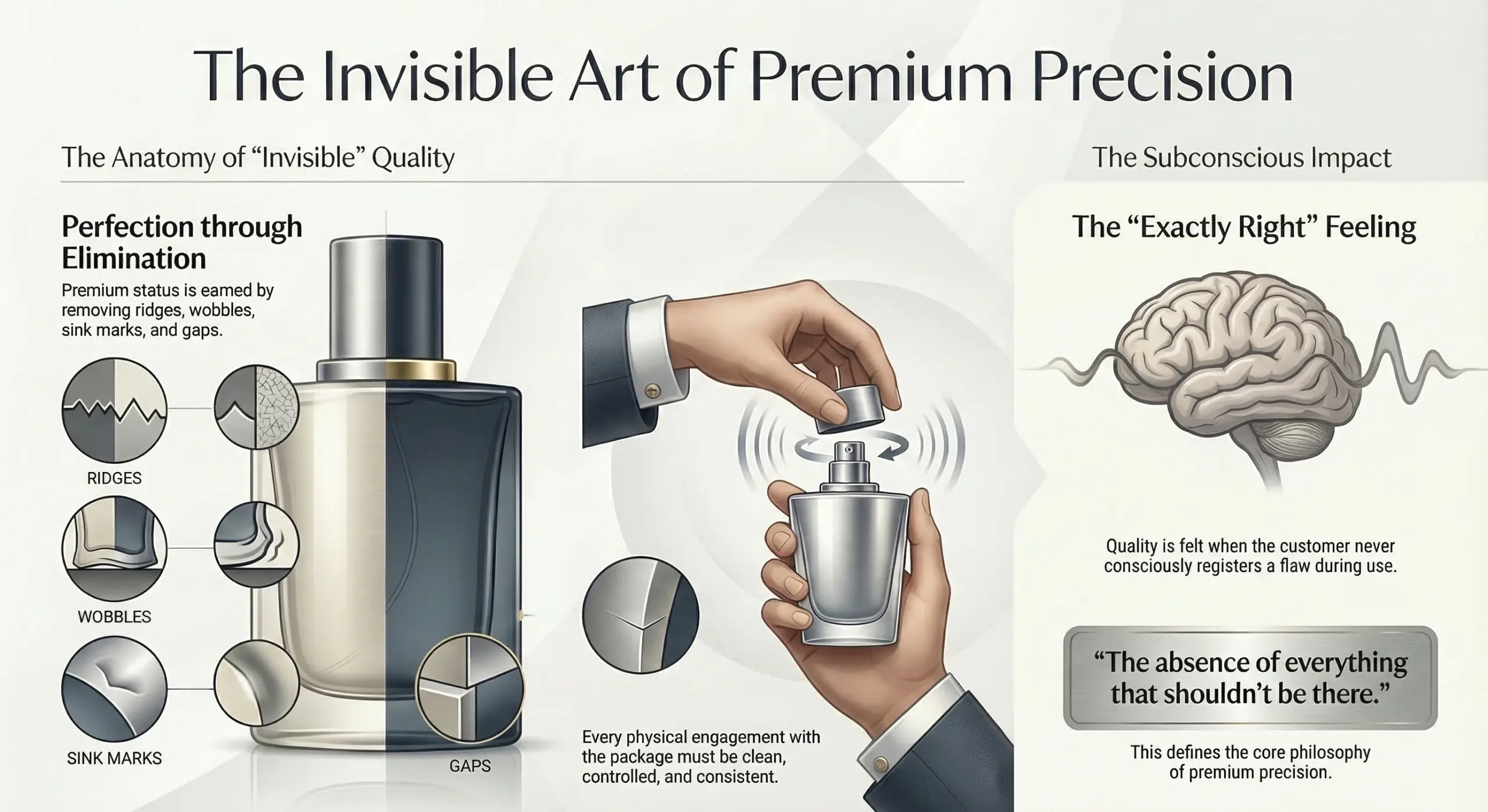
The premium package, by contrast, earns its position not through any single spectacular feature, but through the absence of everything that shouldn’t be there. No ridge. No wobble. No sink mark. No gap. Every interaction with the package is clean, controlled, and consistent. The customer never consciously registers what’s not happening — she just feels, each time she reaches for the product, that it is exactly right.
This is the quiet power of 0.01mm precision. It does not announce itself. It simply removes every reason for doubt.
8. Precision as Sustainability Signal
There is a newer dimension to cosmetic packaging precision that is gaining importance: sustainability. Increasingly, premium beauty consumers expect their products to be not only beautifully made, but responsibly made.
Precision manufacturing contributes to sustainability in ways that are direct and measurable. Uniform wall thickness reduces material consumption — you achieve the same structural performance with less plastic when your walls are optimally sized rather than over-engineered to compensate for inconsistency. Tighter tolerances reduce defect rates, which reduces material waste in production. Better-fitting components extend product life, because caps that fit precisely don’t crack from stress, pumps that function consistently don’t get discarded prematurely, and compacts that hinge correctly don’t break and end up in landfills.
For a prestige beauty brand positioning itself at the intersection of luxury and responsibility, the message implicit in precision packaging is powerful: we made this to last, and we made it without excess. That alignment between quality and sustainability is not incidental — it is increasingly the defining aspiration of the premium beauty consumer.
9. The 0.01mm Standard in Practice
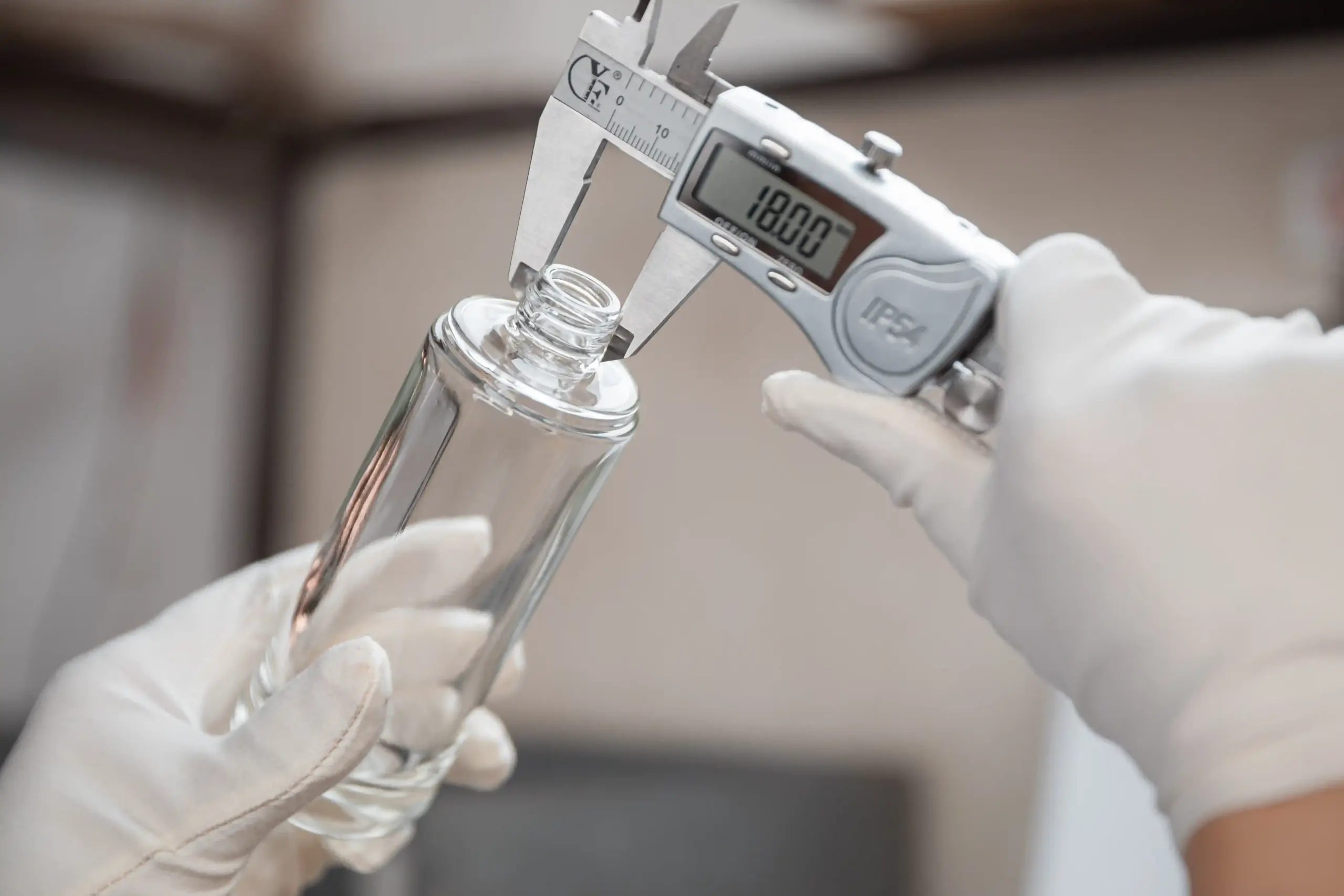
Reaching ±0.01mm tolerance in cosmetic packaging components requires a systemic approach. The molding environment must be temperature and humidity controlled. The molds themselves, typically machined from hardened P20 or H13 tool steel, must be fabricated to tolerances tighter than the parts they will produce. Measurement and inspection protocols — using coordinate measuring machines (CMMs), optical comparators, and surface profilometers — must verify not just that individual parts are within tolerance, but that the process is stable enough to keep every part within tolerance across a full production run.
For the highest-tier cosmetic components — the cap of a $400 perfume, the compact of a couture makeup line — these standards are non-negotiable. The investment in mold quality, process control, and inspection is simply the cost of operating in that tier. For brands moving into the prestige segment, this investment often represents a significant capability upgrade over what budget packaging suppliers can offer. The gap between a $2 per unit packaging mold and a $20 per unit precision mold is not ten times the quality — it is the difference between being in the premium segment and merely claiming to be in it.
10. The Invisible Architecture of Desire
There is something almost philosophical about the role of precision in cosmetic packaging. Beauty products are sold on desire — the promise of transformation, enhancement, sensory pleasure. The packaging must embody and amplify that desire before the formula has had a chance to deliver on it.
Desire is aroused by perfection, or at least by the sense of perfection. And the sense of perfection is created, in physical objects, by the absence of anything that shouldn’t be there — no unexpected ridge, no visible seam, no slight depression, no asymmetric gap. Precision engineering is the discipline of removing everything that shouldn’t be there, down to the level where human perception can no longer detect the residue of the manufacturing process.
At 0.01mm, you are operating below the threshold of conscious perception. The customer cannot see that tolerance. She cannot measure it. But she can feel its absence when it isn’t there — in the wobble, the ridge, the dimple, the gap. And she can feel its presence when it is there — in the seamlessness, the control, the rightness of a product that seems to have been made with absolute attention and absolute care.
That feeling — that wordless conviction that something was made by people who truly cared — is the foundation of brand loyalty in luxury beauty. It is built not in advertising studios or social media campaigns, but in the engineering rooms and tool shops where tolerances are set, molds are cut, and quality standards are either held or compromised.
The 0.01mm is invisible. What it creates — trust, desire, loyalty — is the most visible thing a beauty brand can own.
FAQs
What exactly does "0.01mm tolerance" mean, and why does it matter for cosmetic packaging?
A tolerance is the maximum allowable deviation from an intended dimension during manufacturing. A standard consumer product tolerance sits around ±0.1mm — already quite small. A ±0.01mm tolerance is ten times tighter than that, placing it in the same category as precision medical and aerospace components. In cosmetic packaging, it matters because the human fingertip is extraordinarily sensitive — capable of detecting surface variations and mechanical play far below what the eye can see. A lipstick barrel with 0.1mm of clearance wobbles. One with 0.01mm of clearance glides. That difference is the line between a product that feels luxurious and one that merely looks it.
Why can't a parting line simply be removed from an injection-molded cosmetic package?
It cannot be eliminated because it is a physical consequence of how injection molding works. A mold must open to release the finished part, and wherever the two mold halves meet, a seam — the parting line — will exist. The real engineering challenge is not removal but control: deciding exactly where the parting line falls, ensuring the two mold halves align to within microns so no step or ridge forms, and designing the surface treatment so the line is either hidden or visually absorbed into the design. A prestige brand invests heavily in all three of those decisions. A budget brand typically invests in none of them.
How does uneven wall thickness cause sink marks — and why are they so damaging on luxury packaging?
When one section of a molded part is thicker than its neighbor, it takes longer to cool and solidify. As that thick section contracts during cooling, the already-solidified outer skin is pulled inward, creating a small depression called a sink mark. On matte surfaces, sink marks can be subtle. But luxury cosmetic packaging typically features high-gloss, metallized, or optically clear finishes — surfaces that behave like mirrors and amplify any surface irregularity rather than hiding it. A single sink mark on the shoulder of a prestige perfume bottle catches the light at multiple angles, creating a flaw that is impossible to ignore and impossible to justify at a premium price point.
Does precision manufacturing significantly increase the cost of cosmetic packaging?
Yes — but the economics are more favorable than they first appear. Precision molds, machined from hardened tool steel to ±0.005mm, cost more than standard molds. Climate-controlled molding environments, CMM inspection equipment, and statistical process control all add overhead. However, the per-unit cost increment for precision packaging — often a matter of cents — is trivially small compared to the brand equity it protects. The cost of a quality failure, by contrast, compounds: returns, negative reviews, social media documentation of defects, and lost repurchase can erase the savings from cheap tooling many times over. The question is never whether a brand can afford precision — it is whether it can afford the alternative.
How does temperature affect cosmetic packaging performance, and how does precision help?
Plastics expand and contract with temperature — a property called thermal expansion. A lipstick mechanism engineered to function perfectly at 20°C in a laboratory may seize in a cold retail environment or develop perceptible wobble when left in a warm handbag. Precision manufacturing accounts for this by specifying tolerances that accommodate the expected temperature range for the product’s entire use life. Material selection also plays a role: different resins have different coefficients of thermal expansion, and pairing materials correctly within a multi-component assembly ensures that every component expands and contracts at compatible rates, maintaining fit and function across conditions.
How has social media changed the stakes for cosmetic packaging precision?
Dramatically. Before the era of unboxing videos, flat lays, and macro-lens product photography, a packaging defect had to be quite significant to reach widespread consumer awareness. Today, a single visible parting line on a compact, or a sink mark on a foundation bottle shoulder, can be captured in high resolution under controlled lighting and shared with an audience of tens of thousands — and that content becomes a permanent, searchable artifact associated with the brand and product. Consumers researching a purchase encounter these videos and comments before they ever touch the product, meaning that manufacturing imprecision now has a marketing cost that extends far beyond the individual unit affected. The brands that are thriving in this environment are those that treat every surface as if it will eventually be photographed at 4K resolution under a ring light. Because it will.