

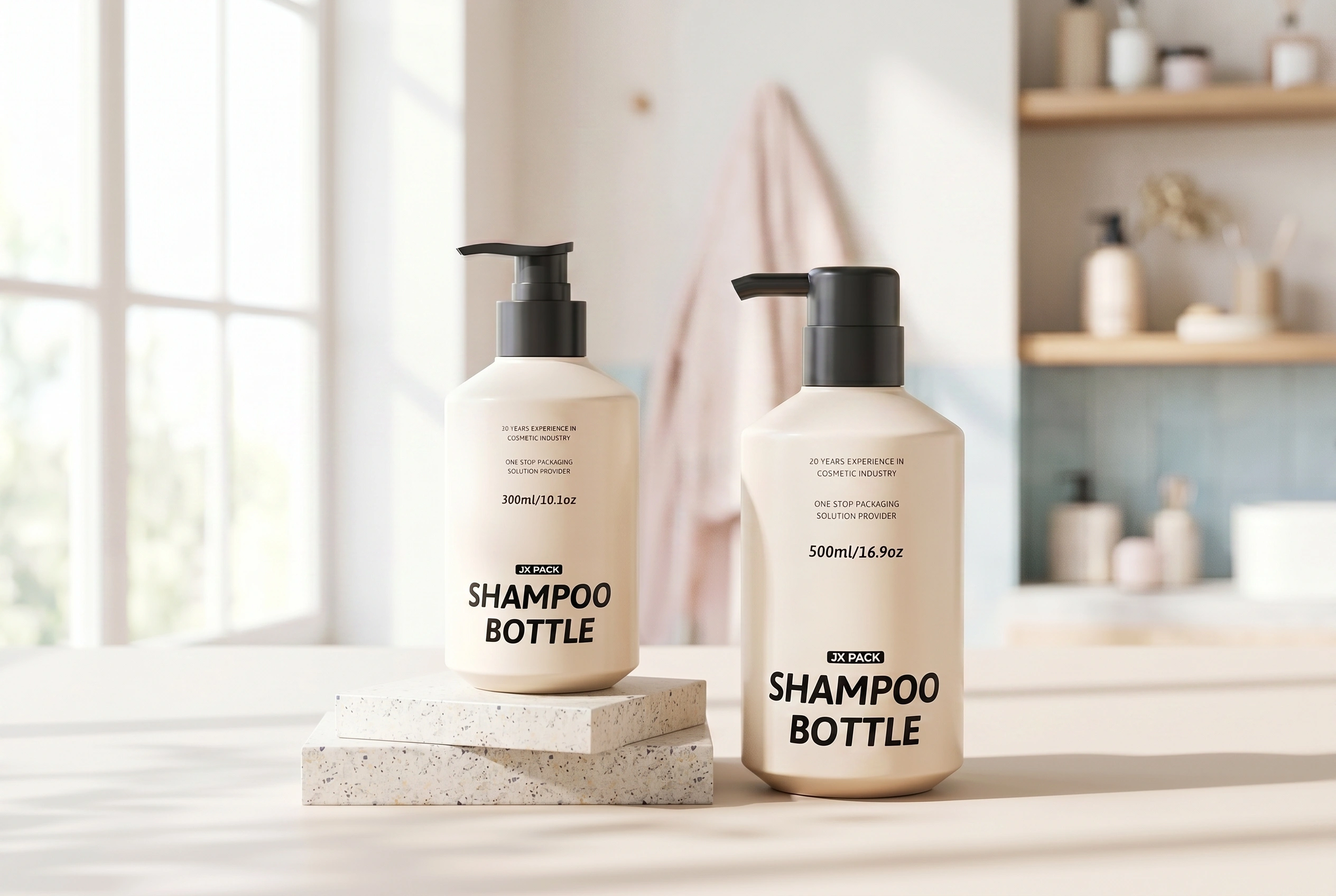

1. The Part Nobody Warns You About When You Launch a Shampoo Brand
If you’re building a new shampoo line, you probably started where everyone does: with the formula.
The fragrance, the lather, the clean-ingredient story, the before-and-after photos—that’s the fun part.
Then, right when you think you’re almost done, packaging walks in like a plot twist.
Suddenly you’re dealing with neck finishes, resin codes, MOQ, leak testing, freight classes, and three different suppliers telling you three different things. You just wanted a nice bottle that doesn’t leak in transit—and now it feels like you’re managing a mini engineering project.
Here’s the uncomfortable truth: in hair care, your shampoo bottle will be judged before your shampoo formula ever gets a chance. Consumers decide in seconds, based on shape, color, material, closure, label, and how easy it looks to use in a slippery shower.
If you get this wrong, you don’t just end up with an “okay” bottle. You end up with:
Leaky shipments and sticky returns
Awkward, unstable bottles that tip over in the shower
High unit costs that quietly eat your margin
A “DIY” vibe that makes your brand look less premium than your formula deserves
The good news: most packaging disasters are predictable—and totally avoidable—if you know where new brands usually trip up.
Let’s walk through the most common shampoo packaging mistakes I see and how to avoid them from day one.
2. Why Shampoo Packaging Matters More Than Ever
Before anyone smells your signature scent or reads your clean ingredient story, they see this:
The silhouette of the bottle on a shelf or a scroll
The color story and finish—matte, glossy, frosted, textured
The material: cheap and flimsy, or solid and trustworthy
The closure: pump, flip-top, disc cap, or some “clever” but confusing dispenser
The label or print: clean and modern, or cluttered and chaotic
In a few seconds, your packaging shapes:
Whether they pick up the bottle or scroll past
Whether they see you as mass, masstige, salon, or luxury
Whether they trust your claims and your price point
Whether they think this will be easy to use in their real bathroom, not just in a photoshoot
And beyond that first impression, shampoo packaging has real jobs to do:
Keep the formula safe during transport and storage
Survive hot bathrooms, wet hands, and repeated squeezes or pumps
Meet recyclability, sustainability, and regulatory expectations
Ship efficiently for e commerce without breaking or leaking
When brands treat packaging as an afterthought, they usually pay for it later—in chargebacks, negative reviews, and rushed redesigns.
3. Mistake 1: Choosing Packaging Only Because It Looks Pretty
I’ve lost count of how many times I’ve heard, “We found this bottle on Instagram and fell in love with it.”
That sentence is usually followed, three months later, by:
“It’s slippery in the shower, the pump clogs, and retailers say it tips over too easily.”
A gorgeous bottle that nobody wants to use in real life is not good packaging. It’s a prop.
Common real-world issues when packaging is chosen on looks alone:
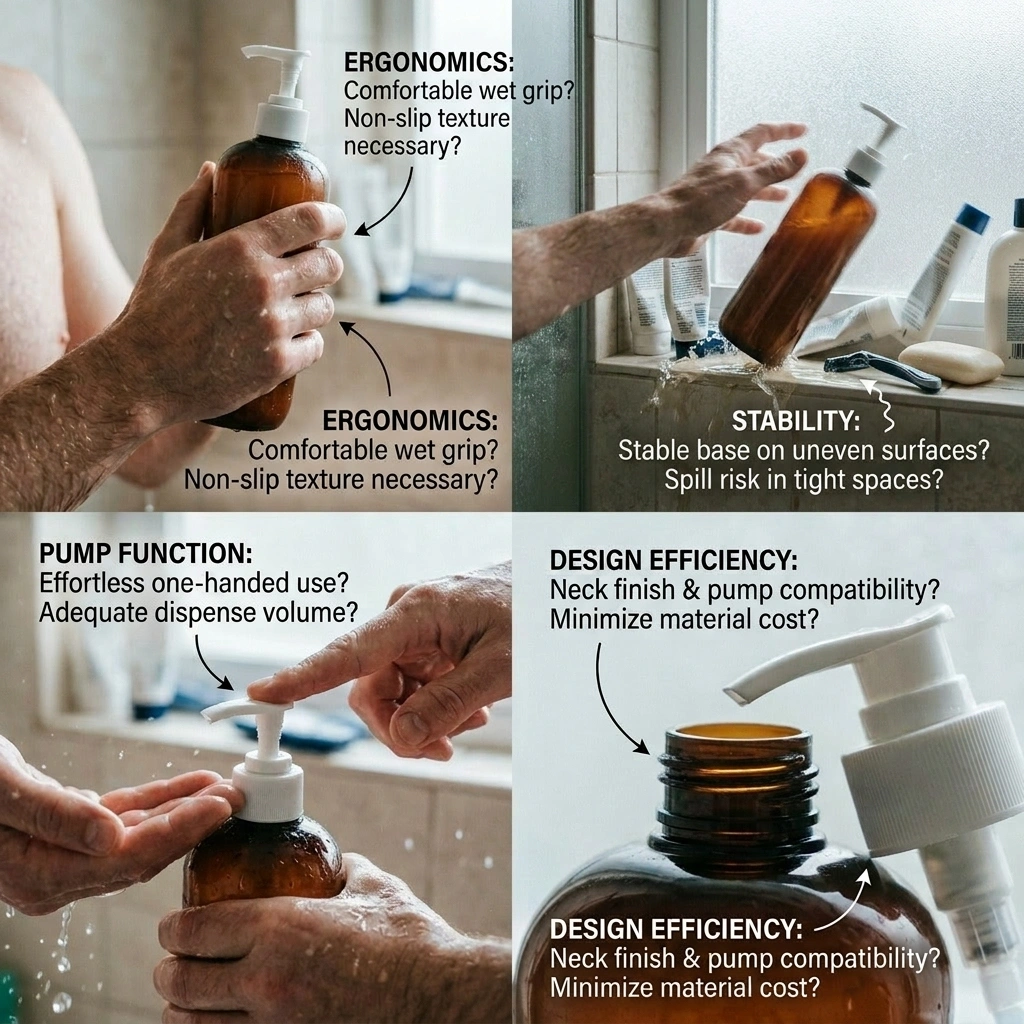
Bottles that are hard to grip with wet, soapy hands
Caps that require too much force or two hands to open
Slim, tall bottles that look elegant but fall over whenever someone bumps the shelf
Closures that don’t match the viscosity of your shampoo
A wildly expensive structure that blows your cost of goods
How to Avoid It
Instead of asking “Do I love how this bottle looks?” ask:
How does this feel in a real shower with wet hands?
Can someone easily hold and pump with one hand?
Does the footprint give it enough stability on a crowded ledge?
Does the neck finish and shoulder shape actually work with the pump or cap we want?
Does this still make sense when I see the landed cost plus freight?
Get physical samples, fill them with your actual formula, stick them in your own bathroom, and live with them for a week. You’ll learn more from that than from 100 moodboards.
A winning shampoo bottle is beautiful, but quietly engineered for daily, messy, real-world use.
4. Mistake 2: Picking the Wrong Bottle Material
Choosing shampoo bottle material isn’t just about “plastic vs eco-plastic.”
The resin you choose affects clarity, durability, recyclability, and even how the formula behaves over time.
Here’s the simple, honest version of the main options most hair care brands start with:
PET: The Clear, Market-Friendly Workhorse
Lightweight and impact-resistant
Great clarity for see-through or tinted formulas
Widely recyclable in most markets
Familiar look for mass and masstige haircare
Best when you want:
A transparent or translucent shampoo bottle
A bright, glossy, “fresh” look
A mass-market or e-commerce friendly option with good strength-to-weight
HDPE: The Trusted, “Serious” Hair Care Resin
Opaque or semi-opaque, with a more utilitarian vibe
Excellent chemical resistance and durability
Very good impact resistance and shower survival
Popular in salon, family-size, and more “functional” hair care packaging
Best when you want:
A more professional or minimalist look
Large-volume pump bottles for families or salons
Strong performance under rough handling
PCR Plastics: Your Sustainability Anchor
PCR (post-consumer recycled) PET or HDPE lets you reduce virgin plastic while keeping the same basic performance profile, if engineered correctly.
Supports sustainability claims with real, measurable content
Often pairs well with refill strategies and lightweight designs
Needs careful color and quality control so it doesn’t look muddy or inconsistent
How to Avoid Material Mistakes
Sit down with your packaging manufacturer or supplier and talk through:
Your formula type (actives, fragrance load, surfactants)
Your brand positioning and price point
Your sustainability commitments for the next 3–5 years
Target markets and recycling infrastructure (EU vs US vs APAC)
If you’re not sure, a smart path is: HDPE or PET to start, then introduce PCR content as you scale and can manage the additional QC and storytelling.
5. Mistake 3: Ignoring Product Viscosity
Here’s a question I wish more founders asked themselves sooner:
“Is my shampoo actually going to come out of this bottle the way I imagine?”
A lightweight clarifying shampoo behaves nothing like a rich, sulfate-free curl cream. Thin, water-like formulas race through loose pumps and disc caps. Thick, buttery formulas barely move through narrow orifices and stiff pumps.
If you choose a “cool” closure without thinking about viscosity, you get:
Customers shaking and banging the bottle to coax product out
Pumps that don’t fully return because the formula is too thick
Drippy mess on caps from formulas that are too thin
Early negative reviews like “Nice formula, terrible packaging”
How to Avoid It
This is where proper compatibility and usability testing comes in:
Measure or at least categorize your formula’s viscosity with your lab
Ask your supplier which closures are designed for that viscosity range
Fill actual components with your real formula and test: pumps, flips, disc caps, and any specialty dispensers
Then run a simple, honest test at home:
Use the bottle in the shower with wet hands for a week
Try one-handed use
Try it nearly empty—does it still dispense, or is half the formula stuck at the bottom?
If you’re building a line—say, shampoo, conditioner, and treatment mask—consider whether they all need the same closure style, or if it makes sense to mix pumps, flip-tops, and tubes based on viscosity rather than aesthetics alone.
6. Mistake 4: Treating Leakage as “Bad Luck” Instead of an Engineering Problem
Leakage is not bad luck. Leakage is a design, testing, or supplier problem.
And in hair care, even a tiny leak can create a big mess: sticky cartons, damaged labels, irritated retailers, and disappointed customers who never reorder.
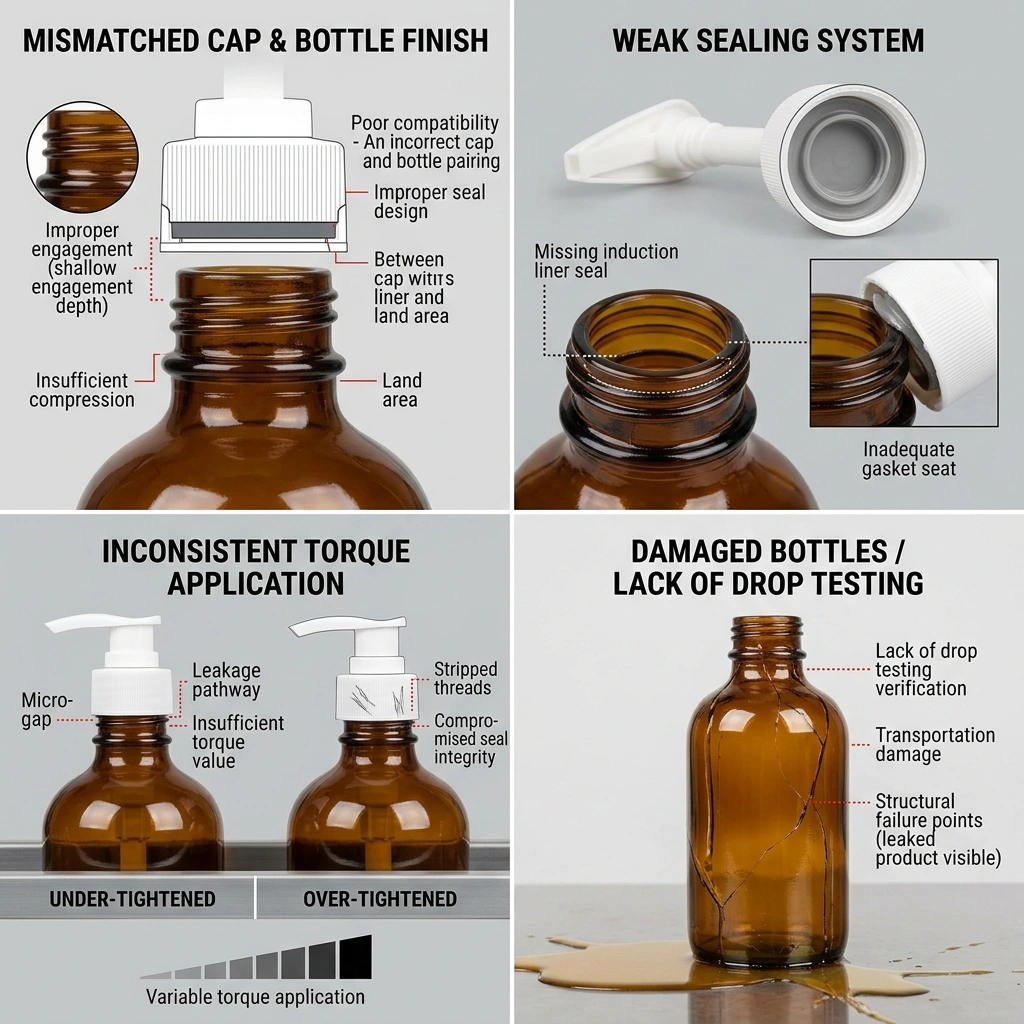
Most leaks come from:
Caps that were never designed for the bottle profile or neck finish
Weak sealing systems and no induction seal where needed
Inconsistent torque during filling and capping
Zero transportation simulation or drop testing before launch
How to Avoid It
Aim to work with suppliers who don’t treat leak testing like an optional extra. Ask directly:
Do you perform leak and vacuum testing on this bottle–closure set?
Have you tested this combo with similar formulas?
What kind of transportation or drop tests are available?
On your side, test like your harshest logistics partner:
Fill real bottles with your actual formula
Ship them to yourself and a friend, ideally in hot weather
Store some upright and some on their sides
Check for weeping around threads, cap, and label edges
If you find issues, solve them before you print a single production run of labels.
7. Mistake 5: Inconsistent Brand Design Across the Line
A lot of early brands make this mistake out of excitement.
Shampoo gets one bottle from Supplier A. Conditioner gets another “cute” bottle from Supplier B. The hair mask comes in a completely different aesthetic because “we wanted it to feel special.”
The end result on shelf? It looks like three different brands.
You see this when:
Each SKU uses a different typeface
Colors jump wildly with no logic or hierarchy
Multiple bottle shapes, shoulder lines, and closures fight for attention
Labels and decoration styles don’t feel related
How to Avoid It
Think in systems, not one-off designs:
Choose a core architecture: shoulder shape, base, closure family
Create a tight color system that signals benefit or hair type, but clearly lives in one brand world
Lock in typography and logo usage rules (size, placement, hierarchy)
Decide how claims, icons, and ingredient callouts will appear across all SKUs
A visually coherent line sends a strong subconscious message: “This brand knows what it’s doing.”
8. Mistake 6: Cramming Every Claim Onto the Front Label
If you’ve ever stared at your front label and thought, “But I want people to know we’re sulfate-free, silicone-free, cruelty-free, color-safe, dermatologist-tested, and made with five botanical extracts,” you are not alone.
The instinct is understandable—but the result is usually chaos.
Front panels overloaded with:
Tiny text claims that no one can read at arm’s length
Three or four certification icons in a row
Ingredient lists disguised as marketing copy
Complex visuals fighting with type for attention
How to Avoid It
Treat your front panel like a billboard viewed at a distance:
Brand name
Product type (shampoo, not just “cleanse”)
Primary benefit (volume, moisture, anti-frizz, scalp care)
Maybe one key differentiator or hero ingredient
Everything else—extended claims, how-to, full INCI, sustainability details—can move to the back or side panels, your website, and your marketing materials.
Clean front panels feel premium and confident. Overcrowded labels feel desperate.
9. Mistake 7: Ignoring Sustainability Until Your Customers Ask About It
In 2026, “we’ll think about sustainability later” is not a strategy; it’s a liability.
Beauty shoppers are increasingly paying attention to:
Recycled content (PCR levels)
Refillability and reuse
Mono-material designs that are easier to recycle
Lightweight packaging that uses less material overall
Regulators are watching too, especially in the EU and certain US states, tightening rules on recyclability and extended producer responsibility.
How to Avoid It
You don’t need to launch with a fully closed-loop refill ecosystem on day one. But you do need a direction.
Realistic starting points:
Use PET or HDPE that’s widely recyclable where you sell
Introduce PCR content where it doesn’t compromise performance
Avoid unnecessary metalized layers or hard-to-separate mixed materials
Design labels, pumps, and closures with end-of-life in mind (e.g., using compatible resins, removable sleeves)
As you grow, you can explore:
Refillable “heirloom” bottles with lightweight refill packs
Concentrated or waterless formats that reduce shipping weight
Reuse or return programs in salons or DTC
The brands that build sustainability into their packaging now will be better positioned when expectations and regulations ratchet even higher.
10. Mistake 8: Jumping Into Custom Molds Too Early
Custom molds are tempting.
You want that distinctive bottle shape everyone recognizes in a split second.
But when you’re still proving demand, a custom mold can quietly trap your cash:
High tooling costs that eat into your launch budget
Longer development timelines and higher risk if something needs changing
Minimum order quantities that force you into big inventory bets
Painful retooling if you discover a functional issue later
How to Avoid It
Think in phases:
Phase 1: Stock packaging with strong branding and decoration
Use a well-engineered, standard PET or HDPE shampoo bottle and differentiate through color, finishes, and graphics.
Phase 2: Optimize based on real feedback
Use your first 6–18 months to learn from customers, retailers, and logistics about what works and what doesn’t: grip, stability, closures, fill volumes.
Phase 3: Custom architecture once the product–market fit is real
Only when you’ve validated demand and UI/UX requirements does it make sense to build a custom mold that locks in your brand silhouette.
This approach preserves cash, reduces risk, and ensures your custom packaging is based on real data, not vibes.
11. Mistake 9: Designing Only for Shelves, Not for E-Commerce
Ten years ago, hair care packaging was designed for shelves first.
Now, a huge percentage of shampoo is discovered, bought, and reordered online.
Packaging that looks great on a retail gondola can fail spectacularly in parcel shipping:
Tall, top-heavy bottles topple and stress closures in transit
Weak caps and threads weep under pressure changes
Heavy glass or overly thick plastics spike your shipping costs
Over-decorated surfaces scratch and scuff easily in mailers
How to Avoid It
Evaluate your shampoo packaging against e-commerce realities:
Can it survive being shipped in a padded mailer, not just a carton?
Does the closure remain secure when knocked or rattled?
Is the weight reasonable for your desired shipping rate?
Does the finish (soft-touch, matte, metallic) resist scuffing?
Ask suppliers whether they’ve tested their components against common e-commerce standards or ISTA testing protocols. If they haven’t, you can at least simulate basic conditions with DIY drop and vibration tests.
12. Mistake 10: Using the Same Packaging for Every Market
A “one size fits all” packaging strategy sounds efficient.
In reality, it often means you’re under-serving at least one of your regional markets.
You’ll see distinct preferences across regions:
North America
Larger family-size formats and pump bottles
Strong interest in sustainability messaging and PCR content
Convenience and value play a big role
Europe
Growing preference for refillable systems and lower-plastic solutions
Minimalist, design-forward aesthetics
High sensitivity to recyclability and material claims
Asia-Pacific
Strong appetite for premium and “special” packaging
Compact formats for crowded homes and frequent travel
Innovative dispensing systems and sensorial experiences
How to Avoid It
Instead of forcing a global template, build a flexible system:
Core brand codes (logo, typography, color logic) stay consistent
Formats, materials, and dispensing may adapt by region
Claims and on-pack language reflect local regulations and expectations
Work with local partners or distributors to pressure-test your concepts before you commit to tooling and massive inventory.
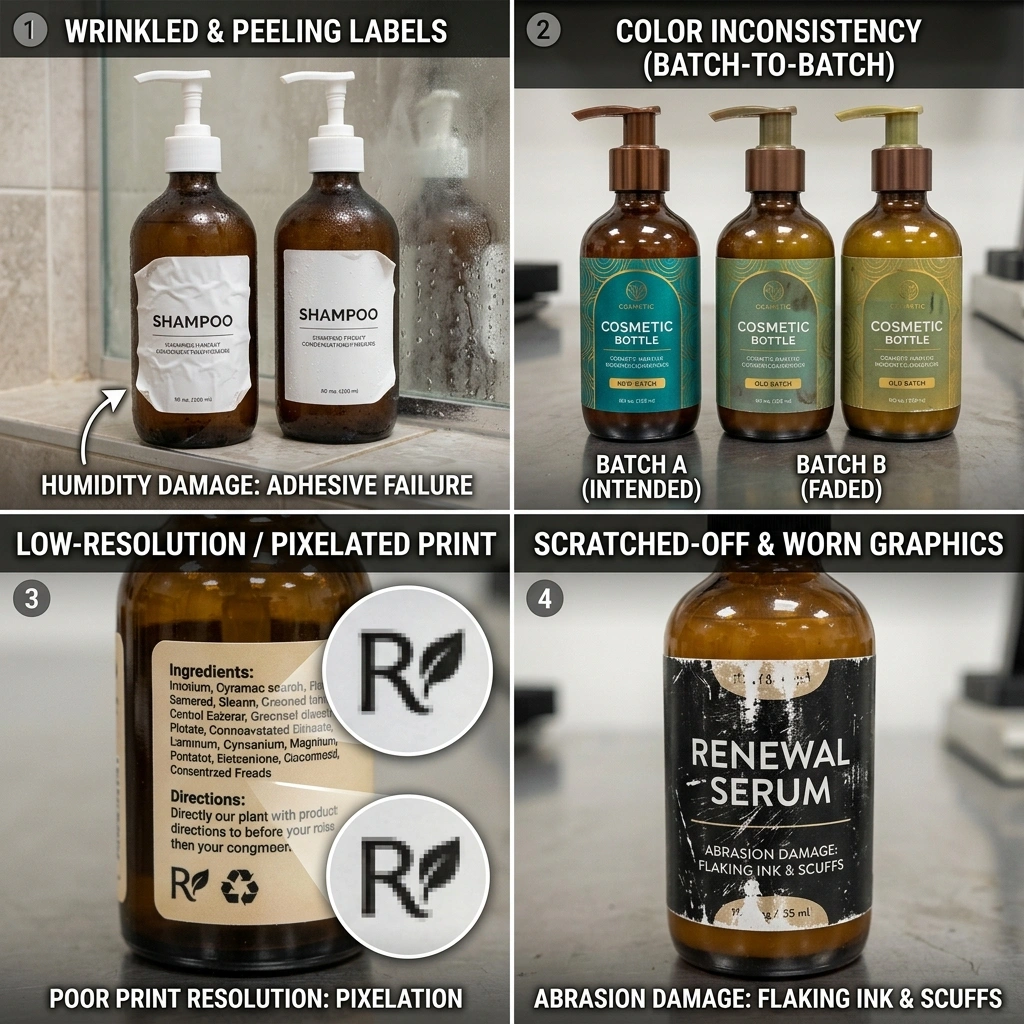
13. Mistake 11: Skimping on Decoration and Printing Quality
You can have a robust, well-engineered bottle—and still end up looking cheap if your decoration is low quality.
Common tells:
Labels that wrinkle or peel in humid bathrooms
Colors that shift between batches or look dull in person
Low-resolution type or imagery, especially on small formats
Printed graphics that scratch off during transit or handling
In hair care, where many brands share similar bottle shapes, decoration is often where the perceived value happens.
How to Avoid It
Work with suppliers who can offer higher-end finishing options and consistent quality, such as:
Silk screen printing with sharp edges and durable inks
Hot stamping for metallic accents that don’t flake
UV printing for vivid colors and crisp gradients
Frosted or matte finishes for a soft, premium touch
Soft-touch coatings or subtle textures that feel expensive in hand
Ask for production-quality samples, not just lab proofs, and test them in daily use—wet, handled, thrown into travel bags.
14. Mistake 12: Choosing a Packaging Supplier Only by Price
When you’re watching every cent—which most new brands are—it’s tempting to treat packaging like a pure commodity.
You get three quotes, pick the lowest, and move on.
That’s usually where the trouble starts.
Low-cost-only decisions can lead to:
Quality drift from batch to batch
Delays that wreck your launch timeline
Poor communication on tolerances, changes, or issues
Lack of support with testing, documentation, or compliance
How to Avoid It
Evaluate suppliers the way you’d evaluate a business partner, not just a vendor:
Experience with hair care and personal care bottles
Evidence of quality systems and QC reporting
Realistic lead times and production capacity
Export experience and logistics support if you manufacture overseas
Access to technical support for compatibility and sustainability questions
Sometimes the “more expensive” supplier is cheaper in the long run because your defect rates are lower, your timelines are predictable, and you’re not constantly putting out fires.
15. Quick Snapshot: Common Shampoo Packaging Choices and Trade-Offs
Here’s a simple overview of a few typical directions you might consider:
| Strategy | Pros | Cons |
|---|---|---|
| Clear PET bottle with flip-top cap | Light, recyclable, shows formula, cost-effective | Less premium than glass, needs careful leak testing |
| HDPE family-size bottle with pump | Durable, shower-safe, great for families/salons | Bulkier for e‑com, more material per unit |
| PCR PET bottle with branded pump | Sustainability story, premium feel | Requires tighter QC to manage color and consistency |
| Refillable bottle + pouch system | Strong eco positioning, repeat purchase loop othilapak+1 | Higher upfront design costs, more complex logistics |
16. How to Choose the Right Shampoo Packaging From Day One
Before you get lost in Pinterest boards and dielines, ask yourself a few grounding questions:
Who is your core customer?
Luxury, salon, natural, or everyday family? What do they expect to see and feel?
Where will you sell first?
DTC only? Amazon? Salons? Retail chains? Each channel punishes different weaknesses in packaging.
What’s your price point and margin target?
Your packaging cost has to fit your unit economics, not just your design dreams.
What sustainability commitments do you want to be able to talk about in 12–24 months?
It’s easier to bake these into your design now than retrofit later.
Can this system scale into a line?
If your first SKU works, will this bottle and closure family still make sense when you add conditioner, masks, serums, and minis?
When you answer these questions clearly, the “right” bottle, material, and closure start to reveal themselves very quickly.
17. The Future of Shampoo Packaging: What You’re Designing Toward
If you’re launching now, you’re not just designing for this year—you’re designing for where hair care is headed.
A few trends that are shaping next-gen shampoo packaging:
Refillable systems with durable outer “shells” and minimal inner refills
Higher PCR percentages and pressure toward fully recyclable mono-materials
Lightweight “smart luxury” that feels premium without being heavy or wasteful
Smarter dispensing: measured pumps, low-waste closures, upside-down structures
Waterless or highly concentrated formats that completely change the packaging requirements
Minimalist, de-branded aesthetics that still feel distinct and editorial
Brands that start now with flexible, sustainability-aware systems will have a much easier time adapting as these trends move from innovation to expectation.
18. Bringing It All Together
Most shampoo packaging failures don’t come from one catastrophic decision.
They come from a bunch of small, “we’ll figure that out later” compromises:
Picking a bottle purely because it photographs well
Treating material choice like a cosmetic detail instead of a performance decision
Skipping compatibility and leak testing because timelines are tight
Ignoring sustainability until your customers ask uncomfortable questions
Chasing the cheapest supplier and paying for it with delays and rework
If you treat your shampoo packaging as part formula guardian, part brand ambassador, and part logistics partner, the decisions you make early on will support you for years instead of haunting you.
Start with real-world usage, honest testing, and a clear sense of where your brand is going.
From there, choosing the right bottle, material, closure, and supplier stops feeling like guesswork and starts feeling like strategy.
If you’re comfortable sharing: are you planning to launch primarily DTC/e-commerce, or are you targeting salons/retail shelves first? That one decision changes a lot about what “good” shampoo packaging looks like for your brand.
FAQs
How early in product development should shampoo packaging be finalized?
Ideally, you should shortlist packaging concepts in parallel with formula stabilization, and lock the final structure only after completing compatibility and transport testing. Packaging decisions impact fill weight, carton dimensions, freight class, and even formula adjustments (e.g., viscosity for pumps), so treating it as the last step often leads to relabeling, retooling, or delayed launches.
What testing protocols are recommended for professional shampoo packaging?
At minimum, you should conduct formula–pack compatibility testing (including stress tests at elevated temperature and humidity), leak and vacuum testing, drop tests, and, for e‑commerce-heavy brands, transport simulation according to recognized test standards where possible. In practice, this means validating not just the bottle and closure independently, but the full filled unit under realistic conditions like heat, repeated handling, and varying orientations.
How do I choose between PET and HDPE for a performance-oriented haircare line?
The choice should be driven by a combination of chemical compatibility, brand positioning, and channel strategy. PET is preferred when formula visibility and a sleek, glossy aesthetic matter, while HDPE is commonly used for higher-volume, salon, or family formats that require superior impact resistance and a more utilitarian, professional look. In both cases, you should confirm that the resin grade and wall thickness are appropriate for your surfactant system and fragrance load.
How can I integrate sustainability without compromising line efficiency and cost of goods?
Start by prioritizing widely recyclable mono-material solutions (e.g., PET or HDPE bodies with compatible closures) and realistic PCR content targets that your supplier can maintain consistently. From there, optimize weight and geometry for material reduction before layering on more complex initiatives like refill systems; this approach typically improves palletization efficiency, lowers transport emissions per unit, and keeps your cost of goods aligned with your price architecture.
What level of design systemization is necessary for a multi-SKU shampoo portfolio?
For a line with multiple SKUs (e.g., moisture, volume, color-safe, scalp care), you should standardize the primary architecture (bottle silhouette, neck finish, closure family) and a core grid for typography and claims. Differentiation can then be achieved through controlled changes in color, finish, and secondary graphics, ensuring strong shelf blocking and brand recognition while still allowing SKUs to be distinguished quickly by both retail buyers and end consumers.
How should packaging strategy differ between DTC, Amazon, and brick-and-mortar channels?
DTC and marketplace channels require packaging that prioritizes dimensional weight, impact resistance, and leak control within small parcels, while brick-and-mortar formats demand strong on-shelf blocking, legible typography at distance, and easy planogram integration. In practice, this often means a single primary pack with slight variations in outer packaging, shipper design, and possibly material thickness to balance cost, protection, and visual impact per channel.