
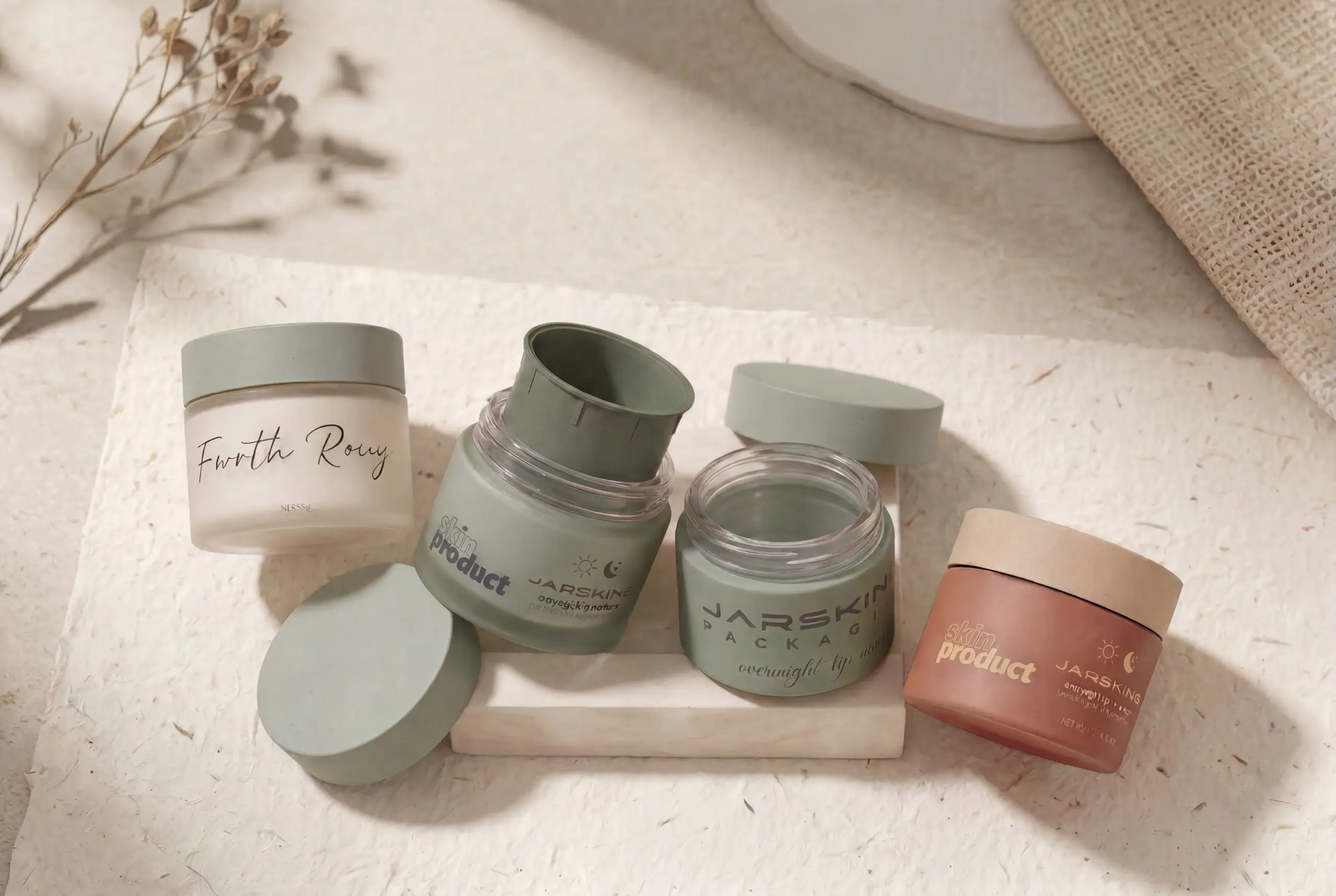
1. The Moment Sustainable Cosmetic Jar Packaging Became Non-Negotiable
Something shifted in the beauty packaging industry around 2023 — and by 2026, that shift has become a full transformation.
Sustainable cosmetic jar packaging is no longer a niche request from eco-conscious indie brands. It is now the single most discussed topic in cosmetic packaging procurement, across every market segment, every product category, and every geography we work with. From startup founders ordering 10,000 units of a facial cream to global skincare houses redesigning their entire packaging architecture, the question is the same: How do we make our jars more sustainable — and how do we prove it?
The urgency is real and multi-directional. Regulatory bodies in the EU and US are tightening requirements around recycled content, recyclability, and environmental claims. Major retail chains are publishing supplier sustainability mandates with teeth. And consumers — particularly in the 25–45 age bracket that drives premium skincare purchasing — are reading labels, researching brands, and making switching decisions based on packaging values alongside product performance.
This guide is written from inside the packaging manufacturing industry. It covers the materials, design innovations, regulatory realities, and sourcing best practices that define sustainable cosmetic jar packaging in 2026 — with the honesty and specificity that brands actually need to make good decisions.
2. What “Sustainable Cosmetic Jar Packaging” Actually Means in 2026
Before diving into materials and trends, let’s be honest about the term itself.
“Sustainable cosmetic jar packaging” has been stretched so broadly by marketing language that it risks meaning everything and nothing. We’ve seen clear virgin plastic jars marketed as “eco-friendly” because the factory had a recycling bin. We’ve seen jars labeled “biodegradable” that would sit in a landfill for centuries under standard disposal conditions. We’ve seen “recycled content” claims with no certification to back them up.
In 2026, sustainable cosmetic jar packaging has a working definition that serious buyers and brands have converged on:
Verified recycled content — post-consumer recycled (PCR) materials certified by an independent third-party standard (GRS — Global Recycled Standard)
Designed for end-of-life — recyclable, compostable, or refillable in the actual waste infrastructure of the target market
Documented and defensible — every sustainability claim backed by a certificate number, test report, or LCA data that can be independently verified
Manufactured responsibly — produced by a factory with ISO 14001 environmental management certification and documented emissions, water, and waste reduction programs
This is the standard the EU’s PPWR regulation, the EU Green Claims Directive, and the US FTC Green Guides are all converging toward. Brands that align their sustainable cosmetic jar packaging programs to this definition are ahead of the curve. Those still using vague green claims without documentation are accumulating legal and reputational risk.
3. The Six Materials Defining Sustainable Cosmetic Jar Packaging in 2026
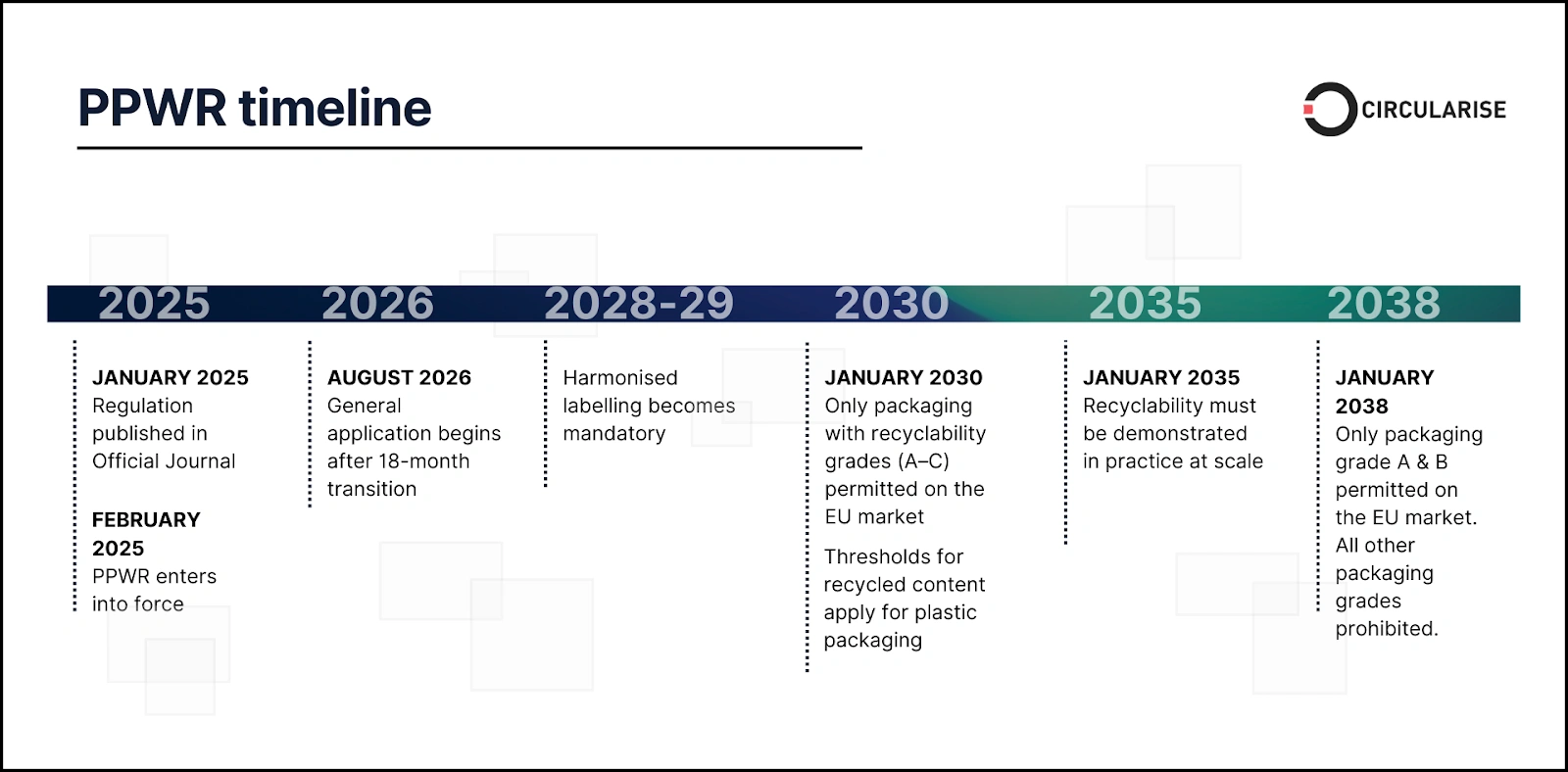
Material selection is the foundation. The right material for your sustainable cosmetic jar packaging program depends on your formulation chemistry, your brand positioning, your target market regulations, and your end-of-life goals. Here is an honest assessment of the six most important materials in play right now.
PCR (Post-Consumer Recycled) Plastic — The Workhorse of Sustainable Packaging
PCR plastic is made from post-consumer waste — plastic collected from recycling streams, cleaned, reprocessed, and turned into new resin. It is the most commercially scalable sustainable material in cosmetic jar manufacturing today, and for most brands beginning their sustainable cosmetic jar packaging journey, it is the most practical starting point.
The environmental credentials are genuine: PCR plastic reduces demand for virgin fossil-fuel-derived resin, diverts waste from landfills and oceans, and is accepted by major retailers as a credible sustainability claim when GRS-certified. Top-tier manufacturers now offer jars with 30%, 50%, or 100% PCR content across PP, PET, and HDPE formats.
What buyers need to know: PCR resin can carry slightly more color variation and surface texture inconsistency than virgin plastic — a natural result of the mixed-source waste stream it comes from. Quality manufacturers manage this through rigorous batch testing and strict incoming material specifications. Always request batch consistency documentation alongside GRS certificates.
Recycled Glass — Premium Sustainability With a Story
Glass holds a unique position in sustainable cosmetic jar packaging: it is the only material that is infinitely recyclable without any degradation in quality or purity. The same glass molecules can cycle through the loop endlessly. For prestige skincare brands where packaging communicates brand values as powerfully as formulation, recycled glass is increasingly the material of choice.
Jars made from recycled cullet (crushed, sorted, post-consumer glass) carry all the functional advantages of virgin glass — chemical inertness, UV protection in amber formulations, visual weight and clarity — with a demonstrably lower carbon footprint and a consumer-resonant sustainability story.
The practical consideration for buyers: clear recycled glass can carry a subtle color cast (faint green or brown) depending on cullet composition. For brands with strict color specifications, this requires careful supplier color tolerance management and batch sampling before production commitment.
Bioplastics — Promising, With Important Caveats
Plant-derived bioplastics represent the frontier of sustainable cosmetic jar packaging material innovation, and they deserve both enthusiasm and careful evaluation.
PLA (Polylactic Acid): Derived from corn or sugarcane. Compostable under industrial composting conditions (EN 13432 certified). Not home-compostable. Has heat resistance limitations — not suitable for products stored in warm climates or sunny retail environments.
PHA (Polyhydroxyalkanoates): Produced by bacterial fermentation of plant sugars. Can be home-compostable under certified conditions. Higher cost and lower production scalability than PLA, but the most genuinely circular bioplastic currently available.
Bio-PE (Bio-based Polyethylene): Chemically identical to fossil PE, derived from sugarcane ethanol. Recyclable through standard PE streams. Does not biodegrade — but carries a meaningfully lower lifecycle carbon footprint than petroleum-derived PE.
The crucial point for any brand making bioplastic-based sustainability claims: confirm the specific certified end-of-life pathway for your polymer, and verify that your customers’ local waste infrastructure actually supports it. A compostable jar is only a sustainable solution if composting infrastructure exists where your customers live.
Aluminum — Infinitely Recyclable and Underutilized
Aluminum deserves more attention in sustainable cosmetic jar packaging than it typically receives. It is infinitely recyclable with no quality loss, lightweight (reducing shipping carbon footprint), naturally antimicrobial (beneficial for preservative-free and clean beauty formulations), and carries a genuinely premium aesthetic that photographs beautifully.
For prestige brands, independent beauty labels, and brands in the solid skincare or concentrated treatment space, aluminum jars are an increasingly compelling choice — one that combines genuine environmental credentials with a visual language that communicates quality and intentionality without requiring a paragraph of explanation.
Monomaterial Recyclable Systems — The Design Standard Every Brand Should Adopt
Monomaterial construction is one of the most impactful decisions in sustainable cosmetic jar packaging design — and one of the least discussed in brand-side conversations.
A conventional cosmetic jar is often a multi-material assembly: PP body, ABS lid, PE inner liner, metal decorative collar, adhesive label. That combination is virtually unrecyclable in standard municipal systems because the materials cannot be separated economically at scale. The jar ends up in landfill regardless of the recycling symbol on its base.
A monomaterial jar — where body, lid, liner, and closures are all the same resin family — can be recycled in a single stream with no separation required. It is cleaner, simpler, and increasingly mandated by EU PPWR and preferred by major retailer sustainability programs. For any brand building a serious sustainable cosmetic jar packaging program in 2026, monomaterial design should be the default specification, not an upgrade.
FSC-Certified and Natural Material Accents
While the jar body and closure are the primary sustainability focus, decoration and accent materials matter too. Bamboo lids, cork closures, FSC-certified wood accents, and compressed natural fiber elements communicate sustainability in a tactile, immediate way that certifications printed in 6pt font cannot.
For brands in the luxury natural beauty, botanical skincare, and wellness space, natural material accents are not just aesthetically differentiating — they are brand language. They put the sustainability story directly in the consumer’s hand.
4. Design Trends Shaping Sustainable Cosmetic Jar Packaging in 2026
Material innovation and design philosophy must work together. The most impactful sustainable cosmetic jar packaging solutions in 2026 combine responsible material choices with thoughtful design architecture.
Refillable Jar Systems: The Future of Sustainable Beauty Packaging
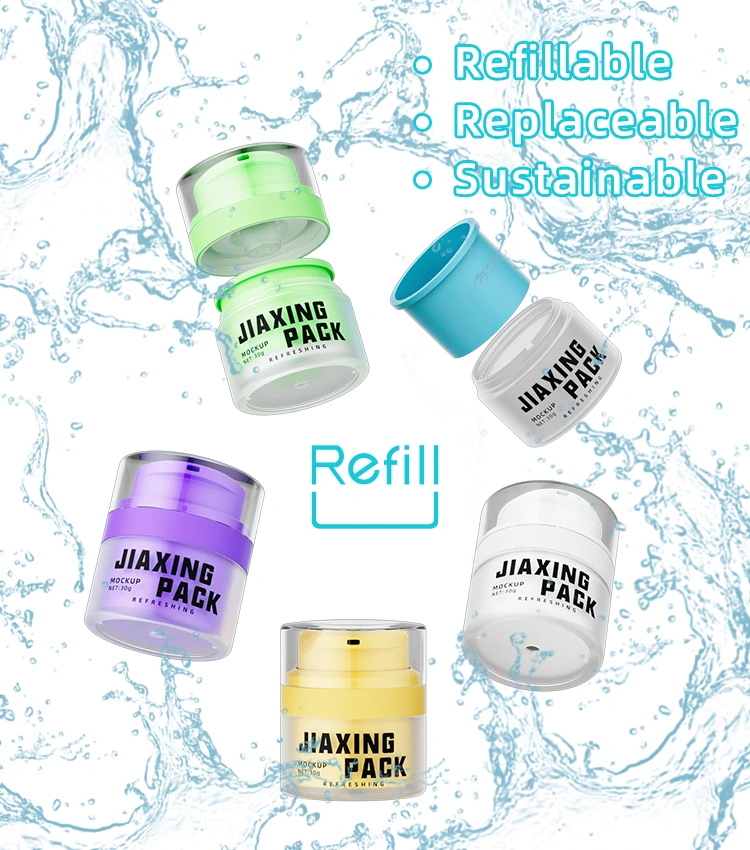
Refillable cosmetic jar architecture is one of the most commercially and environmentally significant design trends defining sustainable cosmetic jar packaging right now. The structure is elegant: a durable, premium outer shell paired with a removable inner pod. Consumers purchase the full system once, then buy only the inner refill on subsequent purchases — reducing virgin material use by 70–80% per product unit sold after the initial purchase.
The brand benefits extend beyond sustainability: refillable systems generate measurably higher customer retention rates, reduce the cost-per-unit of ongoing material consumption, and create a packaging-based loyalty mechanism that conventional single-use jars cannot replicate. Brands like Kjaer Weis, Tata Harper, and Aesop have demonstrated the commercial viability of refillable architecture at scale. In 2026, off-the-shelf refillable formats are increasingly available at accessible MOQs.
Technical note for buyers: Refillable systems require tighter dimensional tolerances than standard jars — inner pods must engage and release reliably across hundreds of refill cycles. Always request a repeat-use durability test report (minimum 50-cycle fit and function test) before committing to production.
Minimalist Packaging and Intentional Material Reduction
The most sustainable package is often the smallest one. Eliminating outer cartons reduces total packaging weight by 20–40%, lowers shipping costs, reduces raw material consumption, and sends a clear visual signal about brand values — one that resonates strongly with premium beauty consumers who are increasingly skeptical of over-packaged products.
Minimalist sustainable cosmetic jar packaging requires brands to rethink where and how they communicate. Product information migrates to the jar surface itself. Brand storytelling moves to QR codes, digital platforms, and FSC-certified paper inserts. The result is both more sustainable and more aesthetically refined — a win on both dimensions.
Smart Packaging Integration
QR codes, NFC chips embedded in lids, and AR-enabled surfaces are becoming meaningful components of premium sustainable cosmetic jar packaging programs in 2026. These technologies replace paper inserts and outer carton copy with digital content — reducing material use while creating more dynamic, updateable consumer touchpoints.
Smart packaging also serves a growing regulatory function: in the EU, the forthcoming Digital Product Passport framework will require traceable product and material information that smart packaging infrastructure can deliver efficiently and cost-effectively.
5. The Regulatory Landscape for Sustainable Cosmetic Jar Packaging in 2026
Understanding the regulatory environment is no longer optional for brands sourcing sustainable cosmetic jar packaging. The rules are specific, the timelines are active, and the consequences of non-compliance are real.
EU Packaging and Packaging Waste Regulation (PPWR)
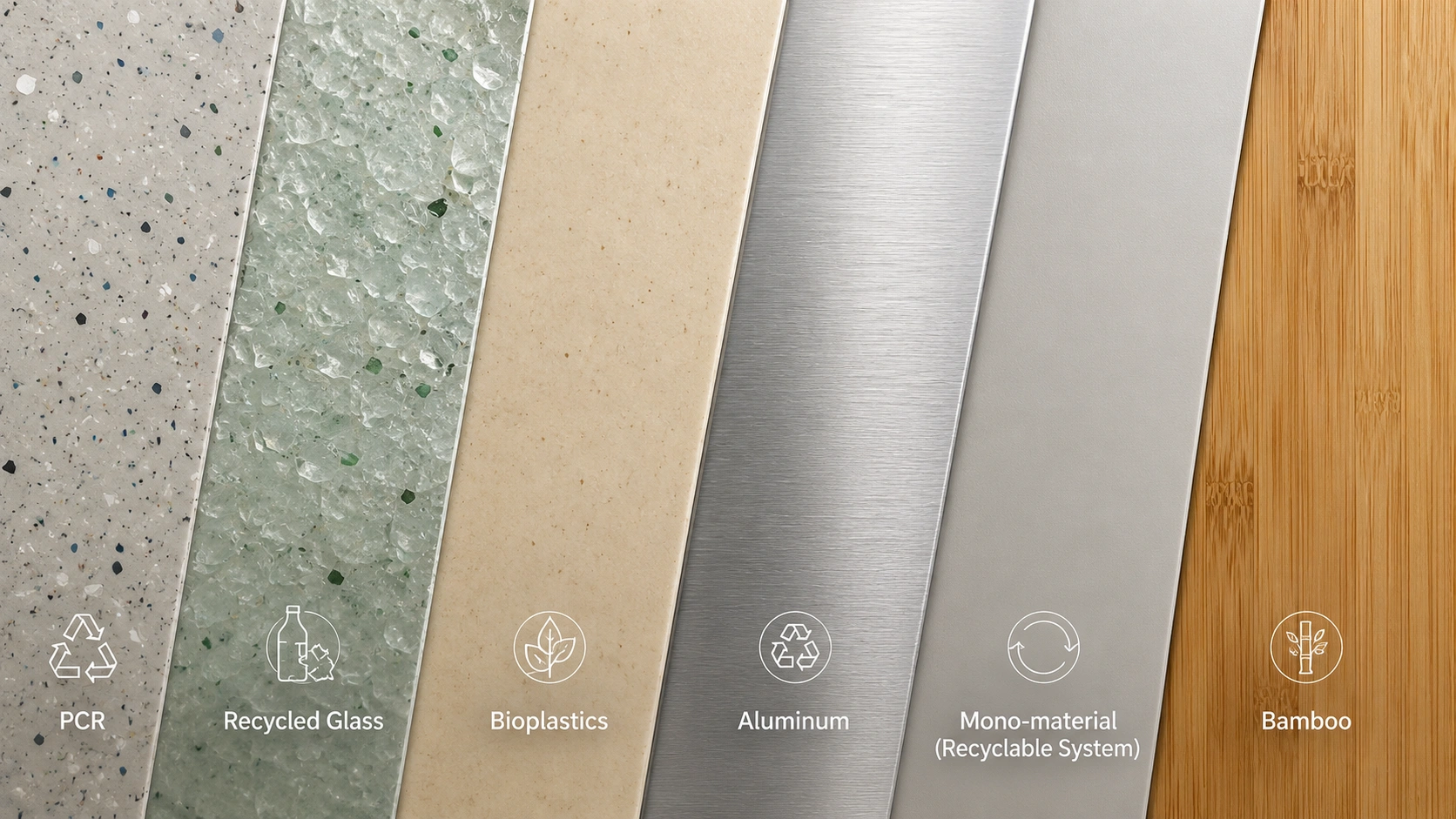
Now active: Minimum 30% recycled content required for single-use plastic packaging sold in EU markets
By 2030: All packaging must be fully recyclable; PCR content minimums rise to 35–65% by material category
Ongoing: Extended Producer Responsibility (EPR) schemes require brands to contribute to end-of-life collection and recycling infrastructure
Any brand selling sustainable cosmetic jar packaging into EU markets must have GRS-certified PCR content documentation and recyclability assessments for every SKU — not as a best practice, but as a legal compliance requirement.
EU Green Claims Directive
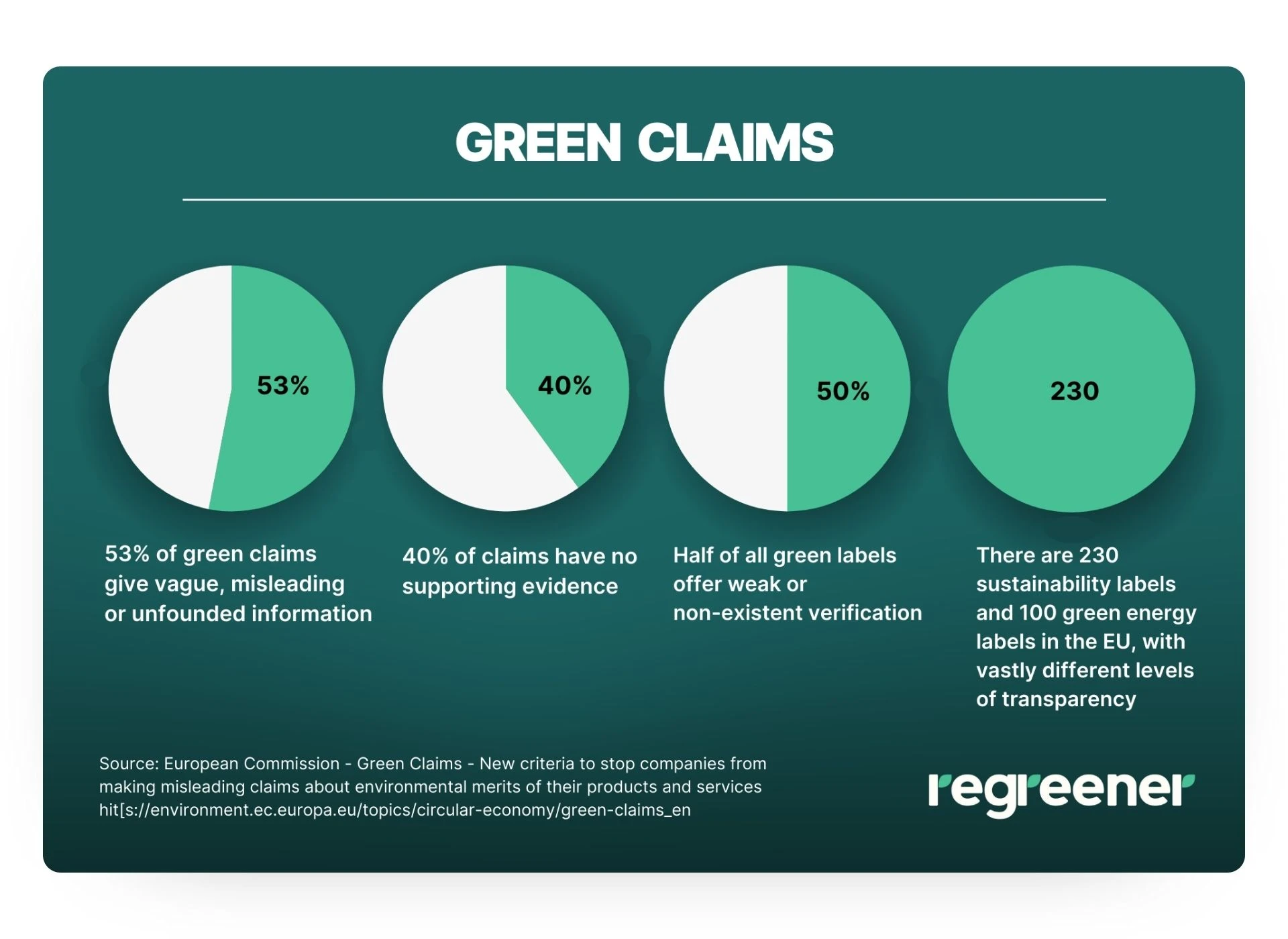
Vague environmental claims — “eco-friendly,” “green packaging,” “sustainable jar” — are prohibited without documented, verifiable substantiation. Every environmental claim on your packaging or in your marketing needs a paper trail: a certificate number, a test report, LCA data. This directive is the regulatory formalization of what credible brands in the sustainable cosmetic jar packaging space have already been doing voluntarily.
US FTC Green Guides
In the US, “recyclable” claims require that recycling infrastructure exists for the material in the communities where the majority of your customers live. “Biodegradable” claims require specific, verifiable conditions and timelines. The FTC Green Guides make vague sustainability marketing a legal liability — not just a reputational one.
Source: https://www.regreener.earth/blog/the-eu-green-claims-directive%3A-a-short-summary
6. How to Source Sustainable Cosmetic Jar Packaging: A Practical Checklist
Use this checklist when evaluating any supplier for a sustainable cosmetic jar packaging program:
Define Your Sustainability Goals
Identify your primary objective: PCR content, recyclability, compostability, refillability, carbon reduction, or a combination
Map your target markets to their applicable regulations (EU PPWR, FTC Green Guides, UK Plastic Packaging Tax)
Determine which sustainability claims you will make on-pack — and what documentation you need to substantiate each one
Confirm whether monomaterial construction is required for your recyclability goals
Qualify Your Supplier
Request GRS certification — verify the certificate number independently on the GRS registry
Request ISO 14001 environmental management system certification
Ask for product carbon footprint (PCF) data in kg CO₂e per unit
Confirm renewable energy use in manufacturing operations
Ask for documented waste and water reduction programs at the factory level
Verify Your Materials
Confirm exact PCR content percentage and post-consumer resin type
For bioplastics: confirm the specific polymer and certified compostability standard
For recycled glass: confirm cullet source, percentage, and color consistency standards
For monomaterial claims: confirm resin type for every single component in writing
Validate Technically
Request a recyclability assessment for the complete packaging system (jar + lid + liner + labels)
Confirm decoration methods (inks, adhesives, coatings) are recyclable-compatible
For refillable systems: request 50-cycle durability test data
Conduct fill compatibility testing with your actual formulation at 30, 60, and 90 days
Build Your Documentation
Create a sustainability documentation file per SKU: GRS certificate, recyclability report, PCR batch data, LCA/PCF figures
Confirm batch-to-batch PCR content consistency is documented per production run
Include sustainability specification compliance as a contractual obligation in your purchase agreement
7. The Business Case for Investing in Sustainable Cosmetic Jar Packaging
For buyers still weighing whether the investment is commercially justified, the 2026 market evidence is clear and compelling.
Premium pricing power: Brands with credible, documented sustainable cosmetic jar packaging programs consistently command 10–25% price premiums over comparable products in conventional packaging within premium beauty retail. The perceived value of genuine, verifiable sustainability is a proven commercial lever.
Retail channel access: Sustainability compliance is increasingly a prerequisite for shelf placement in leading beauty retail globally — Sephora, Ulta, Boots, and others. Brands that cannot document their packaging sustainability credentials face exclusion from retail programs that competitors with compliant packaging will win.
Customer retention: Consumers who connect with a brand’s environmental values show measurably higher repurchase rates and lower price sensitivity than those whose relationship is purely product-performance-based. Refillable sustainable cosmetic jar packaging systems take this to its commercial extreme — converting packaging into a retention mechanism.
Regulatory risk mitigation: Brands already compliant with EU PPWR, the Green Claims Directive, and FTC Green Guides carry no compliance disruption risk as enforcement intensifies. Brands that have deferred this work are accumulating a liability that will eventually demand a rushed, expensive transition.
Cost trajectory: The unit cost premium of sustainable materials over conventional virgin plastics is narrowing rapidly. PCR plastic has reached near-cost parity with virgin resin in several market segments. The cost of non-compliance — regulatory penalties, retail delisting, consumer backlash — increasingly exceeds the cost of doing the right thing proactively.
8. What Separates a Real Sustainable Packaging Supplier From a Marketing One
The final, perhaps most important, element of sourcing sustainable cosmetic jar packaging well is being able to tell the difference between suppliers who are genuinely committed to sustainability and those who have learned the vocabulary without doing the work.
A genuine sustainable cosmetic jar packaging supplier will:
Provide GRS certificates with verifiable certificate numbers — not PDFs without traceable registry entries
Deliver batch-level PCR content documentation for every production run — not one certificate for all orders
Offer recyclability assessments covering every component of the system — not just the jar body
Share specific factory environmental data (energy, water, waste metrics) — not aspirational language in a brochure
Proactively communicate regulatory changes affecting your markets — because they track the landscape, not just their order book
Stand behind their sustainability claims contractually — not just verbally
The documentation your supplier provides is the foundation of every sustainability claim you make. If that foundation is thin, your claims are exposed. Choose your sustainable cosmetic jar packaging supplier the way you would choose any strategic business partner — based on transparency, accountability, and a track record that holds up under scrutiny.
9. Looking Forward: Where Sustainable Cosmetic Jar Packaging Goes Next
The trajectory is clear. By 2030, recyclable, refillable, and low-carbon sustainable cosmetic jar packaging will not be a premium option — it will be the standard. The brands and suppliers building those capabilities now will be positioned to lead. Those waiting for the market to force the change will be scrambling to catch up.
The most exciting developments we see ahead:
Higher PCR content thresholds becoming commercially standard (75–100% PCR) as recycled feedstock supply chains mature
Digital Product Passports making full material traceability a consumer-facing reality — your jar will carry a scannable record of its entire material lifecycle
Home-compostable bioplastics (PHA and next-generation formulations) reaching commercial scalability and accessible pricing
Refillable systems moving from premium niche to mass-market mainstream across skincare, body care, and color cosmetics
Carbon-labeled packaging becoming a retail requirement — jar suppliers providing product carbon footprint data as standard, the way unit cost is provided today
The beauty industry has an extraordinary opportunity — and a genuine responsibility — to lead the consumer goods sector toward more circular, more responsible packaging. Sustainable cosmetic jar packaging is not the end goal. It is the beginning of a deeper commitment to how the industry makes, uses, and recovers the materials it puts into the world.
At Othilapak, sustainable cosmetic jar packaging is at the center of everything we do. We offer GRS-certified PCR plastic jars, recycled glass programs, all-aluminum jar systems, monomaterial recyclable designs, and refillable jar architecture — all backed by full batch documentation, certified sustainability credentials, and a team that genuinely knows the difference between a green claim and a green result. Let’s build something worth being proud of.
FAQs
What is sustainable cosmetic jar packaging?
Sustainable cosmetic jar packaging refers to cosmetic jars that are designed, manufactured, and documented to minimize environmental impact across their full lifecycle. In practice, this means using verified recycled content (such as GRS-certified PCR plastic or recycled glass cullet), designing for recyclability or refillability at end-of-life, and substantiating every environmental claim with third-party certification or test data. In 2026, the term has a working regulatory definition shaped by the EU’s Packaging and Packaging Waste Regulation (PPWR) and the US FTC Green Guides — making documentation just as important as the material itself.
What materials are used in sustainable cosmetic jar packaging?
The most commercially relevant materials in sustainable cosmetic jar packaging in 2026 include GRS-certified PCR (post-consumer recycled) plastic, recycled glass made from post-consumer cullet, bioplastics such as PLA, PHA, and bio-PE, aluminum (infinitely recyclable with no quality loss), and monomaterial PP or PET systems designed for single-stream recycling. Each material has distinct trade-offs in cost, aesthetic, formulation compatibility, and end-of-life pathway. The right choice depends on your brand positioning, target market regulations, and sustainability goals — there is no universal answer.
What certifications should I look for when sourcing sustainable cosmetic jar packaging?
The most important certifications for sustainable cosmetic jar packaging are: GRS (Global Recycled Standard) for PCR content verification, ISO 14001 for supplier environmental management systems, ISO 9001 for production quality management, and EN 13432 or ASTM D6400 for compostable bioplastic claims. For US-market brands, FDA material compliance documentation is also essential. For EU-market brands, REACH compliance and recyclability assessments aligned with PPWR requirements are mandatory. Always verify certificate numbers independently through the issuing body’s official online registry — never rely solely on a PDF supplied by the manufacturer.
How does EU PPWR affect sustainable cosmetic jar packaging sourcing?
The EU Packaging and Packaging Waste Regulation (PPWR) sets binding targets that directly impact cosmetic jar sourcing. As of 2025, single-use plastic packaging sold in EU markets must contain a minimum of 30% recycled content. By 2030, all packaging must be fully recyclable, and PCR content minimums will increase to 35–65% depending on material category. Additionally, the EU Green Claims Directive prohibits vague environmental claims — “eco-friendly” or “sustainable packaging” — without documented, verifiable substantiation. Brands sourcing sustainable cosmetic jar packaging for EU distribution must ensure their supplier can provide certified documentation for every production batch.
What is the difference between a recyclable jar and a sustainable cosmetic jar?
Recyclability is one dimension of sustainability — but not the whole picture. A jar can be technically recyclable but still unsustainable if it is made entirely from virgin fossil-fuel plastic, manufactured in a factory with no environmental management practices, and shipped across the world in ways that negate its recycling benefit. Truly sustainable cosmetic jar packaging considers the full lifecycle: the origin of the raw materials (recycled or virgin), the environmental footprint of manufacturing, the carbon cost of logistics, and the realistic end-of-life pathway in the target market’s actual waste infrastructure. Recyclability is a necessary feature of sustainable packaging — but it is not sufficient on its own.
What is monomaterial cosmetic jar packaging and why is it important?
Monomaterial cosmetic jar packaging means the jar body, lid, inner liner, and all closures are made from the same resin family — for example, all polypropylene (PP) or all PET. This is critical because multi-material jar assemblies (PP body + ABS lid + PE liner + metal collar) cannot be recycled efficiently in standard municipal waste systems — the materials cannot be economically separated, so the jar ends up in landfill regardless of the recycling symbol on its base. Monomaterial design enables genuine single-stream recyclability, aligns with EU PPWR requirements, and is increasingly preferred by major retail partners with supplier sustainability mandates.