

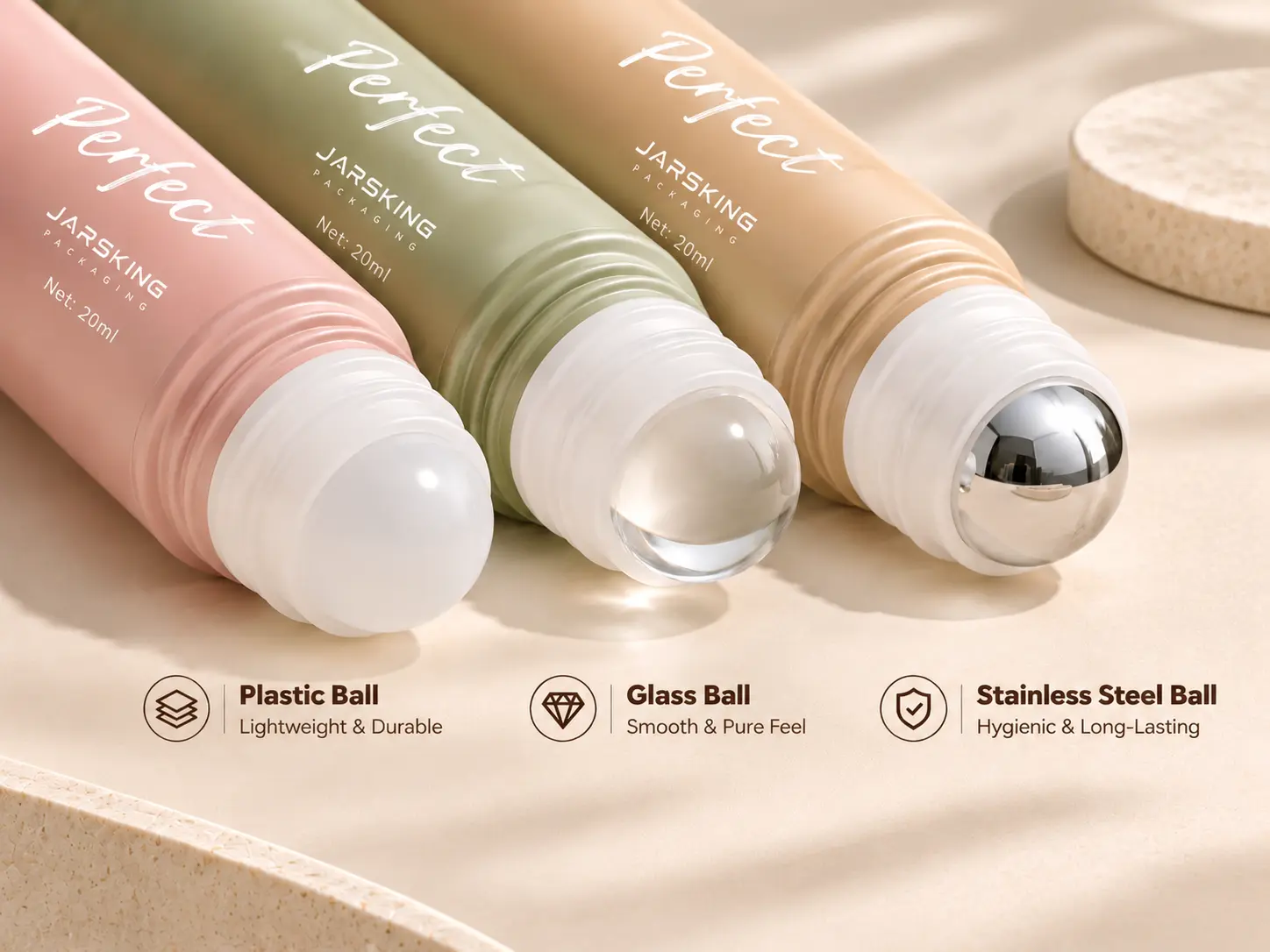

Choosing a roller ball for skincare packaging is not simply a choice between a cool metal applicator, a glass component, or a lower-cost plastic option. The material affects the user’s first contact with the product, but the complete roller assembly determines whether the package dispenses smoothly, stays secure in transport, and remains suitable for the intended formula.
For skincare brands, there is no universal “best” roller-ball material.
Stainless steel is often considered when a brand wants a cooler-touch, treatment-oriented applicator for eye serums and targeted facial care. Glass is often considered when a brand wants a non-metal product-contact option or a glass-led packaging direction. Plastic is often considered for lightweight, cost-conscious, higher-volume, or daily-use skincare formats. However, none of these materials should be approved based on appearance alone.
The correct choice depends on the complete packaging system:
- The skincare application
- Formula type and viscosity
- Roller-ball material and diameter
- Roller housing or seat
- Bottle neck and cap structure
- Filled volume and headspace
- Storage and transport conditions
- Required consumer experience
- Actual formula testing
A roller ball is only one component. A stainless steel ball inside an unsuitable housing can stick or leak. A glass ball can perform poorly if the bottle neck and seat are mismatched. A plastic ball can work reliably when the selected resin, fitment, formula, and test conditions are appropriate.
The right question is not:
Which roller ball material is best?
The better question is:
Which complete roller-ball assembly gives this skincare formula the right application feel, controlled flow, leakage resistance, and commercial fit?
1. Start With the Skincare Application, Not the Material
A skincare roller-ball package is a dispensing system, not simply a bottle with a ball at the top. As the ball rotates inside the housing, it draws product from the bottle and transfers a thin layer to the skin. The ball material contributes to the experience, but the application area and formula behavior determine what the system needs to do.
An under-eye serum has different requirements from a facial treatment gel. A spot-care product has different requirements from a massage-oriented neck treatment. A lightweight water-based serum may release easily through a roller-ball assembly, while a thicker gel may require a different ball size, flow channel, or fitment design.
Before comparing stainless steel, glass, and plastic, define the product use case.
Ask these questions:
- Is the product for the eye area, face, neck, body, or a targeted treatment zone?
- Does the brand want a cooling, neutral, or simple functional application experience?
- Is the formula a low-viscosity serum, gel, emulsion, oil, or treatment fluid?
- Does the formula contain suspended particles, pigments, or ingredients that could affect flow?
- Will consumers use the package frequently, carry it in a bag, or travel with it?
- Does the product need precise application or wider coverage?
- Will the formula be exposed to temperature changes during storage or transport?
These answers should shape the packaging brief before the buyer requests a steel, glass, or plastic roller-ball sample.
2. Stainless Steel vs Glass vs Plastic Roller Balls at a Glance
| Decision factor | Stainless steel roller ball | Glass roller ball | Plastic roller ball |
| Typical skincare direction | Cooling, targeted, treatment-oriented application | Glass-led or non-metal applicator direction | Lightweight, practical, high-volume daily use |
| Initial skin feel | Often perceived as cooler and smoother | More neutral contact sensation | Depends on resin, surface finish, and ball quality |
| Weight | Higher than plastic | Varies with component size | Usually the lightest option |
| Visual effect | Technical, clinical, or treatment-oriented | Can align with clear, frosted, or colored glass packaging | Can be color-matched with plastic bottles, caps, or housings |
| Material specification needed | Steel grade and finish, plus housing material | Glass specification, plus housing material | Exact resin, additives, colorants, and housing material |
| Formula suitability | Must be confirmed with actual formula | Must be confirmed with actual formula | Must be confirmed with actual formula |
| Leakage resistance | Depends on complete assembly, not material alone | Depends on complete assembly, not material alone | Depends on complete assembly, not material alone |
| Sourcing consideration | Material and assembly specification must be clear | Handling and complete fitment should be reviewed | Do not accept “plastic” as a complete specification |
| Approval method | Filled-package testing | Filled-package testing | Filled-package testing |
The table does not identify a winner because the correct material changes with the product, formula, target market, and brand position.
3. When Stainless Steel Roller Balls Are Worth Shortlisting
Stainless steel roller balls are often shortlisted for skincare products where the applicator experience is part of the product story.
For example, an eye serum may benefit from a roller-ball format because the brand wants direct application around the eye contour without using fingers. A stainless steel ball may support a cooler initial touch and a smoother, massage-oriented application experience. This can work well for products positioned around morning routines, targeted treatment, or precision skincare.
Stainless steel can be worth considering when:
- The application is focused on the eye area, facial contour, or small treatment zones.
- The brand wants a cooler-feeling applicator.
- The package will be used repeatedly and needs a durable-looking component.
- The brand visual direction is technical, clinical, or treatment-led.
- The project includes complete sample and formula testing.
However, “stainless steel” is not a complete technical requirement.
The buyer should ask for the steel material description or grade, the ball diameter, the roller housing material, the bottle-neck specification, and the cap structure. The steel ball may be visible to the consumer, but the housing that holds it can be equally important for formula contact, ball movement, product flow, and leakage resistance.
A supplier should not simply promise that a metal roller ball is compatible with all serums or active skincare formulas. Compatibility must be evaluated using the actual formulation and the final product-contact assembly.
4. When Glass Roller Balls Are Worth Shortlisting
Glass roller balls can be useful for skincare brands that want to compare a non-metal applicator option or create a more unified glass packaging direction.
A glass ball may be considered when the product is sold in a glass bottle and the brand wants the applicator system to align with that material direction. It may also be included in a sample comparison when the formula team prefers to evaluate an option without a metal ball at the product-contact point.
Glass roller balls can be worth considering when:
- The brand wants to compare steel and non-metal options during sample development.
- The bottle body is glass and visual consistency matters.
- The desired consumer experience is more neutral than distinctly cooling.
- The formula team wants to evaluate the complete package with a glass product-contact surface.
- The project can include transport, handling, and repeated-use testing.
Glass should not be described as automatically better for every skincare formula, sensitive-skin product, or active ingredient. The formula itself, the roller housing, the bottle neck, the cap, the fill process, and the storage conditions still need review.
The buyer should also consider the complete package’s handling requirements. A glass roller ball may be only a small part of the overall package, but the product still needs to be reviewed for assembly handling, bottle durability, secondary packaging, transit protection, and the final consumer experience.
5. When Plastic Roller Balls Are Worth Shortlisting
Plastic roller balls should not be treated as a lower-quality fallback. For the right skincare project, plastic can be a practical and commercially sensible option.
Plastic roller balls are often considered for lightweight skincare products, daily-use formats, cost-sensitive projects, travel-oriented packaging, and larger-volume applications where the product experience does not depend on a strong cooling sensation. They can also support coordinated all-plastic packaging directions, including matched bottle, cap, housing, and roller components.
Plastic roller balls can be worth considering when:
- The product is a daily-use skincare item with a practical, accessible market position.
- The brand prioritizes lightweight packaging or reduced breakage concerns.
- The package is intended for travel, e-commerce, or high-volume distribution.
- The desired application experience is smooth and functional rather than cooling-led.
- The project requires color coordination across the bottle, cap, roller housing, and ball.
- The selected resin and complete assembly can be tested with the actual formula.
The key rule is that “plastic” is not a material specification.
A buyer should ask which resin is being used for the roller ball, which resin is used for the housing, whether colorants or additives are involved, and whether those materials have been evaluated with the intended formula. Different plastic materials can behave differently under exposure to oils, alcohols, acids, salts, fragrances, temperature changes, and repeated use.
A white plastic roller ball, a clear plastic roller ball, and a colored plastic roller ball may not represent the same specification. The resin, production method, finish, and fitment design all matter.
For a skincare brand, plastic may be the right choice when it supports the product’s commercial model. A lightweight, daily-use eye treatment or facial gel may not need the same applicator experience as a prestige under-eye serum. The decision should follow the product and buyer, not an assumption that metal always communicates higher value.
6. Do Not Compare the Ball Material Without Comparing the Housing
The roller ball does not dispense product by itself. It works within a housing, also called a fitment or roller seat, that holds the ball in position while allowing it to rotate.
The space between the ball and housing determines how much product can reach the skin. If the fit is too tight, the consumer may experience dry rolling, inconsistent flow, or a ball that feels stuck. If the fit is too loose, the package may release too much product, pool around the ball, or leak during storage.
This is why a complete comparison should include:
| Component | What to check |
| Roller ball | Material, diameter, surface quality, and supplier specification |
| Roller housing | Resin, shape, ball retention, and flow-channel design |
| Bottle neck | Drawing, dimensions, and fit with the selected housing |
| Cap | Retention, pressure on the roller assembly, and closure fit |
| Formula | Viscosity, ingredients, particles, temperature response, and fill behavior |
| Bottle body | Material, capacity, headspace, and handling requirements |
| Decoration | Whether coating, printing, labels, or finishes remain acceptable after use |
| Secondary packaging | Protection needed for storage, e-commerce, and transport |
A steel ball can leak. A glass ball can leak. A plastic ball can leak. In each case, the root cause may be the fitment, bottle neck, cap pressure, formula flow, or assembly variation rather than the ball material itself.
7. How Formula Behavior Changes the Choice
A formula that works with one roller-ball material and housing may not work with another.
Low-viscosity serums may move quickly through the ball-seat clearance. If the package is not properly matched, the product may flood the applicator or seep during side storage. A thick gel may not release consistently through a standard roller assembly. A formula with suspended particles may create a clogging risk. A treatment product exposed to warm transport conditions may behave differently from the same product tested at room temperature.
Before sample approval, the buyer should provide as much relevant formula information as possible, including:
- Product type: serum, gel, emulsion, treatment fluid, or other format
- Application area: eye, face, neck, body, or targeted spot care
- Approximate flow behavior and viscosity
- Whether the formula contains particles or pigments
- Whether the formula includes oils, fragrance materials, acids, salts, or actives requiring additional review
- Filling temperature and filling method
- Expected storage temperatures
- Target sales regions and shipping conditions
- Intended shelf-life and stability-testing requirements
The supplier does not need confidential formula details that are not relevant to packaging. But a vague request such as “I need a 15 ml roller bottle” gives far less useful information than a clear skincare brief.
8. What to Test Before Approving Stainless Steel, Glass, or Plastic
A skincare package should not be approved from an empty bottle sample alone.
The final evaluation should use the intended bottle, ball, housing, cap, fill volume, decoration, and actual formula. If the product will be sold internationally or through e-commerce, the test plan should also consider the relevant storage and transport conditions.
A practical sample-approval checklist includes:
- Confirm the bottle, roller ball, housing, cap, and any insert or gasket are the final intended components.
- Record the supplier item number and material description for every product-contact component.
- Fill samples with the actual formula at the intended fill level.
- Check first-use product release after the package has remained unopened.
- Check rolling performance after repeated use.
- Inspect for dry rolling, sticking, uneven flow, pooling, flooding, or product build-up.
- Review upright, side-standing, and inverted storage behavior where relevant.
- Inspect for seepage around the ball, housing, cap, and bottle neck.
- Check the package after temperature exposure and transport simulation appropriate to the project.
- Review the visual condition of printing, labels, coatings, and decorative finishes.
- Retain an approved physical sample, technical drawing revision, and component list.
The approval criteria should be defined before bulk production. A buyer should know what counts as acceptable product flow, acceptable leakage performance, acceptable applicator feel, and acceptable visual quality.
9. How to Brief a Supplier for a Three-Material Comparison
If a brand wants to compare stainless steel, glass, and plastic roller balls, the comparison should be controlled.
Do not request three loose balls and choose based on appearance. Request three complete sample assemblies that are as comparable as possible.
The brief should include:
- Product application and consumer-use area
- Formula type and relevant flow behavior
- Target bottle size and fill volume
- Preferred bottle material
- Desired ball materials: stainless steel, glass, and plastic
- Any required visual direction, such as clear, frosted, white, metallic, or color-matched packaging
- Target market and shipping route
- Expected order quantity and launch timing
- Sample requirements and approval process
Ask the supplier to identify what changes between the three options. For example, will the housing change? Does the ball diameter change? Is the cap structure different? Are the bottle neck and closure the same? Without this information, the buyer may believe they are comparing ball materials when they are actually comparing different complete systems.
10. A Practical Decision Path
Use this five-step process when choosing a roller-ball material for skincare packaging.
• Define the skincare use case
State whether the product is an eye serum, facial serum, spot treatment, gel treatment, or massage-oriented skincare format.
• Define the required user experience
Decide whether cooling contact, neutral application, low weight, color matching, durability, or a glass-led visual direction matters most.
• Shortlist complete assemblies
Build steel, glass, and plastic sample routes using matched bottle, housing, cap, and fill-volume conditions wherever possible.
• Test with the actual formula
Evaluate flow, smoothness, leakage, repeated use, storage orientation, temperature exposure, and transit conditions.
• Approve the whole package
Select the version that performs best across formula behavior, user experience, visual direction, supply consistency, and commercial feasibility.
The right answer may be steel for a cooling eye serum, glass for a glass-led facial treatment, or plastic for a lightweight daily-use skincare product. The decision should follow evidence from the finished package, not a material stereotype.
11. Choose the Complete Roller System
Stainless steel, glass, and plastic roller balls can all have a place in skincare packaging. The best option depends on what the product must do for the consumer and how the complete package performs with the actual formula.
For a cooling eye treatment, a stainless steel ball may be the strongest starting point. For a glass-led serum or a project requiring a non-metal option, glass may be worth sampling. For a lightweight, practical, daily-use skincare format, plastic may provide the right balance of function and commercial fit.
Send your product application, formula type, target volume, preferred bottle material, destination market, and the roller-ball materials you want to compare. Othilapak can review the bottle, housing, ball, cap, and formula requirements together and identify the samples and validation checks needed before production.
FAQs
Which roller ball material is best for skincare packaging?
No single roller ball material is best for every skincare product. Stainless steel, glass, and plastic should be selected according to formula behavior, application area, desired skin feel, packaging weight, and complete filled-package testing.
Which roller ball material is least likely to leak?
Roller-ball material alone does not determine leakage resistance. Leakage depends on the ball-seat clearance, housing, bottle neck, cap pressure, formula viscosity, fill volume, storage position, and transport conditions.
Can gel serums be used in roller-ball packaging?
Some gel serums can work in roller-ball packaging, but thicker formulas may require a different ball size, housing clearance, or flow-channel design. Test for dry rolling, clogging, uneven dispensing, pooling, and leakage using filled samples.
What should a skincare brand ask a roller-bottle supplier?
Ask for the roller-ball material, housing material, bottle-neck details, cap structure, product-contact component list, and sample-testing recommendation. Also provide the formula type, target volume, application area, destination market, and expected storage conditions.
Should skincare brands test steel, glass, and plastic roller balls with the actual formula?
Yes. Water testing can identify obvious assembly problems, but it cannot prove that a skincare formula will flow, remain stable, and resist leakage in the same way. Final approval should use the actual formula in the intended package.
Can a roller ball be changed after the packaging sample is approved?
Changing from stainless steel to glass or plastic should be treated as a component change, not a cosmetic adjustment. The revised complete package should be re-tested because material, fit, flow, skin feel, and leakage performance may change.