

When a beauty brand considers changing the material used in its packaging, the decision reaches well beyond the appearance of the bottle. The proposed material must work with the formula, fit the closure, suit the filling process, and perform throughout storage, shipping, and everyday use. If the project also includes a home compostability goal, the brand needs evidence that supports that specific claim.
At Othilapak, these questions connect material research with practical packaging development. A new material creates possibilities worth exploring, but its suitability depends on the complete application. The starting point is understanding what the brand needs the package to do, which conditions it will encounter, and what evidence is required before a decision can be made.
The evaluation follows a sequence: establish the evidence, define the application, assess the finished package, and confirm production and commercial requirements.
1. Start With What the Patent Actually Establishes
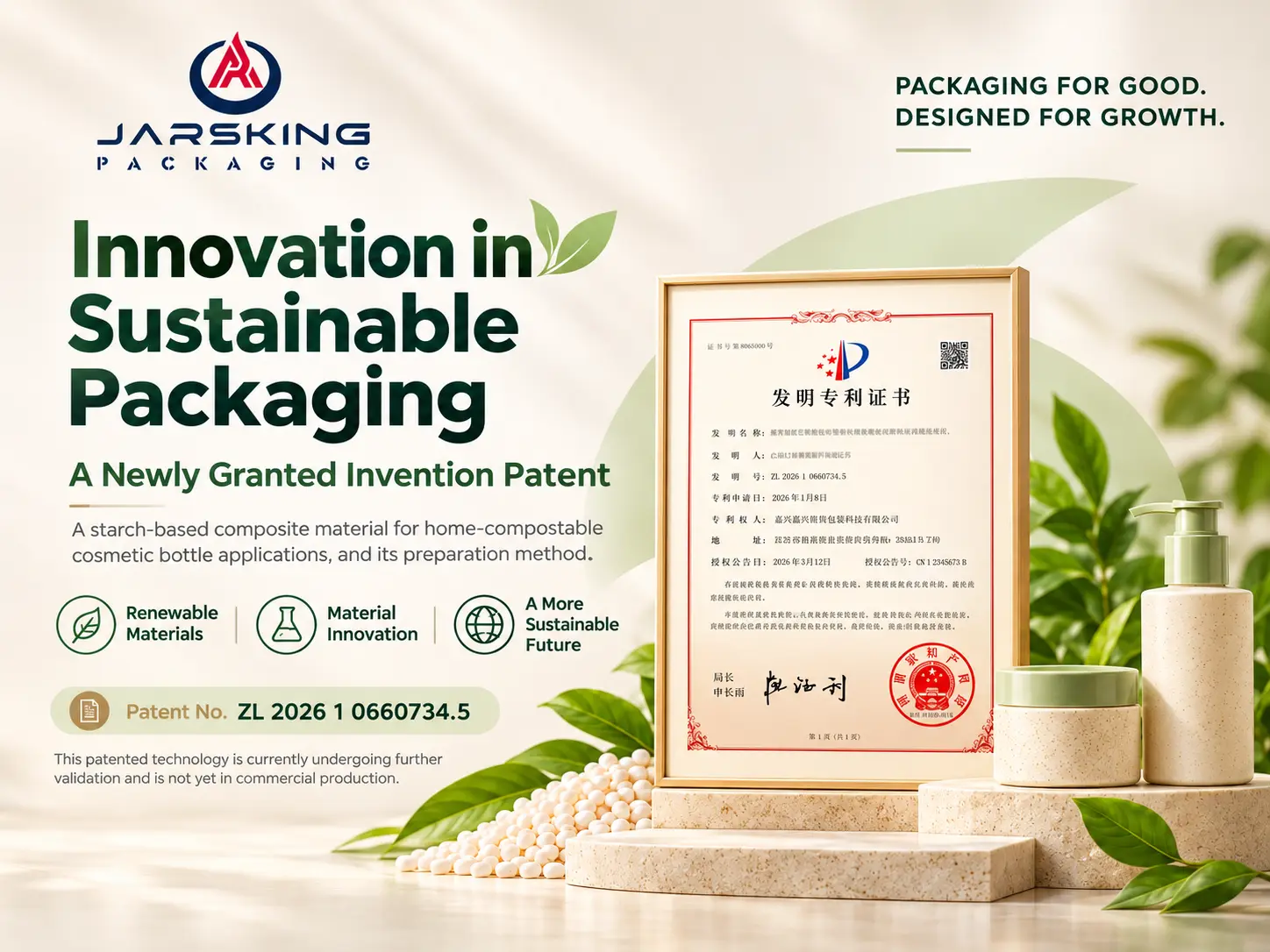
Research into starch-based materials offers one example of this process. Guangzhou Jiaxing Glass Products Co., Ltd. (广州佳兴玻璃制品有限公司) has been granted a Chinese invention patent titled, in English translation, “A Home-Compostable Starch-Based Composite Material for Cosmetic Bottles, Its Preparation Method, and Applications.” The patent number is ZL 2026 1 0660734.5, and the grant publication date is October 27, 2026.
This development provides a reference point for Othilapak-Jarsking’s discussions about packaging materials. It also raises an important practical question: What must happen between a patented material concept and a cosmetic bottle that has been evaluated for a specific product?
A patent grant protects an invention. It does not, by itself, verify finished-product performance, establish readiness for mass production, or certify home compostability. Product performance, manufacturing suitability, and environmental claims require evidence tied to the actual material formulation, finished package, and test conditions.
The patent therefore should not be used to imply that every related product is home compostable or that a finished package has received compostability certification. Nor does the certificate alone support a specific degradation timeline or a claim that the material will break down in an unspecified environment.
The patent provides a concrete way to discuss material research. More detailed statements about its formulation, development history, technical improvements, or results should come from the patent text and approved records. Without that information, those details should remain open questions rather than become a promotional narrative.
2. Define the Product, Use Conditions, and Design Constraints
A useful project brief should identify:
- Formula type and relevant ingredients.
- Target capacity, package format, and dispensing method.
- Filling, storage, transport, and use conditions.
- Design requirements that can or cannot change.
- Destination market and the intended environmental claim.
- Purchasing volume and documentation requirements.
The application review should include the package’s place within the brand’s existing range. A replacement bottle may need to align with current caps, filling equipment, cartons, and display arrangements. A completely new format may allow those elements to be reconsidered together. Neither situation establishes material suitability in advance, but each creates a different set of practical constraints. Recording those constraints helps the team understand which decisions are fixed, which remain flexible, and where sampling will provide the most useful information.
A productive development conversation begins by identifying which features the brand wants to retain and which can change. A familiar silhouette may be essential to an existing product line, while a new launch may allow greater flexibility. The team can then evaluate the proposed material against those requirements instead of assuming that an existing design can be transferred without further review.
For cosmetic packaging, the intended service life introduces another set of requirements. Before disposal becomes relevant, the bottle may pass through warehousing, filling, distribution, retail display, and repeated consumer use. Throughout those stages, it must meet the performance requirements established for the product.
It is also useful to distinguish unopened storage from use after opening. The package may encounter different handling, exposure, and dispensing demands in those two periods. A product used in a bathroom, carried in a travel bag, or dispensed in a professional setting can raise different questions. The brief should describe the expected situation without assuming that one generic test represents every setting. That description gives the evaluation team a practical basis for deciding which conditions warrant attention.
The development plan should identify the relevant storage conditions, handling requirements, and expected use pattern. A package opened occasionally raises different questions from one repeatedly handled, squeezed, or actuated. The specific requirements must come from the product brief and intended application rather than a general assumption about the material.
Performance during use and behavior after use should be treated as separate evaluation goals. A project can pursue a defined composting outcome while still requiring the package to remain suitable throughout its intended service life. Neither goal can be assumed from the other.
3. Review the Material and Its Fit With the Bottle Design
The term “starch-based composite” also deserves closer attention. It identifies a material direction, but it does not describe the entire formulation. The name alone does not establish the starch content, identify every other constituent, or explain the role of additives.
It should not automatically be interpreted as pure starch, entirely plant-derived, or plastic-free. Those are separate statements that require their own supporting information. Likewise, without the patent text and relevant technical records, it would be inappropriate to speculate about the patented formulation or claim that it has resolved a particular performance challenge.
Brands should request material information that corresponds to the grade actually proposed for their project. Technical discussions can accommodate confidential information through arrangements acceptable to both parties. Even where a full formulation cannot be disclosed, the information needed to assess application limits and substantiate claims still needs to be addressed.
Material origin and disposal behavior must also be distinguished. “Bio-based” describes where feedstocks come from. Biodegradation and compostability concern behavior under specified conditions. A material’s biological origin does not automatically demonstrate that a finished package is home compostable. The European Commission’s explanation of bio-based, biodegradable, and compostable plastics makes this distinction clear.
Material selection influences the package long before it reaches a consumer. A bottle design developed for one material may need to be reassessed when another material is proposed. The walls, base, shoulders, neck, and threads all contribute to how the package is manufactured and used. Closure fit, sealing, dispensing, decoration, and filling conditions also need to be considered together.
Moving from a material specimen to a finished bottle requires another careful comparison. The specimen described in a technical report may differ from the proposed bottle in thickness, geometry, colorants, additives, or processing conditions. Those differences need to be identified before the report is used to support a product decision.
A finished bottle also contains features that a simple specimen may not represent. The neck must engage with a closure, the base must support the package, and the overall structure must suit handling and dispensing. These requirements belong to the finished design.
Brands should therefore ask what was tested, which configuration was evaluated, and how closely it matches the package being purchased. If capacity, wall thickness, color, decoration, or another relevant feature changes, the team should determine whether existing evidence remains applicable or whether additional assessment is needed.
4. Test the Actual Formula in the Final Packaging
Formula compatibility deserves particular attention because cosmetics are not a single, uniform product category. Water-based serums, oils, alcohol-containing products, and viscous creams present different evaluation questions. The relevant ingredients, contact duration, storage conditions, and dispensing method all need to be considered.
For example, an oil-based product prompts questions about the behavior of the bottle, closure, and seals in contact with that particular formula. A viscous cream adds questions about product access or dispensing. A light-sensitive formula requires consideration of whether the proposed package provides the protection the product needs.
Depending on the project, observations may include deformation, changes in sealing, leakage, mass loss, odor changes, or dispensing problems. The evaluation may also need to track formula characteristics. The appropriate observations and acceptance criteria should be selected for the product rather than copied from an unrelated packaging program.
The test plan should explain the purpose of each evaluation and how its results will be interpreted. A sealing assessment asks whether the selected assembly contains the product under the defined conditions. Formula observations address whether the product remains acceptable in contact with that assembly. Tracking both helps avoid treating a single successful observation as approval of the entire package. Reports should describe the samples, conditions, observations, and acceptance criteria clearly enough for the brand to understand what was demonstrated.
These are questions for evaluation, not statements that the patented material is suitable or unsuitable for those applications. Any product-specific recommendation needs the relevant technical information and results.
Tests using water or simulated liquids can serve defined screening purposes, but they should not automatically replace assessment with the actual formula and final packaging configuration. Microchem Laboratory’s discussion of package compatibility testing emphasizes evaluating products in their intended market packaging because the formula, package, and environment can interact.
Othilapak’s published quality control process includes dimensional checks, sealing, component fit, and formula compatibility where applicable. For a new material project, the specific work still needs to be defined. A general description of quality capabilities should not be presented as proof that a particular product has already completed validation.
5. Assess the Complete Package Before Making Compostability Claims
Map the Assembly and Its Components
The package must also be considered as an assembly. A pump bottle can include a bottle body, pump, dip tube, seals, overcap, and label. A dropper bottle may include a bulb, cap, liner, and pipette. Identifying these components is essential to understanding both functional requirements and claim boundaries.
If a report covers only the bottle body, its conclusions should not be extended automatically to the pump, label, or complete package. The same discipline applies when a component is changed after initial evaluation. The brand needs to know which version of the assembly the supporting information describes.
Include Decoration in the Evaluated Configuration
Decoration should be included early in this discussion. Brands often have specific expectations for color, gloss, texture, printed graphics, and the relationship between the bottle and closure. Those expectations should be assessed through physical samples and agreed acceptance criteria.
Labels, adhesives, inks, and coatings belong in the final packaging specification. When a project includes a compostability objective, the team should establish whether the supporting assessment concerns an undecorated bottle or the finished decorated configuration.
This is also a reason to review later changes. A different label, ink, coating, or color may require the team to check whether the original documentation still covers the revised package. The appropriate response depends on the change and applicable requirements; it should not be assumed in advance.
Keep Claims and Disposal Instructions Within the Evidence
Compostability assessment follows defined scheme requirements. Whether components can be evaluated separately or need to be considered together depends on the applicable rules and actual configuration. For example, the REAL Home Compostable Products scheme addresses products with multiple components, including separable and inseparable units.
Consumer instructions should match the evidence. If parts must be removed or handled separately, the instructions need to explain those steps clearly. A broad claim on the front of a package should not leave consumers to guess which components it covers.
The destination market also matters to the customer’s ability to act on disposal instructions. A project should distinguish the intended technical treatment route from the arrangements available to users. If the package needs a particular collection or handling step, that step belongs in the discussion before the claim and artwork are finalized. Clear instructions should describe an applicable route, rather than suggest that disposal conditions are interchangeable or that an environmental claim permits littering.
For marketing teams, the practical task is to preserve the distinction between what has been researched, what has been tested, and what can be claimed about the product being sold. Wording should identify the relevant component and conditions. If evidence applies only to a bottle body, the claim should say so. If a certification is being referenced, its holder, validity, product coverage, and permitted use need to be checked.
6. Separate Sample Approval From Production Readiness
Sample approval is another milestone that needs a defined purpose. A sample can help a brand assess appearance, structure, handling, and dispensing. Production trials address the additional question of whether agreed requirements can be achieved consistently.
A practical sample review can bring purchasing, design, and quality representatives into the same discussion. Design can identify the appearance features that matter to the brand. Quality can identify the checks needed to support approval. Purchasing can confirm that the reviewed configuration matches the item being quoted. Bringing those perspectives together reduces ambiguity over what the sample represents and helps prevent a visually approved sample from being mistaken for a fully evaluated production specification.
Coordinating appearance and technical review early gives the brand a clearer basis for approving samples. It also helps identify questions before artwork, decoration, and packaging specifications are finalized.
For a new material program, the team should identify the processing conditions and quality characteristics that need attention. Relevant considerations may include raw material batches, key dimensions, appearance, sealing, and functional results. The exact requirements should follow the material, design, and intended application.
Before approving production, brands should agree on what constitutes an acceptable package. Which dimensions are critical? What appearance variation is acceptable? Which functions require inspection? What records will accompany a batch, and what happens if the material, process, or production conditions change?
A clear change management process is particularly useful. An approved sample describes a configuration at a point in time. Continued confidence depends on knowing whether subsequent supply matches that configuration and whether changes require further review.
A sourcing brief should therefore distinguish confirmed facts from open development questions. It can identify the approved drawing revision, material designation, decoration specification, and closure configuration alongside any evaluations still pending. This gives purchasing, product development, quality, and marketing teams a shared reference. It also makes it easier to see whether a proposed change affects only appearance or requires a broader technical review.
Documentation should connect claims to identifiable products. A useful review asks whether the report names a material grade, a test specimen, a finished component, or an assembled package. The team should also check the sample description, evaluation conditions, reported results, and stated limitations. A document title or certification logo alone does not provide all of that information. Where the connection is unclear, the appropriate next step is clarification.
These steps describe considerations for developing and supplying new packaging. They do not establish that the product associated with this patent has completed every step, is already in commercial production, or is available under specific purchasing conditions.
7. Compare Material Options, Total Cost, and Timing
Commercial comparison should begin with the brand’s objectives. Some projects prioritize recycled content, others seek lower material use, repeated use, or a defined composting route. Starch-based materials, post-consumer recycled materials, lightweight designs, and refill systems can be considered in that broader decision.
They should not be ranked by material name alone. Formula protection, package weight, intended use, manufacturing requirements, distribution, and the destination market’s disposal options all affect the comparison. Claims about lower carbon emissions require an appropriate assessment with a defined scope and method.
The same care applies to cost. A meaningful discussion may need to include material, tooling, sampling, validation, decoration, manufacturing, and shipping. For an application still under evaluation, an early material price is only one part of the purchasing decision.
Timing should be discussed with equal precision. Material selection, structural review, sampling, testing, and production planning may have dependencies. A timeline should identify the approvals or results needed before later stages can proceed. Without project-specific information, the patent should not be used to support promises about sampling speed, minimum order quantities, production capacity, or delivery dates. Those commercial terms need confirmation for the proposed product and order.
8. Approve Against a Documented Evidence Checklist
Use the following checklist to connect each approval decision with the information needed to support it:
| Evaluation area | Questions to resolve | Information to review |
|---|---|---|
| Material identity | What grade is proposed, and what limitations apply? | Material descriptions, technical information, and applicable declarations |
| Formula contact | Do the formula and package remain acceptable together? | Formula conditions, compatibility records, and stability observations |
| Structural fit | Do the bottle and closure function together as intended? | Drawings, dimensional checks, sealing results, and functional records |
| Decoration | Is the final appearance suitable for the selected material? | Decorated samples, adhesion checks, and relevant resistance evaluations |
| Manufacturing | Can agreed requirements be maintained across production? | Trial records, acceptance criteria, and batch inspection information |
| End-of-life claims | Which components and conditions does the evidence cover? | Relevant reports, certificates, scope information, and disposal instructions |
The required evaluations, methods, acceptance criteria, and documentation should be agreed upon for the actual application. This checklist does not mean that every listed document or test is available for every proposed material.
One useful starting document is a component and evidence checklist. For each part, list the proposed material, drawing or specification reference, supplier information, and available supporting documents. Then identify what remains to be confirmed and who will coordinate that work. This does not require the brand to resolve every technical question before contacting a supplier. It simply creates a shared view of the project, making it easier to separate confirmed specifications from preferences, unresolved questions, and claims that cannot yet be used in customer communications, including product labels and other sales materials.
Brands exploring starch-based or other new cosmetic packaging materials can begin by sharing their formula type, target capacity, proposed closure or pump, filling and storage conditions, expected purchasing volume, and destination market. They should also explain the environmental outcome they hope to achieve and any documentation requirements already identified.
Those inputs provide a basis for discussing feasibility, information needs, sample development, and evaluation responsibilities. Any testing, documentation, pricing, or schedule commitments should then be confirmed for the specific project.
FAQs
Does an invention patent prove that a cosmetic bottle is home compostable?
No. A patent protects an invention and does not replace finished-product testing or compostability certification. Any home compostability claim needs evidence covering the actual product and its stated conditions, rather than the patent title alone.
Is starch-based cosmetic packaging automatically plastic-free?
No. Starch-based packaging may combine starch with other polymers and additives, so the name alone does not establish a plastic-free composition. Request the material declaration for the exact grade and verify the complete package before using a plastic-free claim.
Can starch-based bottles hold water-based serums, oils, or alcohol-containing products?
Suitability must be established for the actual formula and package. Ingredient composition, contact time, storage conditions, and sealing components need to be considered during evaluation. Test the proposed formula in the final bottle and closure system rather than relying solely on water tests or generic material data.
If the bottle body is certified, can the entire pump bottle carry the same claim?
Not automatically. Pumps, dip tubes, seals, labels, and adhesives may fall outside the bottle body’s assessed scope. Verify the complete assembly and confirm any required disassembly or separate disposal instructions before making a claim about the whole package.
How long does a starch-based cosmetic bottle take to break down?
There is no single timeline that applies to every starch-based bottle. Any stated timeframe needs evidence identifying the finished product, test method, environmental conditions, and measured endpoint. Results for one material specimen or composting environment should not be presented as a universal degradation promise.
Which documents should a beauty brand request before placing a bulk order?
Request the exact material designation, approved package drawings, relevant test reports, and agreed acceptance criteria. For any certification claim, verify the certificate holder, validity, covered products, and permitted wording or logo use. Keep the patent certificate separate from performance evidence, and document how material or design changes will be reviewed.