

If you’re adding products, refreshing your brand, or looking for a new packaging supplier, Cosmopack Asia 2026 is a chance to do more than browse bottles. It’s a chance to work out what your next packaging order really needs to achieve.
That’s the purpose of this article: to help beauty brands make clearer packaging decisions before committing to samples, customization, or production.
Cosmopack Asia takes place from November 10–12, 2026, at AsiaWorld-Expo in Hong Kong. Its focus on the beauty supply chain makes it a relevant place to discuss packaging alongside the practical work of bringing a product to market.
But the useful conversation starts with your business, not the exhibition.
Maybe you want several products to look like one collection. Maybe your packaging no longer reflects the brand you’re building. Perhaps you still like the design, but adding another size or product has become awkward.
These are different problems. They don’t all need a custom mold—or a complete redesign.
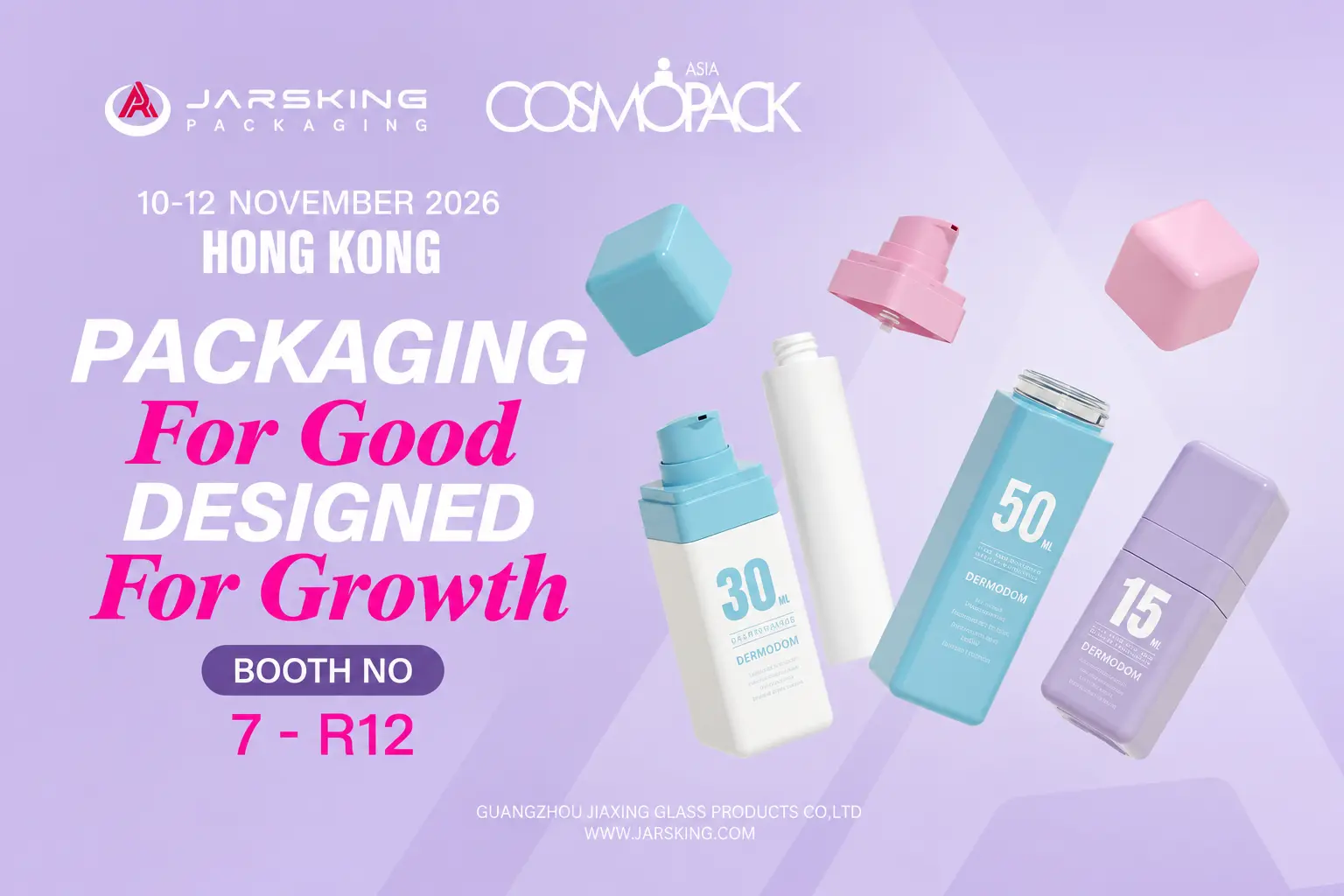
“Designed for Growth,” the theme featured in the Jarsking exhibition artwork, offers a useful way to approach them: start with the change your brand is making, then ask what your packaging needs to do differently.
Not the most elaborate option. Not automatically the cheapest. The one that makes sense for your products, your budget, and what comes next.
1. What Does Packaging “Designed for Growth” Actually Mean?
Packaging designed for growth means choosing packaging with your brand’s next move in mind—not just the product sitting in front of you today.
That next move needs to be specific.
“We want to grow” doesn’t tell a packaging supplier very much. “We’re adding a cleanser and a moisturizer to our serum range” gives the discussion somewhere to go.
So does “We want to refresh the collection without changing the bottle,” or “We need to understand whether our current design can work in a smaller size.”
You don’t have to predict the next five years. You do need to look beyond the immediate sample.
Think of it this way: a packaging decision should solve today’s problem without creating an avoidable problem for the next launch.
That might mean choosing a range with more than one suitable capacity. It might mean keeping the same visual language across different container types. Or it could mean deciding that the current bottle is still right, and the real issue is the decoration.
There’s a useful restraint in this approach.
You don’t need to commission a whole packaging family because you might launch ten products someday. You don’t need a custom structure just because the brand is becoming more established.
Start with what you know. Make room for what you reasonably expect. Leave the more distant possibilities open.
2. Before You Choose a Bottle, Be Clear About What Is Changing
It’s easy to begin with pictures.
A reference folder grows. Someone shares a bottle they like. Another person prefers a different cap. Soon the team is comparing finishes before agreeing on what the project is meant to accomplish.
There’s nothing wrong with inspiration. But it works better after you’ve named the problem.
“We want something more premium” is not quite enough. What feels wrong with the current packaging? The proportions? The graphics? The dispensing experience? The way different products look together?
“Premium” can point people in very different directions.
One person imagines heavier glass. Another sees a quieter design with less decoration. A third wants a more distinctive silhouette.
Before asking a supplier to interpret all of that, write down what the next packaging project needs to change.
A short brief can cover:
- What you sell now and what you plan to add.
- What you like about the existing packaging.
- What feels awkward, inconsistent, or out of date.
- Which details are fixed and which are open to discussion.
- Your expected quantities, budget range, and intended launch date.
- The questions you need help answering.
This doesn’t have to become a lengthy presentation. One clear page is often a better starting point than twenty pages of images without context.
Be honest about uncertainty, too.
If the product capacity is still being discussed, say so. If the formula isn’t final, make that clear. If the launch date is fixed but the packaging direction isn’t, put the date near the top.
A useful supplier conversation doesn’t require a perfect brief. It requires a shared understanding of where the project stands.
3. Build a Collection, Not Just a Group of Matching Containers
Adding a second or third product changes the design question.
You’re no longer asking, “Does this bottle look right?”
You’re asking, “Do these products look right together?”
A cleanser bottle, a serum bottle, and a cream jar don’t need the same shape to belong to one brand. But they do need something that connects them.
Decide What Makes the Range Recognizable
Look at the collection without focusing on the logo.
What holds it together?
It might be the color, the proportions of the closures, the position of the product names, or a consistent approach to decoration. A few carefully chosen details can give different formats a shared identity.
You don’t need to repeat everything.
In fact, making every item too similar creates another design problem: how will someone quickly tell the products apart?
The goal is a family resemblance, not a row of twins.
Othilapak’s published packaging collections include options such as Pantone color matching, frosting, coordinated decoration, and custom mold development. These are tools a brand can explore, rather than a checklist every collection needs to follow.
Choose the details that do a useful job. Leave out the ones that only add noise.
Let Each Product Keep Its Own Requirements
A coordinated appearance shouldn’t force every formula into the same type of container.
The package still needs to suit the product. Technical guidance in Cosmetics & Toiletries emphasizes checking interactions between a formula and its packaging, including whether either could be adversely affected.
So separate two questions.
What should the products share visually?
And what does each product need technically?
You might keep a common color and graphic system while choosing different dispensing formats. You might use related proportions rather than identical structures.
Review the whole range before approving each item separately. Put the proposed capacities side by side. Check the artwork at its actual size.
A layout that looks generous on a large bottle may feel cramped on a smaller one. It’s better to see that while the design is still easy to change.
4. A Brand Refresh Doesn’t Always Need a New Bottle
Sometimes the bottle is not the problem.
The graphics may no longer fit the brand. The assortment may look inconsistent. A collection that developed one product at a time may need a stronger visual direction.
Changing the structure can feel like a decisive answer. But before starting again, ask what the redesign is meant to fix.
Keep What Still Works
There may be parts of the current packaging worth preserving.
A color. A silhouette. A familiar closure. Even the amount of space around the product name.
Ask your team two questions:
“What do we want to improve?”
“What would we regret losing?”
The answers don’t need to be sentimental. They need to be useful.
If the current structure suits the product and the intended use, a decoration refresh deserves a fair look. If the structure is getting in the way, changing the graphics alone won’t solve that.
The point is to match the scale of the change to the problem.
Choose the Development Route for a Reason
Existing packaging and custom packaging are not opposite ends of a quality scale. They are different routes with different questions to answer.
| Your situation | A route worth exploring | What to clarify |
| The container works, but the appearance needs updating | New colors, decoration, or artwork on the existing format | Available finishes, artwork limits, quantities, and sample approvals |
| Several products need a more consistent look | A coordinated selection of existing formats | Suitable capacities, closures, proportions, and decoration |
| One component needs a distinctive feature | A customized closure or other component | Fit, tooling, testing, assembly, and order requirements |
| Available formats cannot meet a defined need | A custom structure | Design work, tooling, validation, ownership, cost, and timing |
Othilapak describes both adapting available formats and developing new packaging, including component matching, structural work, and mold development. Which route makes sense depends on the brief.
A custom bottle can be the right answer. But “we want something unique” needs more work before it becomes a tooling decision.
What should the new shape achieve that an existing one cannot?
If that answer is still vague, keep developing the idea.
5. Don’t Let a Beautiful Sample Answer Questions It Hasn’t Been Tested For
A sample can look convincing without answering every question about the finished package.
That isn’t a criticism of samples. It’s a reminder to be clear about their purpose.
Some show a shape. Some demonstrate decoration. Others are prepared for a particular evaluation. Don’t assume they all represent the final production configuration.
Ask What You’re Looking At
When reviewing a sample, ask whether the pump or closure is the proposed component. Check whether the material, capacity, and finish match the direction being discussed.
If something is only a reference, mark it as a reference.
The conversation can stay simple:
“Is this the exact combination we would be ordering?”
“What does this sample allow us to approve?”
“What still needs to be checked?”
Those questions help prevent a visual approval from being mistaken for a complete technical approval.
Cosmetics & Toiletries discusses compatibility testing as well as evaluation under conditions relevant to handling, warehousing, and transportation. Appearance is one part of the package, not a substitute for those checks.
Agree on What Approval Means
Before signing off, make sure everyone is referring to the same version.
That includes the component combination, artwork, color reference, decoration placement, and any details still awaiting confirmation.
This is where plain language helps.
“This looks good” is encouraging. It isn’t always precise enough to move a project forward.
“We approve this artwork layout, subject to the agreed checks on the final package” tells the team more.
The wording will depend on the project, but the principle is straightforward: know what you are approving and what remains open.
6. Price Matters. Make Sure You’re Comparing the Same Thing.
There’s no need to apologize for asking about price.
Packaging has to work within a business. A design that looks excellent but doesn’t fit the budget needs another conversation.
Still, before asking why one quotation is cheaper, check what each includes.
Are the bottle and closure the same? Is the decoration comparable? Are the quantities equal? Does one price include an item that appears separately in the other quote?
A lower number is worth understanding, not dismissing or accepting automatically.
Ask suppliers to make the proposed configuration clear. Then discuss tooling, samples, packing arrangements, delivery terms, and any other costs or responsibilities that need separate agreement.
Growth adds another question: how will you order the collection?
You may launch three products together but reorder them at different times. You may want the same decoration across several formats without knowing whether the minimum quantities apply to each one separately.
Raise those questions before treating the collection as one simple order.
And be careful with forecasts.
If a larger volume depends on a launch that hasn’t happened yet, say so. An ambitious sales target and a confirmed purchasing requirement are not the same thing.
You can discuss both. Just don’t blur them.
Clear assumptions give the supplier a better basis for an answer—and give you a better basis for comparing it.
7. Give Environmental Goals a Specific Job
“Packaging for Good” appears alongside “Designed for Growth” in the exhibition artwork. It’s a useful prompt, provided the discussion goes beyond a label.
What does your brand actually want to change?
You might be exploring a refill format, reviewing components, or asking about a different material. Those are different tasks. Calling all of them “sustainable packaging” doesn’t tell a development team which problem to solve.
Be specific about the goal and careful about the claim.
If you’re considering a refill system, ask how the parts are used, retained, and replaced. If recycled content is part of the brief, request the relevant material information. If you plan to make a recyclability claim, establish what supporting evidence and market-specific review will be needed.
Othilapak’s published solutions describe material and packaging choices in relation to positioning, compatibility, and sustainability goals. But an available option is not, by itself, proof of an environmental benefit in your application.
Don’t let a compelling material story end the discussion too early.
The packaging still needs to be assessed with the intended formula and use in mind. Compatibility remains a separate question.
A better starting point than “Which option is greener?” is:
“What are we trying to improve, and what information would let us compare these choices fairly?”
That question is less convenient than a simple label. It is also more useful.
8. Make Your Cosmopack Asia Visit About Your Project
There will be plenty to look at. Give yourself a reason to stop and have a deeper conversation.
Cosmopack Asia 2026 runs at AsiaWorld-Expo from November 10–12. The finished-product exhibition, Cosmoprof Asia, runs at the Hong Kong Convention and Exhibition Centre from November 11–13. Keep that distinction in mind when arranging meetings.
Bring your current packaging if you can. If not, bring clear photographs and the details you already know.
Reference images help explain taste. Existing samples help explain the starting point. A short brief explains what needs to happen next.
Together, they make “Can you make something like this?” a much more useful conversation.
Ask About Choices, Not Just Possibilities
It’s easy to leave a meeting with a long list of things that might be possible.
Try to narrow it.
Which available formats are worth reviewing for your range? What can change within those formats? What would need additional development? What information is missing before the supplier can prepare a meaningful sample request or quotation?
You don’t need every answer at the booth.
Some questions will need a later review. What matters is leaving with a clear understanding of the next step.
That might be a shortlist. It might be a revised brief. It might be confirmation that a particular idea needs more investigation before you spend money on it.
That is useful progress, too.
9. After the Exhibition, Turn the Discussion Into a Working Plan
The follow-up shouldn’t begin with another vague request for “more options.”
Start by confirming what you discussed.
Which formats were shortlisted? Which samples were references only? What did the supplier agree to check? What does your own team still need to provide?
A short written recap gives everyone a chance to correct a misunderstanding before it grows into more work.
Then look back at the reason for the project.
Does the proposed direction help the products work as a collection? Does it address the issue that triggered the refresh? Are you adding a feature because it solves something—or because it was appealing on the display stand?
This is the moment to simplify if necessary.
For brands considering Othilapak, its published process covers consultation, design, prototyping, production, and delivery. Its manufacturing information also identifies the business as part of Jarsking Group. Those capabilities provide a starting point for discussing your project, not a reason to assume every project needs the full list of services.
Ask what your project needs, who will handle each part, and what information is required before the next decision.
A clear working plan is more valuable than an impressive collection of possibilities.
10. Bring What You Have. Be Clear About What You Want to Change.
Your next packaging choice doesn’t need to anticipate every future version of the brand.
It needs to support the move you are ready to make now.
That may be a coordinated skincare range. A refresh that keeps the right familiar details. A different format for a new product. Or simply a clearer way to develop, approve, and reorder the packaging you already use.
Start there.
The supplied Jarsking invitation lists Booth 7-R12 for the Hong Kong exhibition on November 10–12, 2026. Bring your current packaging, show the products you want to add, and tell the team what you are trying to improve.
You don’t need a finished packaging plan before the conversation starts.
You need a clear reason to have the conversation—and a better idea of what should happen after it.
FAQs
What does “packaging designed for growth” mean for beauty brands?
Packaging designed for growth means choosing containers, components, and decoration with your brand’s next move in mind. That could mean adding products, refreshing an existing range, or introducing another size. The aim is to meet today’s needs without creating unnecessary obstacles for the next launch.
Does a growing beauty brand need custom packaging molds?
Not necessarily. Existing formats may suit your products and leave plenty of room for customization through color, artwork, and decoration. Consider a custom mold when you can explain what the new structure must achieve that available formats cannot. Being different is a starting point, not a complete development brief.
How can different skincare containers look like one collection?
Choose a few consistent design elements, such as color, typography, decoration, or closure styling. Then allow individual products to use formats suited to their needs. Review the proposed range together, at actual sizes, rather than approving each item separately.
Can a brand refresh its packaging without changing the container?
Yes. If the container remains suitable, explore changes to artwork, color, decoration, or the arrangement of information. First identify what feels wrong and what deserves to stay. A refresh should address a specific problem rather than replace familiar elements simply for the sake of change.
How should buyers compare cosmetic packaging quotations?
Check that each quotation covers a comparable package: container, closure, decoration, quantity, and any agreed packing arrangements. Clarify tooling, sampling, delivery terms, and other separately quoted items. Compare the price only after you understand what each offer includes.
How should environmental goals influence a packaging brief?
State the specific change you want to explore, such as a refill system, different material, or revised component arrangement. Ask what information would support a fair comparison and any planned environmental claims. Avoid treating an appealing material description as proof that the complete package meets your goals.